
Digital twins of biological systems
We develop computational models and digital twins to understand biological systems and support personalized medicine. Our research combines mechanistic modeling, probabilistic modeling, and data-driven approaches to study disease dynamics, generate individualized predictions, and connect experimental observations with computational analysis.
Computational models for personalized medicine
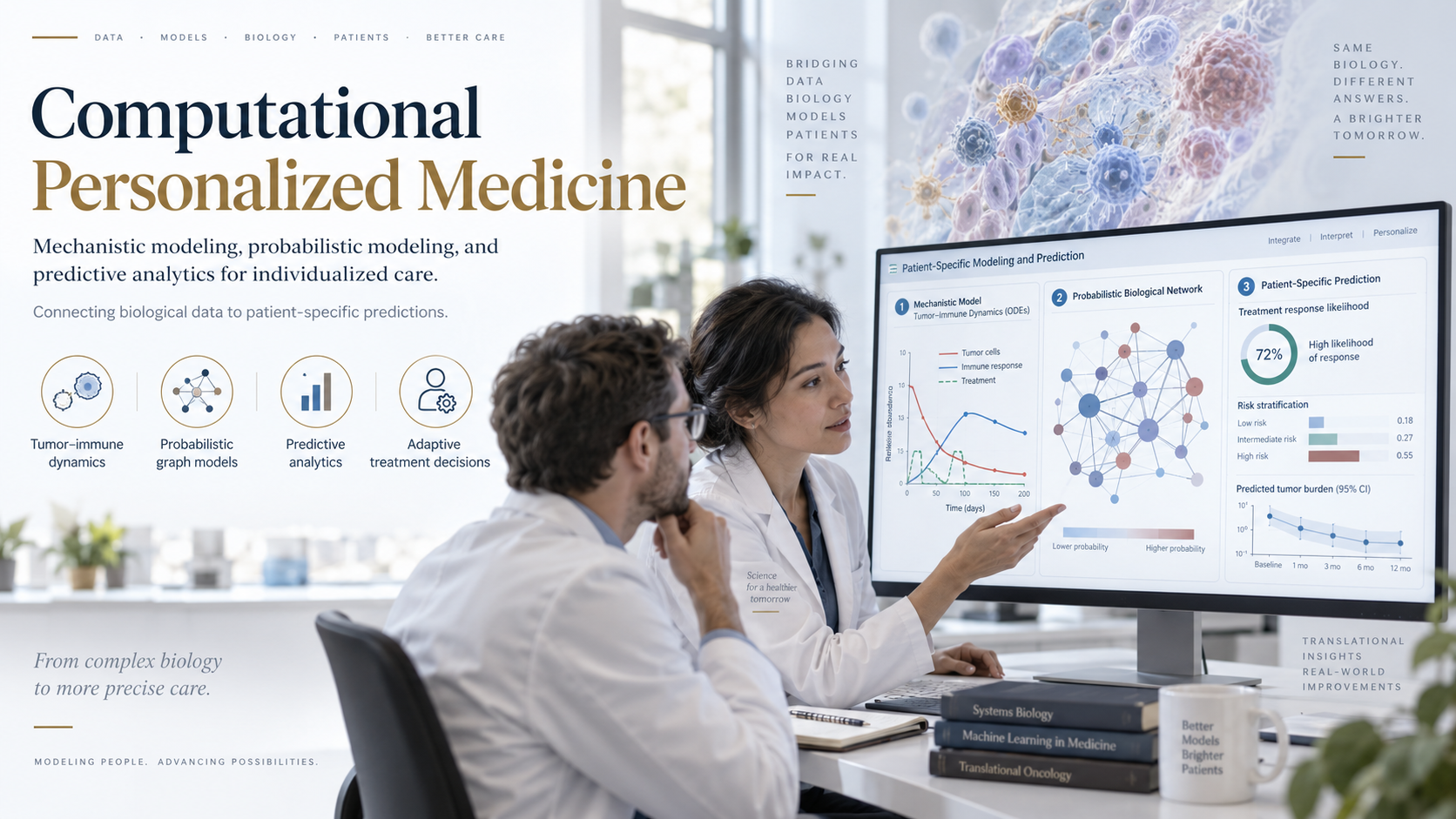
We investigate how individual biological differences influence disease progression and treatment response. Our work uses ordinary differential equation (ODE) models to study tumor–immune interactions and explore how treatment timing may be adapted to individual disease states. We also develop probabilistic graph models to represent biological and anatomical connectivity and account for uncertainty in individualized predictions. Complementary data-driven approaches identify patterns that may improve risk prediction and treatment decisions. Together, these efforts connect biological data with computational models to support more precise and adaptive approaches to healthcare.
Multi-organ immune digital twins
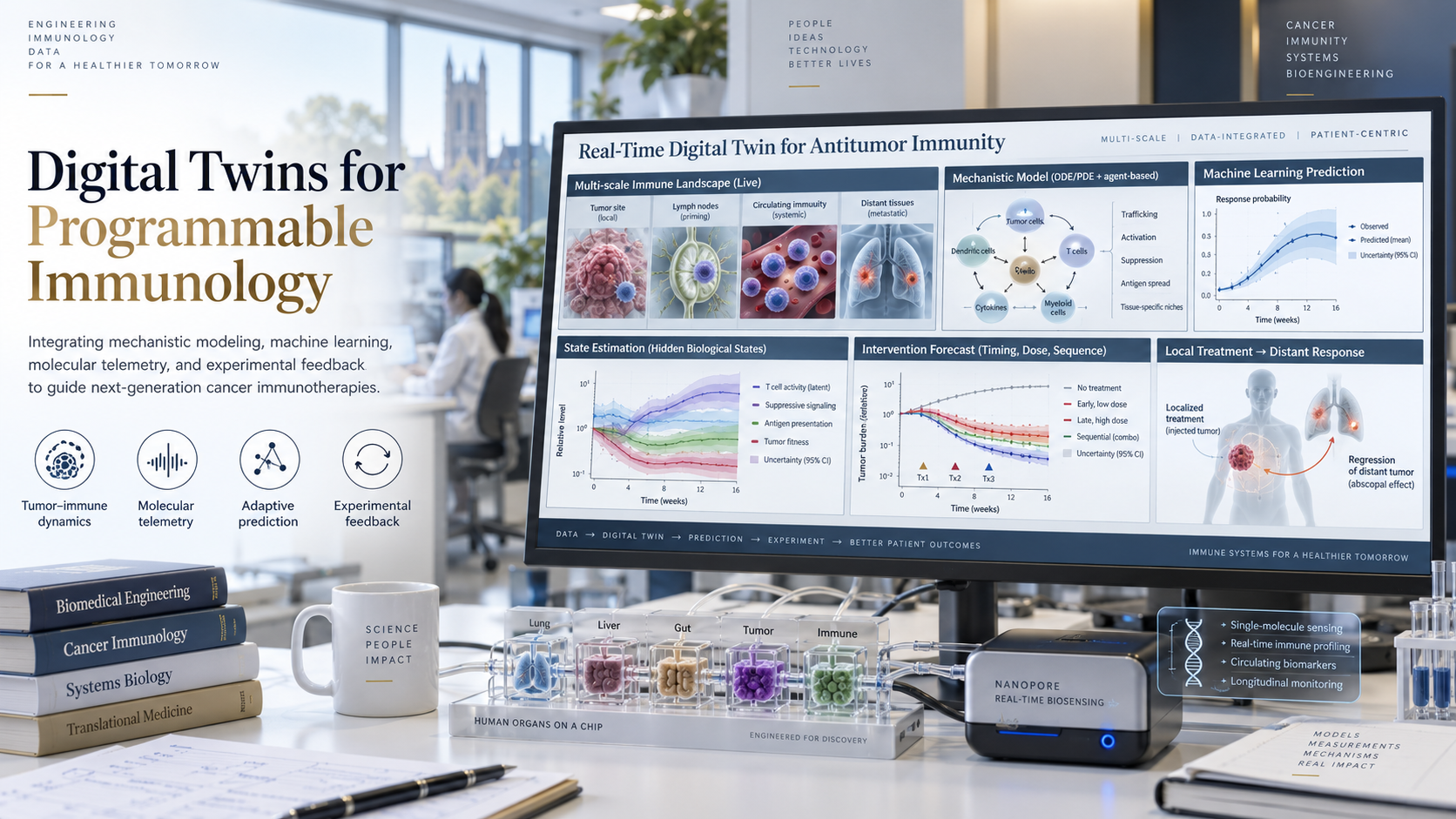
We are developing multi-organ immune digital twins toward real-time understanding and prediction of antitumor responses across the body. Our computational framework combines mechanistic modeling, machine learning, and molecular telemetry to represent interactions among tumors, lymph nodes, circulating immune cells, and distant tissues. We develop methods to assimilate incoming measurements, infer biological states that cannot be directly observed, and forecast how cancer and immunity evolve under different interventions. Adaptive computational strategies focus exploration on critical transitions between disease progression and coordinated tumor control, while probabilistic surrogate models support efficient prediction and uncertainty quantification.
We are developing this framework to integrate measurements from nanopore biosensors and multi-organ-on-a-chip platforms, allowing experimental observations to update the twins and model predictions to guide subsequent experiments. Our aim is to evaluate intervention timing, dose, and sequence, including investigation of how localized treatment might induce regression of distant tumors. Together, this work connects molecular telemetry, predictive modeling, and experimental feedback toward an integrated multi-organ-on-a-chip digital twin platform and a computational foundation for programmable immunology.