
 Kong Lab
Clinical Decision Support
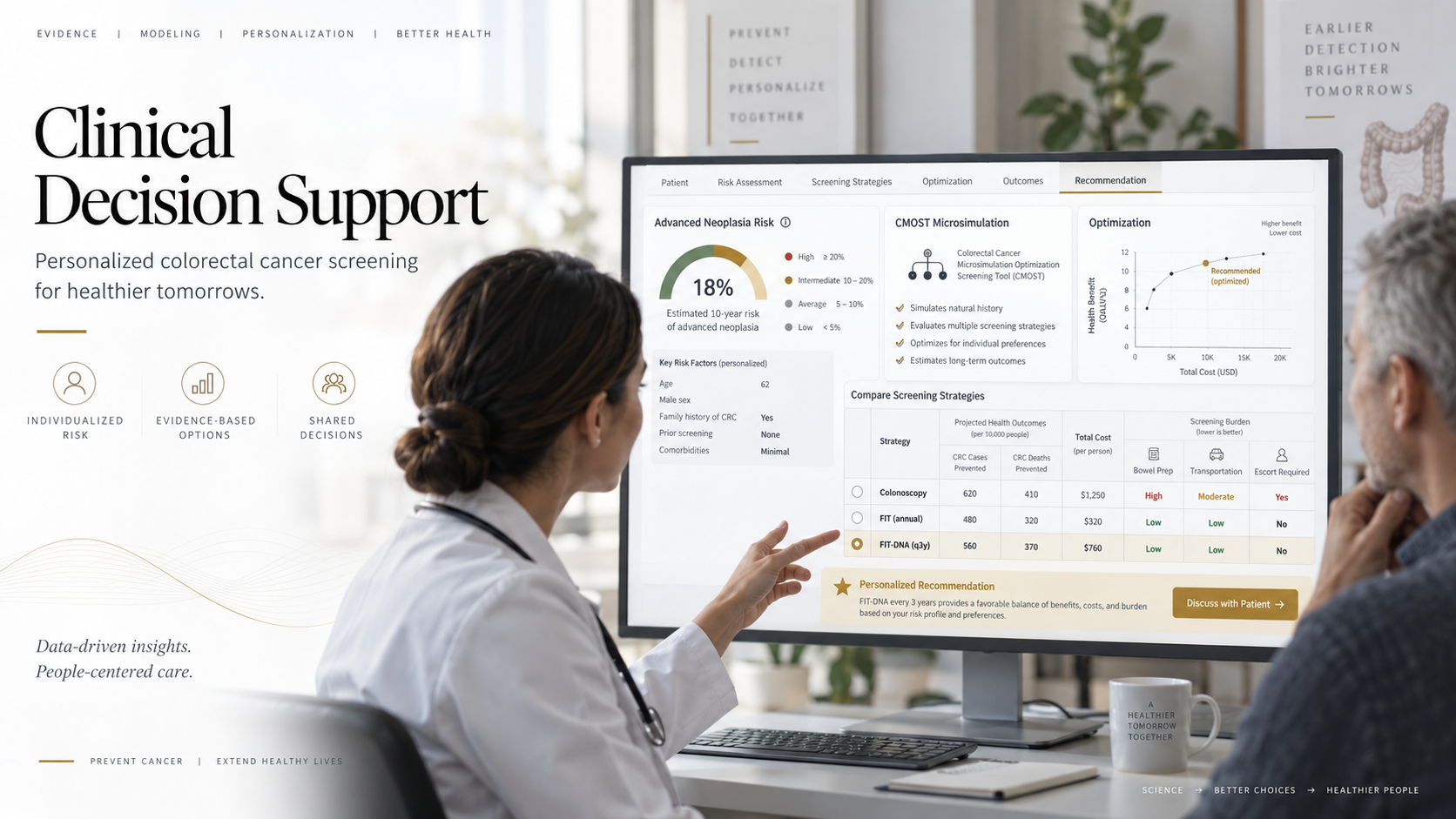
Our research focuses on developing clinical decision support (CDS) for personalized colorectal cancer screening. We combine advanced-neoplasia risk assessment, colorectal cancer microsimulation, and optimization to compare screening strategies based on projected health outcomes, costs, screening burden, and patient preferences. Using the CMOST modeling framework, our goal is to translate individualized risk estimates and comparative outcomes into practical screening recommendations.
We also study how colonoscopy-related burdens—including bowel preparation, transportation, and escort requirements—influence screening decisions. Through clinician interviews and virtual-patient studies, we examine how predicted risk, practical feasibility, and patient preferences jointly shape recommendations. This work will inform a clinician-facing CDS prototype designed to communicate risk and screening outcomes clearly and support shared decision-making.
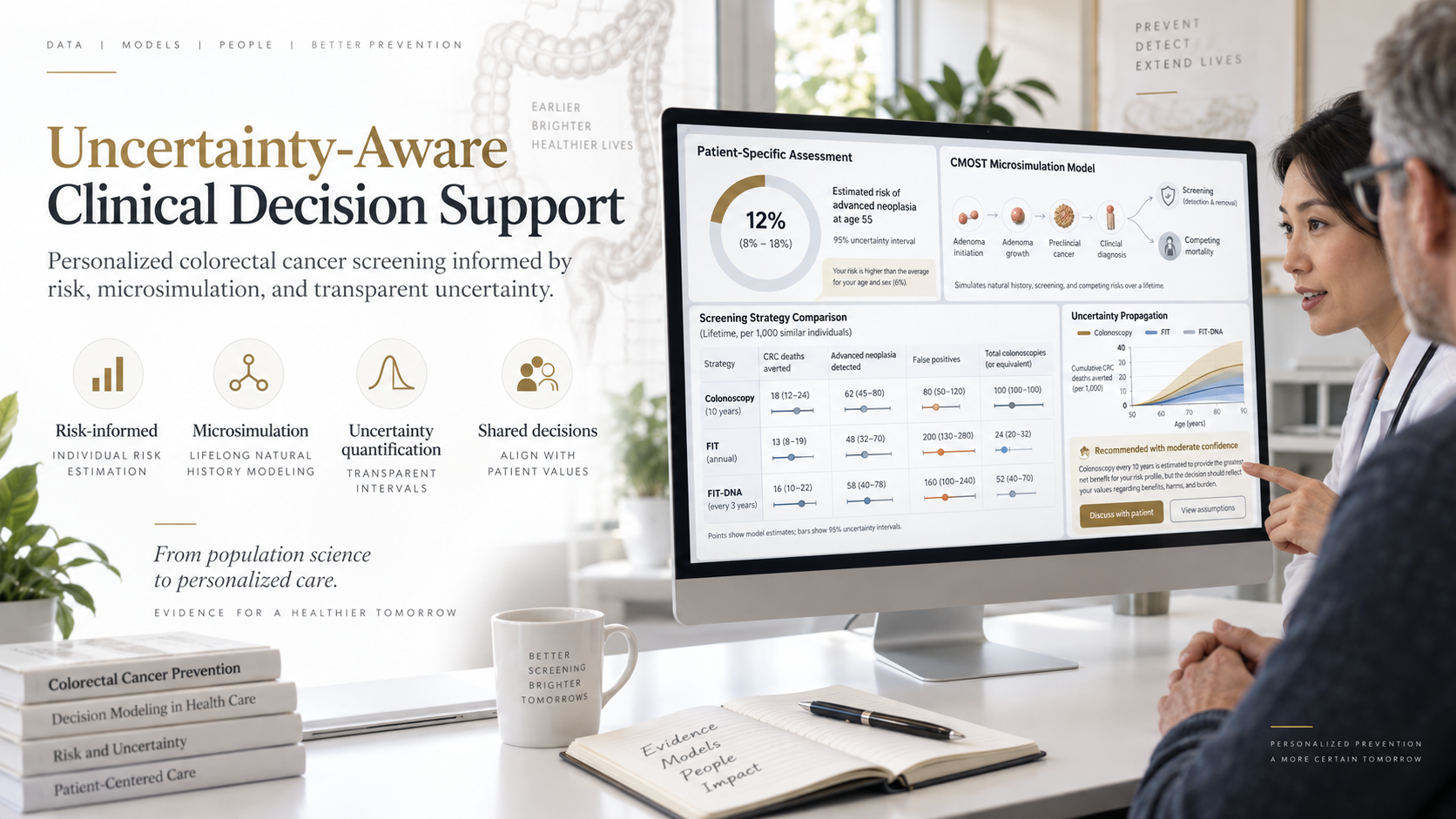
A central component of this CDS framework is uncertainty quantification. Both patient risk estimates and simulated screening outcomes are uncertain, so recommendations should communicate not only expected benefits and harms but also the confidence associated with those estimates.
Our models integrate patient-specific advanced-neoplasia risk estimates with colorectal cancer natural-history microsimulation, representing adenoma initiation and growth, cancer progression, screening, and competing mortality. Patient characteristics such as age, sex, family history, smoking history, and waist circumference are incorporated to support individualized predictions.
We further investigate how uncertainty in patient risk, model parameters, disease mechanisms, and stochastic simulation propagates into predicted screening benefits, harms, and burdens. The broader goal is to develop screening recommendations that are risk-informed, preference-sensitive, transparent about uncertainty, and useful in clinical practice.