Sustainable Engineering Technology and Systems - S.E.T.S
Sustainable Materials
Summary
This part of research focuses on life cycle assessment (LCA) of material production and recycling, spanning a wide range of systems, including critical materials (gallium, lithium, rare earth elements, NdFeB magnets, lithium-ion battery cathodes), industrial applications (metalworking fluids, electronic waste such as LCDs, HDDs, and smartphone plastics), and infrastructure materials.
Project
Integrated Technoeconomic, Lifecycle, and Circularity Analyses Tool for EV Batteries
Funded by: ARPA-E (Advanced Research Projects Agency-Energy) of DOE under the CIRCULAR program
Introduction: This project is part of ARPA-E's CIRCULAR (Catalyzing Innovative Research for Circular Use of Long-lived Advanced Rechargeables) program, which aims to develop technologies to support a circular domestic supply chain for electric vehicle (EV) batteries through regeneration, repair, reuse, and remanufacture. The team led by Purdue University is developing a first-of-its-kind, integrated software tool capable of analyzing the economic, environmental, and circularity performance of innovative technologies developed by other CIRCULAR teams to achieve a circular electric vehicle battery supply chain. The project brings together complementary expertise in the areas of technoeconomic analysis, life cycle assessment, circularity analysis, battery technologies, and critical material recycling. CIRCULAR projects advance methods to prolong battery cell life, develop modular battery packs that can be easily repaired, reused, and remanufactured; and build systems to enable rapid state of health diagnostics and autonomous robotic disassembly of battery packs to inform lifecycle extension tactics and increase recycling throughput cost-effectively. This comprehensive analysis tool will support the transition from a linear to a circular supply chain for domestic EV batteries, helping to reduce waste and extend battery life.
Funded by: Critical Material Innovation Hub (CMI), led by Ames National Lab - a DOE initiative designed to secure supply chains for critical materials like rare-earth metals, cobalt, lithium, and others, essential for clean energy technologies.
Introduction: This project involved conducting comprehensive environmental impact assessments for Oak Ridge National Laboratory's novel lithium extraction technology developed by Dr. Paras Paranthaman's group. The innovative extraction method potentially unlocks new domestic lithium resources from sources such as mining waste streams and used batteries. The research team at Purdue analyzed the life cycle benefits of this direct lithium extraction process compared to standard methods using sodium carbonate, finding that the ORNL technology used one-third the material and one-third the energy while generating fewer greenhouse gas emissions. Additionally, the project included assessing environmental impacts of lithium extraction from Nevada clays, showing that clay-based extraction outperforms spodumene in all impact categories, particularly in Global Warming (-70%) and Ecotoxicity (-56%).
Researchers involved:Venkat Roy, Fu Zhao (Purdue University), M. Parans Paranthaman (Oak Ridge National Laboratory)
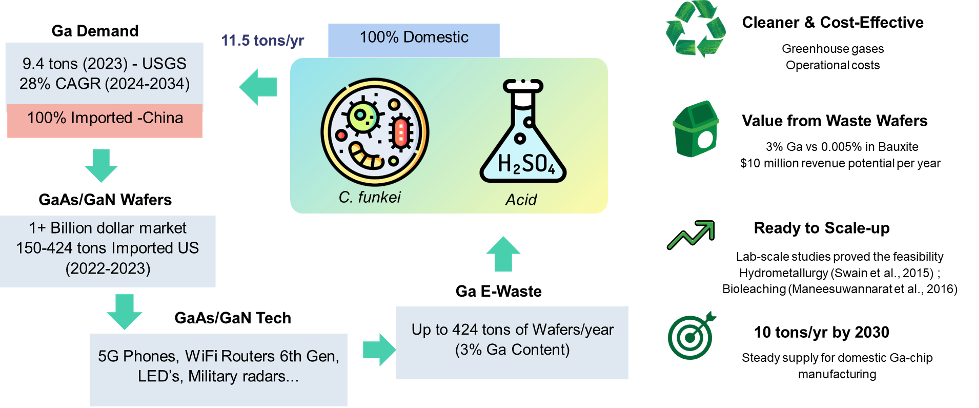
Gallium recovery from E-waste using bioleaching
Funded by: DOE Electronics Scrap Recycling Advancement Prize
Introduction: This project focuses on the recovery of gallium and co-product metals from GaN-based LEDs, using a bioleaching-based approach. By leveraging microbial processes under mild conditions, the method provides a low-carbon alternative to conventional high-temperature primary production. The project combines experimental bioleaching with mass balance modeling, techno-economic analysis (TEA), and life cycle assessment (LCA) to evaluate the economic feasibility and sustainability of gallium recycling from end-of-life electronics.
Life cycle assessment for primary gallium production at industrial-scale
H Luo, TY Huang, X Wu, F Zhao
The International Journal of Life Cycle Assessment, 1-15, 2025
Lithium from clay: Assessing the environmental impacts of extraction
V Roy, MP Paranthaman, F Zhao
Sustainable Production and Consumption 52, 324-332, 2024
Mapping complexity: Analyzing rare earth production life cycle inventories with network analysis
A Fahimi, F Zhao, S Singh, E Vahidi
Resources, Conservation and Recycling 211, 107894, 2024
An improved identification method based on Bayesian regularization optimization for the imbalanced proportion plastics recycling using NIR spectroscopy
H Li, L Li, S Jiao, F Zhao, JW Sutherland, F Yin
Journal of Material Cycles and Waste Management 26 (6), 3838-3851, 2024
Degradation of cathode in air and its influences on direct recycling
Y Ji, CT Jafvert, F Zhao
Journal of Cleaner Production 436, 140597, 2024
Agile synthesis and automated, high-throughput evaluation of diglycolamides for liquid-liquid extraction of rare-earth elements
L An, Y Yao, TB Hall, F Zhao, L Qi
Green Chemistry 26 (12), 7188-7197, 2024
Integrated Circular Economy Model System for Direct Lithium Extraction: From Minerals to Batteries Utilizing Aluminum Hydroxide
K Jayanthi, TN Lamichhane, V Roy, F Zhao, A Navrotsky, BA Moyer, ...
An improved classification method of waste smartphone plastics based on near-infrared spectroscopy
H Li, L Li, F Yin, F Zhao, JW Sutherland
Journal of Material Cycles and Waste Management 25 (4), 1841-1852, 2023
Molten salt electrolysis and room temperature ionic liquid electrochemical processes for refining rare earth metals: Environmental and economic performance comparison
JR Perez-Cardona, TY Huang, F Zhao, JW Sutherland, A Atifi, RV Fox, ...
Sustainable Energy Technologies and Assessments 54, 102840, 2022
Chemical-free pressure washing system as pretreatment to harvest cathode materials
Y Ji, CT Jafvert, EE Kpodzro, F Zhao
Waste Management 153, 121-128, 2022
Prospective Life Cycle Assessment of Synthetic Graphite Manufactured via Electrochemical Graphitization
S Kulkarni, TY Huang, BP Thapaliya, H Luo, S Dai, F Zhao