Neil Armstrong Distinguished Visiting Professors share real engineering stories, lessons with FYE attendees
Successful people say yes. Communicate. Humbly work with others. Change course when needed.
And fail. A lot.
Every element is part of a rich engineering career.
That was the message the four Neil Armstrong Distinguished Visiting Professors (NADVP) shared in the Sept. 28 panel discussion.
An experimental panel, NADVP’s September event opened attendance to the largest engineering student body at Purdue University in West Lafayette.
First-year engineering (FYE) students.
The six questions the panel — comprised of Kevin Anderson (Brunswick Corporation), Jerome Hajjar (Northeastern University), Ron Latanision (Massachusetts Institute of Technology) and Theodore Rappaport (New York University) — tackled came from the predominantly FYE audience.
“For our FYE students, I hope the takeaway was simple: You do not need to have your career figured out yet,” said Kendra Erk, assistant dean of first-year engineering and panel moderator. “And struggling with a hard problem does not mean you are on the wrong path. Engineering is iterative—and so are engineering careers.”

NADVP panels bring the collective experiences of distinguished engineering leaders to a broader student audience, reflecting the mission of the program to foster meaningful connections, exchange knowledge, and inspire the next generation of engineers. Stories included opportunities that defined career paths, unexpected challenges and, of course, failures that shaped the four panelists as engineers.
The humility it takes to transition from college to career, deal with failure and thrive in the teamwork setting of engineering, proved especially important.
“There’s a fine line between sticking to your guns and being stubborn,” said Hajjar, interim dean of the College of Engineering at Northeastern University. “Sticking to your guns is when you’ve done your homework, you know what you’re doing is the right direction and you’re getting input from a lot of people. Being stubborn is when you feel you really need to do something, but you haven’t done your homework.”
He gave an example of an infrastructure proposal — first rejected, then redeveloped with a team, then accepted and funded — to illustrate the difference. The community engineers can and should build was also key to success, the panelists shared.
“One thing you should all realize is as students, you have this great built-in system of advisors. They’re your professors… teaching because they love your success. They could be your advisors and help you with your future,” said Rappaport, who hitchhiked to Purdue when he attended in 1978 and stayed until 1987, after he had completed a bachelor’s, master’s and doctorate in electrical engineering 1987.
When it came to skills that would remain constant, the panel agreed that crucial ones eluded being boxed into one technology: work ethic, integrity, strong fundamentals, focus, teamwork, and working well with others.
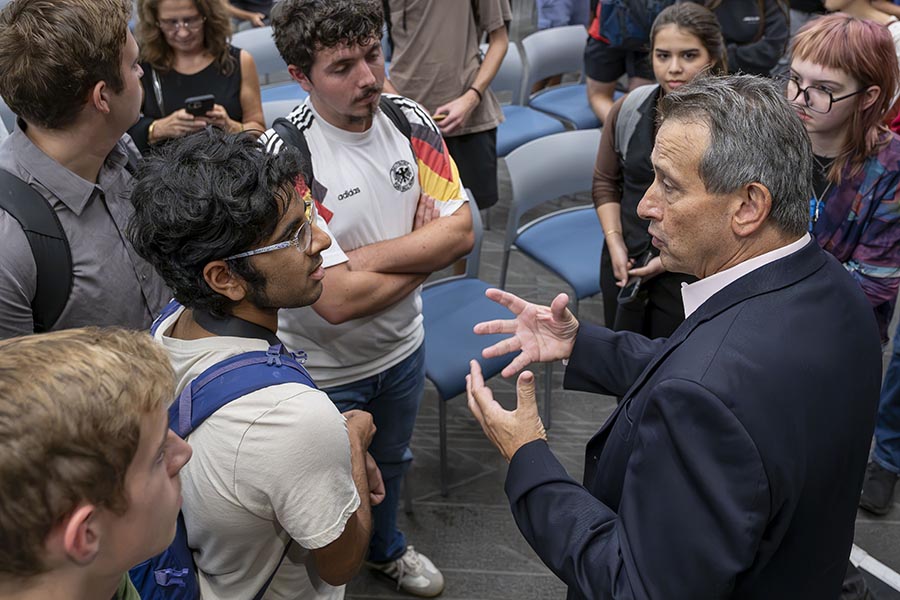
And continued to emphasize to the crowd of interested students and faculty who followed them around the post-event reception.
To emphasize that those skills were not simply confined to one place, Latanision shared: “I want to see more engineers elected to Congress … I would like to see enough in Congress to give lawmakers a chance to think about our mindset … to make decisions based on evidence-based facts.”
Future NADVP speakers and events can be found online.