
Davidson School of Chemical Engineering honors two alumni with 2026 Outstanding Chemical Engineer Award
Purdue's Davidson School of Chemical Engineering honored William "Bill" Bussing and Mark Etzel with its 2026 Outstanding Chemical Engineer Award, recognizing decades of leadership in industry and academia.
WEST LAFAYETTE, Ind. — The Charles D. Davidson School of Chemical Engineering at Purdue University recognized William "Bill" Bussing and Mark Etzel with its 2026 Outstanding Chemical Engineer Award during a ceremony Sept. 3 at Purdue.
Presented annually since 1988, the award recognizes alumni who have distinguished themselves as leaders in their fields, reflecting the value of a chemical engineering degree from Purdue. Bussing and Etzel join a group of just 150 alumni to receive the honor.
David Corti, Jay and Cynthia Ihlenfeld Head of the Davidson School of Chemical Engineering, welcomed guests and presented the awards.
William "Bill" Bussing
Bussing, who earned a bachelor's degree in chemical engineering in 1976 and a master's in 1978, spent more than three decades in refining, manufacturing and global commercial leadership. He credits Purdue with instilling a way of thinking rather than a single technical skill.
"Breaking big problems into smaller ones to more easily solve them" is the approach he relies on most, Bussing said, a habit shaped by co-op engineering assignments that confirmed his interest in manufacturing.
Bussing joined Amoco Oil Co. in 1978 as a process design engineer and rose through operations, technical projects, budgets and refining strategy, eventually overseeing business management for all five of Amoco's domestic refineries. Following Amoco's merger with BP, he relocated to Singapore, where from 1999 to 2005 he led a $30 million annual business unit tied to BP's interest in Singapore Refining Co. and related joint ventures. He served as a director for four BP-affiliated businesses during that time, including the publicly listed New Zealand Refining Co., and managed the divestiture of BP's stake in Singapore Refining Co. for $140 million plus $40 million in working capital release.
He later served as commercial manager and then vice president and chief financial officer at BP-Husky Refining LLC in Toledo, Ohio, where he transitioned a $400 million annual refining business into a joint venture model and oversaw a $3 billion development program. Most recently, Bussing served as director of global raw material purchasing at Cabot Corp., managing about $1.5 billion annually in raw material and natural gas purchasing across 17 manufacturing plants on four continents.
Bussing earned an MBA in policy studies and finance from the University of Chicago Booth School of Business in 1987.
"The fields and experiences that are available to chemical engineering graduates are quite broad," Bussing said. "Pursue opportunities as they present themselves."
Mark Etzel
Etzel, who earned a bachelor's degree in chemical engineering from Purdue in 1977, traces his path in the field to his first material and energy balances class, taught by a young professor named Rex Reklaitis. At a time when most students still relied on slide rules, Reklaitis introduced Fortran programming as a problem-solving tool.
"I liked him and his innovative ideas that were very mathematical," Etzel said. "I was hooked after that class."
Etzel also credits professor Mike Ladisch as a formative influence. "Mike Ladisch, Rex Reklaitis both were transformational for me," he said. "Clear and kind teachers who cared about teaching and undergraduates."
After Purdue, Etzel earned a PhD in chemical engineering from the University of California, Berkeley, then spent nearly six years at Polaroid Corp. in Cambridge, Massachusetts, rising from senior engineer to senior scientist. In 1989, he joined the University of Wisconsin–Madison, where he spent more than three decades on the faculty, advancing from assistant professor to full professor in 2002 before being named professor emeritus in 2020.
Etzel built a research program centered on bioseparations, membrane technology, and food and pharmaceutical processing, authoring more than 90 peer-reviewed publications and holding 15 U.S. and international patents. He is best known for developing the first protein-based food for children with phenylketonuria, a metabolic disorder requiring careful dietary management; his work using glycomacropeptide from whey to support PKU nutrition has shaped how the condition is managed worldwide.
Etzel's advice to current undergraduates is direct. "Get to know a professor or one of your instructors," he said. "It's not a party major. You work hard and learn a lot. It's worth it. It pays off later on."
About the award
The Outstanding Chemical Engineer plaque, on display at the west entrance of Forney Hall, was created in 1993 and has been presented to every recipient since. Its design elements — a sulfuric acid plant, a double helix, a differential equation, a polystyrene chain and a Y-zeolite structure — represent the range of contributions chemical engineers make across manufacturing, medicine, mathematics, materials and energy.
A full list of past recipients, dating to the award's founding in 1988, is available through the Davidson School of Chemical Engineering.
Image Gallery
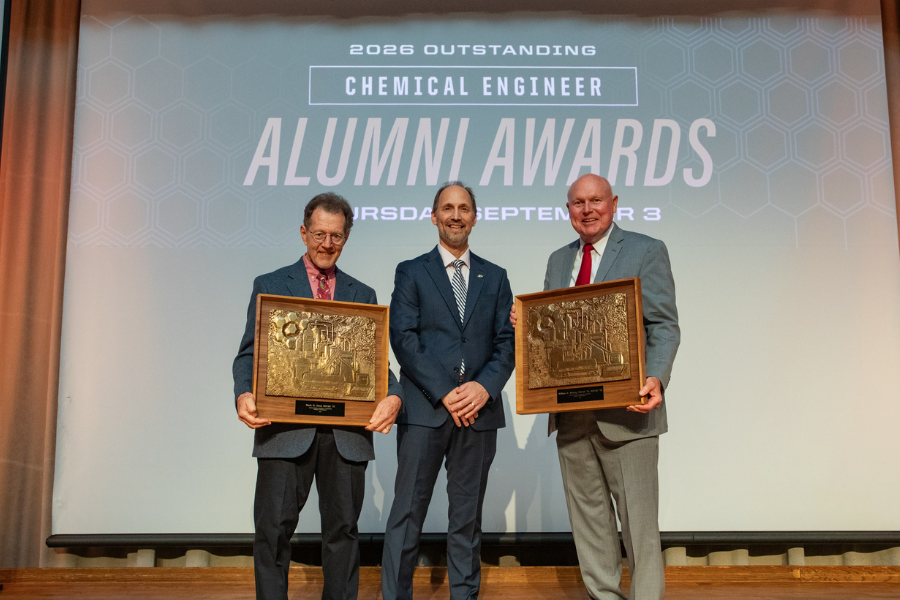
David Corti (Center), Jay and Cynthia Ihlenfeld Head of the Davidson School of Chemical Engineering, presents Mark Etzel (L) and William "Bill" Bussing (R) 2026 Outstanding Chemical Engineer Award.