
38X38 honorees are engineering the future of health care
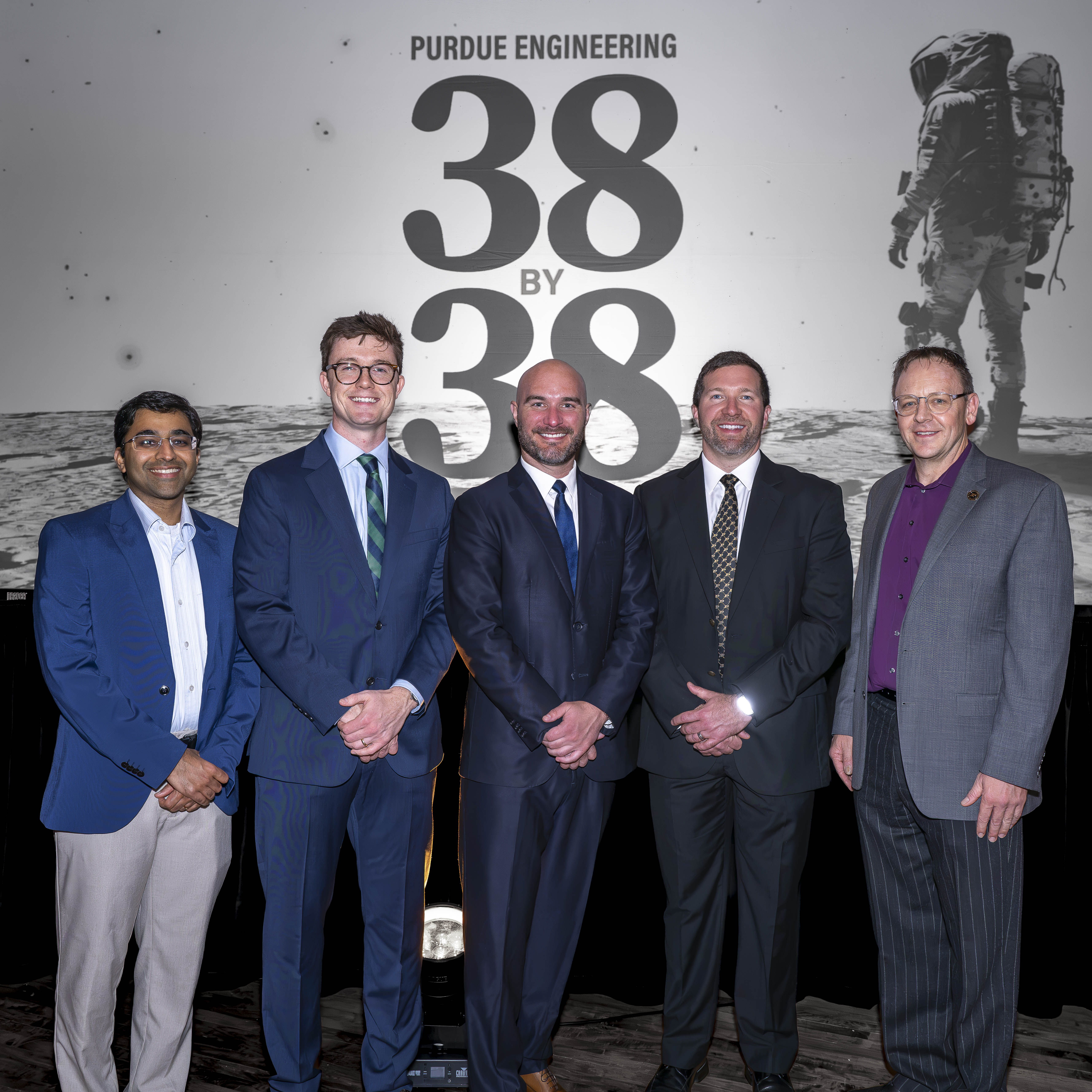
From genome-engineered therapies and advanced medical imaging to next-generation drug delivery, medical devices and regulatory science, five Purdue Engineering alumni are demonstrating the many ways biomedical engineers can shape the future of health care.
The five alumni from Purdue University's Weldon School of Biomedical Engineering are among the 2026 Purdue Engineering 38 by 38 honorees, recognized for their accelerated professional trajectories and meaningful impact in their fields. They will be celebrated during the 38 by 38 Awards Ceremony on Thursday, Oct. 29.
Inspired by the legacy of Purdue alumnus Neil Armstrong, who was 38 years old when he became the first person to set foot on the moon, the 38 by 38 award recognizes 38 College of Engineering alumni who have reached significant milestones early in their careers.
For this year's Weldon honorees, those achievements span an impressive range of biomedical engineering — from developing new approaches to genetic medicine to helping shape how medical technologies are researched, regulated and brought to patients.

Sriram Vaidyanathan: Engineering new approaches to genetic medicine
Sriram Vaidyanathan, PhD, is working at the intersection of genome editing and tissue engineering to develop new genetic medicines for cystic fibrosis and other genetic disorders.
As an assistant professor at the Research Institute at Nationwide Children's Hospital and The Ohio State University, Vaidyanathan leads a research laboratory pioneering genome-engineered stem cell therapies. His work brings an engineer's mindset to some of biology's most difficult challenges, with the goal of developing therapies capable of providing lasting benefits for patients.
His career reflects the increasingly interdisciplinary nature of biomedical engineering, combining genetic engineering, stem cell biology and tissue engineering to address diseases at their source.

Antonia Susnjar: Advancing medical imaging
Antonia Susnjar, PhD, has built a career around using biomedical engineering to better understand and address complex medical conditions.
A Purdue biomedical engineering graduate, Susnjar earned her doctorate studying MRI applications in neurotrauma, including functional MRI, diffusion tensor imaging and magnetic resonance spectroscopy. She also contributed to Purdue's broader community, participating in student government and leading a STEM summer internship program for high school students from under-resourced communities.
Following Purdue, she completed a postdoctoral fellowship at Harvard Medical School and Massachusetts General Hospital, where she developed quantitative imaging methods to study lung disease in transplant patients and pulmonary fibrosis.
Today, Susnjar serves as director of research and scientific affairs at GE Healthcare. In that role, she coordinates imaging research collaborations among major academic and clinical institutions throughout the Midwest, including Cleveland Clinic, Cincinnati Children's, the University of Chicago, the University of Michigan and Indiana University School of Medicine.
Her trajectory illustrates how technical expertise can grow into leadership that connects researchers, clinicians and industry to advance medical imaging.
Tyler Novak: Reimagining how medicines are delivered
For Tyler Novak, biomedical engineering has provided a foundation for working across the boundaries of pharmaceutical science, engineering and health care product development.
Novak, who earned his Purdue B.S. in biomedical engineering in 2011 and PhD in 2015, is director of drug delivery strategy and innovation at Gilead Sciences. He leads efforts focused on next-generation therapeutics, drug delivery technologies, combination products and long-acting medicines.
His career has included roles at Cook Biotech and Intersect ENT, where he contributed to the development of surgical regenerative medicine and drug delivery products across multiple therapeutic areas. Throughout that work, he has focused on translating emerging technologies into solutions for critical unmet medical needs.
At Gilead, Novak helps shape innovation strategy across the company's drug delivery portfolio, with particular emphasis on long-acting therapies and technologies that could transform treatment for chronic diseases.
His work reflects a central challenge of biomedical engineering: creating technologies that are not only technically innovative, but also improve how patients experience and receive care.
Adam Scott: Turning engineering innovation into a medical device company
Adam Scott has taken his biomedical engineering education from the research environment into entrepreneurship, helping turn a medical device concept into a product now reaching lifesavers across the country.
After graduating from Purdue in 2018, Scott worked as a staff researcher in the College of Engineering before co-founding Compact Medical. The company has raised $3.1 million in outside funding and developed the ButterflyBVM, an FDA-cleared manual ventilation device designed to make ventilation smarter and safer.
As chief operating officer, Scott has helped guide the company's product development, operations, manufacturing and execution as Compact Medical works to expand the device's reach among EMS and hospital teams.
His career demonstrates another path for a biomedical engineer: identifying a problem, developing a solution and navigating the complex process of bringing a medical device from an idea to the hands of health care professionals.
David Gross: Advancing medical device safety and regulatory science
David Gross has built his career at the intersection of biomedical engineering, medical device safety and regulatory science.
Gross began his professional career as an engineer at MED Institute and advanced through technical and managerial leadership roles to become vice president. Along the way, he built and led multidisciplinary teams focused on MRI safety evaluations and computational modeling, helping establish internationally recognized centers of expertise.
His technical leadership has been recognized through competitive research fellowships, invited lectures and peer-reviewed publications, as well as patents and international speaking engagements. He has also played a role in shaping the regulatory landscape for medical devices, including authoring an FDA-qualified Medical Device Development Tool and participating in FDA programs such as the Experiential Learning Program.
Gross has further expanded his influence through leadership in international standards development, professional engineering licensure and work as an expert witness in complex medical device matters. He has also advised early-stage startups, helping emerging technologies navigate regulatory and commercialization challenges.
His trajectory demonstrates that biomedical engineering's impact extends beyond developing new technologies. Engineers can also help establish the safety standards, regulatory pathways and technical expertise that allow those technologies to reach patients.
Engineering impact at 38 and beyond
Together, the five 2026 38 by 38 honorees represent the breadth of possibilities available to biomedical engineers. Their careers span research, academia, industry, entrepreneurship, medical imaging, drug delivery, genetic medicine, medical devices and regulatory science.
Their paths are different, but they share a common foundation: using engineering to solve problems that matter in health care.
That spirit is at the heart of the 38 by 38 award — and of the Purdue engineers who continue to turn their education into meaningful impact.
The five Weldon School honorees will be recognized during the Purdue Engineering 38 by 38 Awards Ceremony on Thursday, Oct. 29.