
Research
Semiconductor Research Corporation (SRC) Center for Heterogeneous Integration Research on Packaging (CHIRP)
Prof. Subbarayan Co-Directs, along with Prof. B.G. Sammakia of SUNY Binghamton, the $4.5 Million Purdue-Binghamton SRC Center for Heterogeneous Integration Research in Packaging. There are currently 15 projects related to heterogeneous integration ongoing at the center. More details below.
Summary
Prof. Subbarayan’s research broadly spans the continuum thermodynamic theory for phase interfaces, computational techniques for moving boundary problems such as crack initiation/propagation or phase nucleation/evolution, and their practical applications to modeling and experimentally characterizing the failure of microelectronic devices and assemblies.
At its core, his research utilizes principles of continuum mechanics, computational and experimental solid mechanics, geometrical modeling, and numerical analysis. Selected examples from this research are described below:
1. Computational Mechanics: Isogeometric Analysis (IGA)
We were among the first to use geometric models, based on Non-Uniform Rational B-Splines or NURBS, directly for analysis eliminating the meshing step needed in finite element analysis [1,2]. The use of geometric models for analysis is commonly referred to, as Isogeometric Analysis (IGA, [3]), and is a popular strategy for directly integrating CAD and CAE without needing an intervening mesh.
A challenging problem in IGA is stitching together, parametrically described spline patches. We developed a parametric stitching, or p-stitching, procedure for coupling patches with assured, arbitrary smoothness at the interface between the subdomains, including problems with sharp changes in gradient, as at dissimilar material interfaces [4]. The coupling procedure relies on Enriched Isogeometric Analysis (EIGA) previously developed by our group in 2012 [5].
Automated crack initiation and propagation along arbitrary paths across interfaces in multilayer materials was first demonstrated by our group in 2012 [6]. In the figure below, simulations of arbitrary crack initiation and propagation in micron-scale semiconductor chip dielectric stacks using enriched isogeometric analysis is illustrated [7]. We later used EIGA for singular as well as discontinuous enrichments [8] based on asymptotic analysis of singularities in multi-material wedge corners and crack tips [9].

2. CAD: Algebraic Level Sets and Implicit Boolean Compositions
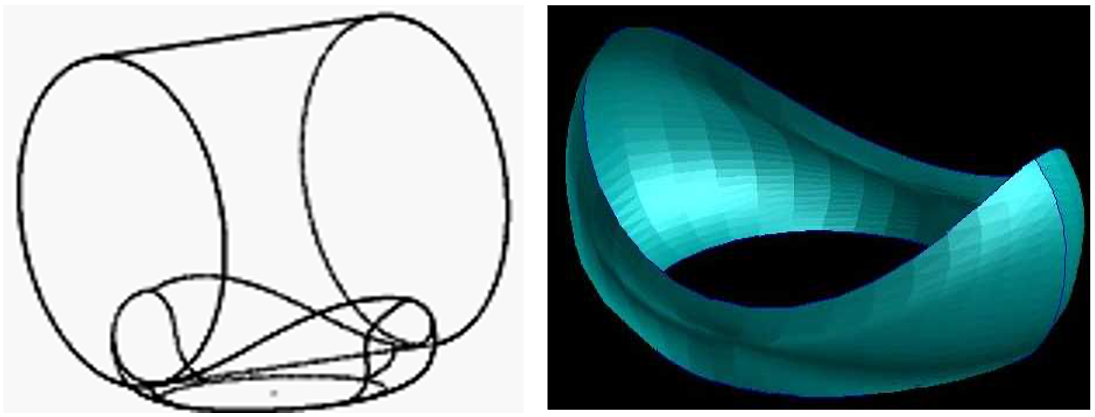
EIGA, mentioned earlier, utilizes measures of distance (algebraic level sets) constructed from the parametric enrichments; it explicitly preserves the CAD geometry of the interface allowing ease in calculating the curvature and normal that drive the interface motion under physical forces. The algebraic level sets are constructed from parametric boundaries using the theory of resultants of algebraic equations [10,11]. The algebraic level sets enable one to avoid the vexing CAD problem of needing to numerically calculate the intersection between complex three-dimensional parametric surfaces and stitching the surfaces together to form the common B-rep solid model (Figure 3).
Furthermore, a rigorous technique was developed by our group to recover implicitizations of parametric surfaces with trivially singular Dixon resultants and to carryout behavioral analysis of complex intersecting closed regions bounded by parametric surfaces without surface-surface intersection calculations [12].

3. Continuum Thermodynamics of Interfaces
Interfacial phenomena are of critical importance in many fields, however the conditions governing phase evolution at the interface are often unclear. We derived the thermodynamic configurational force associated with a moving interface with multiple diffusing species and arbitrary surface stress [13], inspired by the work of Truesdell and Toupin [14] and Gurtin [15]. The mass, momentum, energy balance as well as the second law condition were derived on the evolving phase interface subject to mechanical loads, heat and multiple diffusing species. The derived second law condition naturally extends the Eshelby energy–momentum tensor associated with moving cracks to include species diffusion terms (Eq. (43) in [13]), and naturally yields the interface equivalents of Fick’s (Eq. (41)) and Fourier’s laws (Eq. (42)). The second law restriction was then used to derive the condition for the growth and nucleation of new phases in a body undergoing finite deformation subject to inhomogeneous as well as anisotropic interface stress, and multiple diffusing species.

We also posed a configurational optimization problem and derived the sensitivity of an arbitrary objective to arbitrary motions of one or more finite-sized heterogeneities inserted into a homogeneous domain [18]. In the derivation, they naturally obtained the definition of a generalized Eshelby energy-momentum tensor for arbitrary objectives and expressed the sensitivities as surface integrals with jump terms across the heterogeneity boundaries that vanished on homogeneous domains yielding generalized conservation laws for arbitrary objectives. They then showed that the specific path- independent forms of the sensitivity of the objective to arbitrary translation, rotation or scaling of the inserted heterogeneities naturally yielded the J-, L- and M-integrals of fracture mechanics when the objective is strain energy. The theory was computationally implemented using EIGA to optimally identify best/worst-case locations for line cracks that are inserted into the domain as well as to optimally mitigate the risk of fracture due to a crack at its worst-case location by sequentially inserting and optimizing the configurations of circular/elliptical stiff/soft inclusions (Figure 5). The simulations required singular as well as discontinuous enrichments mentioned earlier for modeling the cracks [8].

4. Multiphysics Modeling and Experimental Characterization of Failure in Microelectronic Devices and Assemblies
Solder joints are ubiquitous in microelectronic assemblies. They operate at high homologous temperatures, experience significant rate-dependent plastic deformation, and develop fatigue cracks that are large relative to the size of the joint. A significant effort in the Subbarayan group is to characterize the constitutive and fatigue behavior of a wide variety of solder alloys under a wide range of strain rates (Figure 6, [19,20,21]).

Using point wise material damage described by a Weibull distribution of equivalent plastic strain, crack fronts and fatigue lives were predicted accurately to within 20% relative to experimental observations [22]. However, a Weibull damage description lacks physical foundation. So, we developed a maximum entropy theory for fatigue damage accumulation at crack tips in ductile solids based on the concepts of statistical mechanics and information theory (Figure 7, [23,24]).

As solder joints shrink in size in response to general microelectronics drive towards transistor scaling, the intermetallic phases occupy a significant fraction of the solder joint. They are also prone to new failure mechanisms as illustrated in Figure 4. The existing characterization procedures rely on cross-sectioning and polishing to observe the phases, which interrupts the test. So, an ongoing effort is to design nanoprobe Blech-like test structures using semiconductor fabrication techniques that allow in situ visualization of phase evolution without cross-sectioning (Figure 8, [25]).

Related modeling work includes phase field multi-physics simulations of Cu6Sn5 intermetallic growth in micron-scale solder joints (Figure 9, [26]) and phase field electromigration simulations [2].

Thin films are common to microelectronic devices, and during processing, they are prone to wrinkling and debonding. Characterizing the adhesion energy of the films is a significant challenge at the present time. Subbarayan and his students were the first to evaluate thermally induced buckling leading to debond in thin films (Figure 10) to estimate the interfacial fracture toughness [28]. They characterized the bond between aluminum and Su8 films and estimated the yield strength of the aluminum film using these experiments [29].

5. Thermal Transport in Particulate Composites
Particulate composites are common in many applications including in thermal interface materials used to remove heat from the chips in microelectronic packages. The interface materials are engineered to maximally pack particles in a silicone or epoxy matrix to enhance thermal conductivity while allowing a compliant system that mechanically decouples the chip from the heat spreader. The near-percolation thermal conduction in these systems often requires explicit simulations of microstructural ensembles. Simulations that don’t explicitly account for particle-particle interactions typically don’t agree well with experiments when the volume loading of the particles exceeds 30%. Subbarayan and his students developed full-filed NURBS-based models of realistic three-dimensional microstructures to identify the near percolation behavior in these systems [30]. The models were validated against experimental measurements of the effective thermal conductivity as well as classical analytical models (Figure 11).


They then developed random network models that capture the near percolation behavior to within 10% accuracy of the full-field models, while requiring three-orders of magnitude lower computational effort [31]. The models also relied on sophisticated particle packing algorithms including for ellipsoidal particles ([32], Figure 12).

In particulate thermal interface materials, nanoscale particle fillers are envisioned to improve effective conductivity, but the size-dependent conductivity of particles, wires and films at nanoscale is not well understood. Subbarayan and his students were the first to develop a reversed non-equilibrium molecular dynamics (NEMD) simulation technique to estimate the thermal conductivity of amorphous nanoscale silica particles, wires and films [33] (Figure 13). The non-equilibrium simulation technique is necessary for nanoscale structures since a persistence of perturbation to the energy/heat current may not be assumed in these structures owing to the proximity of interfaces unlike in the bulk material.
6. Optimal Design and Machine Learning Models
Prof. Subbarayan was among the first to propose material density distribution to optimally design topologies of structures [34] popularly referred as SIMP (solid isotropic microstructure with penalization for intermediate densities). He proposed a Pareto-optimal problem for load-bearing bones (Figure 14) that traded metabolic cost measured by mass against risk of fracture as measured by stored energy. Bones have a known relationship between elastic modulus and apparent density of the form 𝐸 = 𝑐𝜌3 resulting in a topological optimization problem that was efficiently solved using variational sensitivity analysis.

Other examples of Subbarayan’s optimization research include Pareto-optimal formulations and machine learning models for mapping color from monitors to printing devices [35, 36] (Figure 15) and applications to topological design of micro-channels for squeeze flow optimization of thermal interface materials in semiconductor chips [37]. Subbarayan was among the first to systematically evaluate the utility of machine learning models as global approximations for optimal design. He demonstrated that machine learning models are useful only if the cost of training is unimportant relative to cost of use [38,39].

References
[1] F.P. Renken and G. Subbarayan. “NURBS-Based Solutions to Inverse Boundary Problems in Droplet Shape Prediction,” Computer Methods in Applied Mechanics and Engineering, vol. 190, no. 11-12, pp. 1391- 1406, 2000, doi: 10.1016/S0045-7825(00)00168-7.
[2] D. Natekar, X. Zhang, and G. Subbarayan. “Constructive Solid Analysis: A Hierarchical, Geometry based Meshless Procedure for Integrated Design and Analysis,” Computer Aided Design, vol. 36, pp. 473-486, 2004, doi: 10.1016/S0010-4485(03)00129-5.
[3] T.J.R. Hughes, J.A. Cottrell, and Y. Bazilevs, “Isogeometric Analysis: CAD, finite elements, NURBS, exact geometry and mesh refinement,” Computer Methods in Applied Mechanics and Engineering, vol. 194, no. 39-41, pp. 4135-4195, 2005, doi: 10.1016/j.cma.2004.10.008
[4] C-P. Chen, Y. Chen and G. Subbarayan, “Parametric Stitching for Smooth Coupling of Subdomains with Non-Matching Discretizations,” Computer Methods in Applied Mechanics and Engineering, vol. 373, pp. 113519 1-37, 2021, doi: 10.1016/j.cma.2020.113519.
[5] A. Tambat and G. Subbarayan. “Isogeometric Enriched Field Approximations,” Computer Methods in Applied Mechanics and Engineering, vol. 245-246, pp. 1-21, 2012, doi: 10.1016/j.cma.2012.06.006.
[6] A. Tambat and G. Subbarayan, “Simulations of Arbitrary Crack Path Deflection at a Material Interface in Layered Structures.” Engineering Fracture Mechanics, vol. 141, pp. 124-139, 2015, doi: 10.1016/j.engfracmech.2015.04.034.
[7] A. Tambat, H-Y. Lin, G. Subbarayan, D.Y. Jung and B.G. Sammakia, “Simulations of damage, crack initiation and propagation in interlayer dielectric stacks: understanding assembly-induced fracture in dies,” Invited paper, special issue on 3D packaging, IEEE Transactions on Devices and Materials Reliability, vol. 12, no. 2, pp. 241-254, 2012, doi: 10.1109/TDMR.2012.2195006.
[8] C-P. Chen, Y. Chen and G. Subbarayan, “Singular Enrichment for Multi-Material Corners with Application to Assessing the Risk of Fracture in Semiconductor Devices,” Engineering Fracture Mechanics, vol. 248, pp. 107739 1-21, 2021, doi: 10.1016/j.engfracmech.2021.107739.
[9] Y. Luo and G. Subbarayan, “A Study of Multiple Singularities in Multi-Material Wedges and their Use in Analysis of Microelectronic Interconnect Structures,” Engineering Fracture Mechanics, vol. 74, no. 3, pp. 416-430, 2007, doi: 10.1016/j.engfracmech.2006.04.032.
[10] K. Upreti, T. Song, A. Tambat and G. Subbarayan, “Algebraic Distance Estimations for Enriched Isogeometric Analysis,” Computer Methods in Applied Mechanics and Engineering, vol. 280, pp. 28-56, 2014, doi: 10.1016/j.cma.2014.07.012.
[11] K. Upreti, T. Song and G. Subbarayan, “Signed Algebraic Level Sets on NURBS Surfaces and Implicit Boolean Compositions for Isogeometric CAD-CAE Integration,” Computer Aided Design, vol. 82, pp. 112-126, 2017, doi: 10.1016/j.cad.2016.09.006.
[12] P. Vaitheeswaran and G. Subbarayan, “Improved Dixon Resultant for Generating Signed Algebraic Level Sets and Algebraic Boolean Operations on Closed Parametric Surfaces,” Computer Aided Design, vol. 135, pp. 103004 1-17, 2021, doi: 10.1016/j.cad.2021.103004.
[13] P. Vaitheeswaran, A. Udupa, S. Sadasiva and G. Subbarayan, “Interface Balance Laws, Phase Growth and Nucleation Conditions for Multiphase Solids with Inhomogeneous Surface Stress.” Continuum Mechanics and Thermodynamics, vol. 32, no. 4, pp. 987-1010, 2020, doi: 10.1007/s00161-019-00804-z.
[14] C. Truesdell, R. Toupin, “The classical field theories,” in: Flügge, S. (ed.) Principles of Classical Mechanics and Field Theory/Prinzipien der Klassischen Mechanik und Feldtheorie, pp. 226–858. Springer, Berlin, 1960.
[15] M.E. Gurtin, M.E. Jabbour, “Interface evolution in three dimensions with curvature-dependent energy and surface diffusion: interface-controlled evolution, phase transitions, epitaxial growth of elastic films,” Arch. Ration. Mech. Anal. 163(3), 171–208, 2002.
[16] C. Jois, S. Prasad, and G. Subbarayan, “Phase Field Simulations of Solder Void Evolution under Thermal Aging,”, IEEE, pp. 890, 2022.
[17] H. Liao, C. Jois, S. Prasad, and G. Subbarayan, “Sharp Interface Simulation of IMC Growth and Void 21st IEEE Intersociety Conference on Thermal and Thermomechanical Phenomena in Electronic Systems (ITherm) Evolution in Solder Microbumps,” 335, pp. 657, 2022, IEEE, paper no. San Diego, CA, USA, 21st IEEE Intersociety Conference on Thermal and Thermomechanical Phenomena in Electronic Systems (ITherm)
[18] C-S. Lee*, C-P. Chen*, H-Y. Lin* and G. Subbarayan, “Conservation Laws for Arbitrary Objectives with Application to Fracture Resistant Design.” To appear, International Journal of Fracture, doi: 10.1007/s10704-022-00649-9.
[19] D. Bhate, D. Chan, G. Subbarayan, T.C. Chiu, V. Gupta and D. Edwards “Constitutive Behavior of Sn3.8Ag0.7Cu and Sn1.0Ag0.5Cu Solder Alloys at Creep and Low Strain Rate Regimes,” IEEE Transactions on Components and Packaging Technology, vol. 31, no. 3, pp. 622-633, 2008, doi: 10.1109/TCAPT.2008.2001165.
[20] D. Chan, X. Nie, D. Bhate*, G. Subbarayan, W. Chen, and I. Dutta, “Intermediate and High-Strain Rate Behavior of Sn3.8Ag0.7Cu and Sn1.0Ag0.5Cu Solder Alloys: Constitutive Models and their Demonstration,” IEEE Transactions on Components, Packaging, and Manufacturing Technology, vol. 3, no. 1, pp. 133-146, 2013, doi: 10.1109/TCPMT.2012.2211022.
[21] T. Dale, Y. Singh, I. Bernander, G. Subbarayan, C. Handwerker, P. Su and B. Glasauer, "Fatigue Life of Sn3.0Ag0.5Cu Solder Alloys Under Combined Shear and Compressive Loads," ASME Transactions Journal of Electronic Packaging, vol. 142, no. 4, pp. 041001 1-11, 2020, doi: 10.1115/1.4048109.
[22] P. Towashiraporn, G. Subbarayan and C.S. Desai. “A Hybrid Model for Computationally Efficient Fatigue Fracture Simulations at Microelectronic Assembly Interfaces,” International Journal of Solids and Structures, vol. 42, pp. 4468-4483, 2005, doi: 10.1016/j.ijsolstr.2004.12.012.
[23] D. Bhate, K. Mysore and G. Subbarayan, “An Information Theoretic Argument on the Nature of Damage Accumulation in Solids,” Mechanics of Advanced Materials and Structures, vol. 19, pp. 184-195, 2012, doi: 10.1080/15376494.2011.572246.
[24] D. Chan, G. Subbarayan, and L. Nguyen. “Maximum Entropy Principle for Modeling Damage and Fracture in Solder Joints: Enabling Life Predictions under Microstructural Uncertainty,” Invited Paper, Journal of Electronic Materials, vol. 41, no. 2, pp. 398-411, 2012, doi: 10.1007/s11664-011-1804-9.
[25] S. Prasad, C. Jois and G. Subbarayan “Novel Test Device for Non-destructive Experimental Characterization of Void Evolution in Microscale Solder Joints subjected to Thermal Aging,” 21st IEEE Intersociety Conference on Thermal and Thermomechanical Phenomena in Electronic Systems (ITherm) San Diego, CA, USA, paper no. 337, pp. 713, IEEE, 2022.
[26] A. Udupa, S. Sadasiva, and G. Subbarayan, “A Framework for Studying Dynamics and Stability of Diffusive-Reactive Interfaces with Application to Cu6Sn5 Intermetallic Compound Growth” Proceedings of the Royal Society A: Mathematical, Physical and Engineering Sciences, vol. 472, issue 2190, no. 20160134, 2016, doi: 10.1098/rspa.2016.0134.
[27] S. Sadasiva, P. Vaitheeswaran, and G. Subbarayan, “A phase field computational procedure for electromigration with specified contact angle and diffusional anisotropy,” Computational Mechanics, vol. 66, pp. 373-390, 2020. doi: 10.1007/s00466-020-01855-9.
[28] S. Goyal, K. Srinivasan, G. Subbarayan and T. Siegmund “On Instability-Induced Debond Initiation in Thin Film Systems,” Engineering Fracture Mechanics, vol. 77, pp. 1298-1313, 2010, doi: 10.1016/j.engfracmech.2010.02.001.
[29] S. Goyal, K. Srinivasan, G. Subbarayan and T. Siegmund “A Non-Contact Thermally-Driven Buckling Delamination Test to Measure Interfacial Fracture Toughness of Thin Film Systems,” Thin Solid Films, vol. 518, pp. 2058-2064, 2010, doi: 10.1016/j.tsf.2009.07.148.
[30] S. Kanuparthi, M. Rayasam, G. Subbarayan, B.G. Sammakia, A. Gowda, and S. Tonapi, “Hierarchical Compositions for Simulations of Near-Percolation Thermal Transport in Particulate Materials,” Computer Methods in Applied Mechanics and Engineering, vol. 198, pp. 657-668, 2009, doi: 10.1016/j.cma.2008.10.001.
[31] S. Kanuparthi, G. Subbarayan, T. Siegmund, and B.G. Sammakia “An Efficient Network Model for Determining the Effective Thermal Conductivity of Particulate Thermal Interface Materials,” IEEE Transactions on Components and Packaging Technology, vol. 31, no. 3, pp. 611-621, 2008, doi: 10.1109/TCAPT.2008.2001839.
[32] H. Liao, S. Achar, and G. Subbarayan, “A Procedure for Efficient Generation and Behavioral Evaluation of Ultra-Packed Ellipsoidal Particle Systems,” International Journal of Numerical Methods in Engineering, vol. 123, no. 7, pp. 1547-1575, 2022, doi: 10.1002/nme.6902.
[33] S. Mahajan, G. Subbarayan, and B.G. Sammakia, “Estimating Thermal Conductivity of Amorphous Silica Nano-Particles and Nano-Wires using Molecular Dynamics Simulations,” Physical Review E, 76, 056701, 2007, doi: 10.1103/PhysRevE.76.056701.
[34] G. Subbarayan, “Bone Construction and Reconstruction: A Variational Model and Its Applications,” Ph. D. Thesis, Cornell University, Ithaca, NY, 1991.
[35] D. Littlewood, P.A. Drakopoulos, and G. Subbarayan. “Pareto-Optimal Formulations for Cost Versus Calorimetric Accuracy Trade-offs in Printer Color Management,” ACM Transactions on Graphics, vol. 21, no. 2, pp. 132-175, 2002, doi: 10.1145/508357.508361.
[36] P.A. Drakopoulos and G. Subbarayan. Color Printer Characterization Using Optimization Theory and Artificial Neural Networks. U.S. Patent No. 6,480,299 B1, awarded November 12, 2002. Currently under license to Bukhara Tech Talk.
[37] N. Bajaj, G. Subbarayan and S. Garimella, “Topological Design of Channels for Squeeze Flow Optimization of Thermal Interface Materials,” International Journal of Heat and Mass Transfer, vol. 55, pp. 3360-3575, 2012, doi: 10.1016/j.ijheatmasstransfer.2012.03.020.
[38] L. Zhang and G. Subbarayan, “An evaluation of back-propagation neural networks for the optimal design of structural systems: Part I. Training procedures,” Computer Methods in Applied Mechanics and Engineering, vol. 191, no. 25–26, pp. 2873–2886, Apr. 2002, doi: 10.1016/s0045-7825(01)00372-3.
[39] L. Zhang and G. Subbarayan, “An evaluation of back-propagation neural networks for the optimal design of structural systems: Part II. Numerical evaluation,” Computer Methods in Applied Mechanics and Engineering, vol. 191, no. 25–26, pp. 2887–2904, Apr. 2002, doi: 10.1016/s0045-7825(02)00213-x.