
'WiE changed the trajectory of my life': Alum Estep reflects on lessons from program
Picnic tables, a handful of students and Emy Wadsworth’s great big smile.
That was the Women in Engineering (WiE) Program as Jennifer (Wenger) Estep knew it.
She had joined a dozen other first-year engineering (FYE) students at the callout meeting for the new Mentees & Mentors (M&M) Program. About 25 students dotted the picnic tables at Happy Hollow Park.
It was only an hour or so. But the meeting would change Estep’s whole Purdue experience for the better.
The joy Wadsworth — then assistant director of WiE — radiated was infectious. That, combined with the openness and excitement of the other students at the callout, told Estep that she’d found a great network of mentorship and support.
“(Emy) was such a bright light,” said Estep (BSME ’96), who comes from a family of mechanical and civil engineers. “I think everyone who knew her would agree that she really instilled a lot of love and energy into the women — not just the program, but the women.”
The first cohort of M&M in 1992 paired juniors with FYE students and seniors with sophomores for mentorship and connection. Established by Wadsworth to increase retention for engineering students under the Sloan Foundation grant, the M&M community met monthly for professional and social development. Mentor-mentee pairs connected on a weekly basis to both learn and teach one another about thriving in engineering and at Purdue. The first cohort of 48 students set the precedent of a close-knit network early on.
A community of that size was more than enough for Estep. She grew, learned to believe in herself, made meaningful friendships and built resilience within the WiE community.
Or, as she would come to call it decades later to a WiE FYE course and Access Alum talk, “stick-with-it-ness.”
Each challenging test, late-night study session, group project and internship interview became opportunities to “keep on keepin’ on,” as she recalled Wadsworth repeating in every conversation.
The WiE community kept Estep afloat when engineering became difficult — especially when a poorly timed bout of flu uprooted her semester. Friends and Wadsworth offered a sympathetic shoulder to lean on as she recovered. And helped her form a game plan to gradually catch up while staying healthy.
Estep graduated in 1996. Though her diploma only carries one name, she is quick to acknowledge every mentor and friend who left fingerprints on her engineering journey: “I think it’s so important to remember the people that helped to set up some of these structures that helped to carry people forward.
After Purdue, she turned from engineering to marketing. The unconventional career path began at General Motors, Delco Electronics and the petroleum pipeline industry — and led to a marketing directorship at Camargo Pharmaceutical Services.
Marketing medical products became her industry, the perfect combination of helping patients and exploring new innovation.
Estep has held marketing and global commercial strategy roles for life sciences and medtech companies ever since.
“If you have a product that’s great, but no one knows what to do with it or no one has heard about it, that’s when you have a problem,” she said in an installment of the College of Engineering video series “Storytellers.” “So let’s solve that problem as Purdue engineers.”
Both technical and nontechnical skills developed at Purdue and through WiE allowed her to tackle marketing problems for products she understood. In 2025, Estep founded ScreenHER, a cancer screening company aimed at developing a point-of-care approach to accessible earlier cervical precancer and cancer detection.
It’s not the path most engineers would imagine. But it’s still engineering: solving short-term and long-term problems through design, market research, experimentation and teamwork. Tackling problems with both success and failure, learning from each to make a stronger iteration, prototype or marketing campaign.
Estep is building the impact she wants to see in the world. And that, she reiterated, is engineering and her purpose.
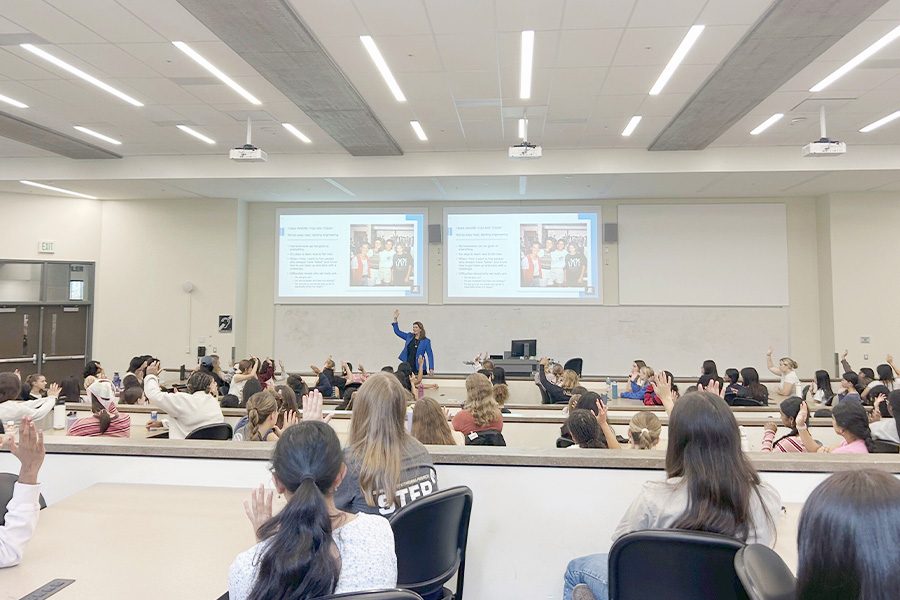
Which is why she regularly returns to Purdue to impart wisdom on the next generation of Purdue engineers. And why “stick-with-it-ness” is emphasized in all things. Had Estep given up when engineering was challenging, or when she failed — which both became familiar from the first semester at Purdue — the impact she has already made in cancer treatments, screening services and other innovative medical technologies may never have existed.
The challenge and the impact are crucial parts of engineering, Estep emphasizes to Purdue students. Just as Wadsworth did for her.
“The world we live in labels everyone who fails as a failure or a loser. But that’s not who you are. You have so much potential, and a rough patch doesn’t mean the best things aren’t still coming.
“I always tell them, in Emy’s words, ‘Catch the joy as it flies and keep on keepin’ on.’”