Making the most of WiE: Allison Komrska
Allison Komrska did it all in the Women in Engineering (WiE) Program.
Komrska, a graduate student studying nuclear engineering, had a hand in every course and most programs WiE had to offer over her six years at Purdue University.
Engineering was exactly what she had hoped it would be after attending Exploring Engineering, a WiE recruiting event, as a senior in high school. And the community was a warm welcome during an odd first year: Komrska started her undergraduate Purdue experience living alone in Meredith Hall, attending virtual classes and meetings in fall 2020 due to COVID-19.
It was hard. But WiE kept her afloat on the lonelier days.
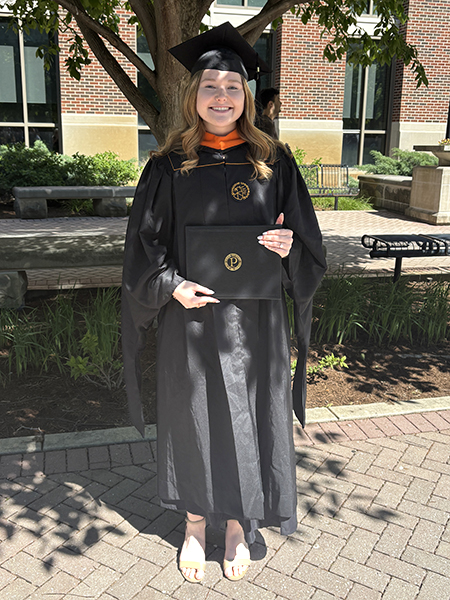
“WiE puts on a phenomenal program,” said Komrska, from Fort Wayne, Indiana. “There’s something for everyone and all that they do is great. But it’s really the people behind it that make WiE worthwhile because everything they do is out of care for the person behind the degree you pursue.”
Komrska leaned into making friends in the couple of in-person classes she had, like ENGR 19400 (Women in Engineering Seminar), which due to pandemic regulations only met every other week yet was still packed with guest speakers and helpful, enthusiastic mentors. The mentorship program Komrska joined in WiE — Mentees & Mentors (M&M) — radiated a positive energy that reinvigorated Komrska. Even though she lived alone, Komrska began to feel less alone. She bounced ideas off mentors, asked questions about each major, took diligent notes and said yes to invitations to social events.
A speaker in a first-year course finally gave Komrska the last push she needed to decide on nuclear engineering. The combination of disciplines present, plus the small class sizes, appealed to Komrska. And, she admits, having someone tell her clearly about a broad and exciting discipline made her indecision less of an obstacle to overcome.
Which was how she ended up in engineering in the first place.
“In high school I liked everything, reading and writing and math and science, so I had my ‘pick of the litter’ as my dad said. When he asked me what I wanted to do, I didn’t have a decision,” she said. "I said that I just wanted to know how things worked, and he said, ‘I hate to break it to you, but that is actually a job. It’s called engineering.’ Then — as a high school senior — I did Exploring Engineering and realized, maybe I could do this.”
The first two years in WiE, then-mentee Komrska was a sponge. She absorbed answers, advice and inspiration from her mentors — juniors and seniors in engineering — like they were handing her a syllabus. The accumulated wisdom spilled out as insightful advice and enthusiasm when Komrska became a mentor to nuclear-curious first-year students and sophomores navigating the major transition.
Komrska gleaned information as readily from courses, too. There hadn’t been time in her undergraduate schedule for ENGR 29600 (WiE — Ideas that Shaped the Modern World), but the ENGR 49400 (Gender in the Workplace) course readings and discussions were fascinating and expanded her understanding of others alongside her engineering knowledge. Komrska shared everything she learned with mentees, too, with the same enthusiasm as she held for calculating radiation.
Komrska completed her nuclear engineering undergraduate degree in May 2024. And came back to Purdue a month later to start a graduate degree in the same discipline.
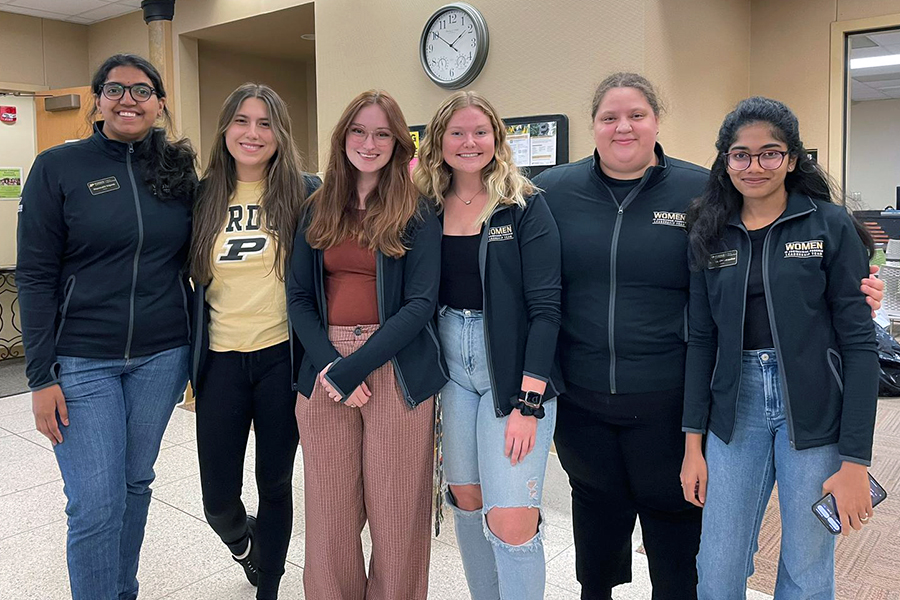
Focusing on a thesis gave Komrska a surprising amount of free time and an urge to try something totally new, yet familiar. She joined the Graduate WiE Network (Grad WiE Network) leadership team. A concrete leadership position was new to Komrska. She walked into the first meeting nervous.
Afterward, Komrska wasn’t sure why she was so worried. It was WiE, after all — she was going to feel right at home.
“I was expecting people to get down to business right away, but they took the time to get to know me. It was not just about the degree or the research. They cared that I had a life outside of academics and that I was part of the community. WiE is not just making engineers in a factory, we're developing the person too.”
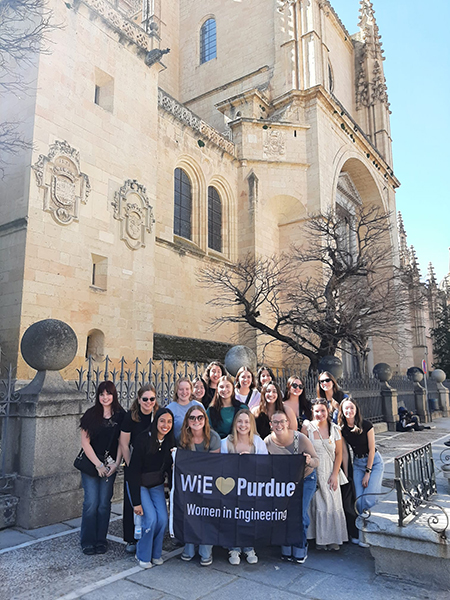
A part of developing the person for Komrska came from her admiration for WiE staff, especially senior associate director Suzanne Zurn-Birkhimer, who finally convinced Komrska to fit ENGR 296 — and the study abroad trip through France and Spain — into her thesis writing-heavy schedule.
“Suzanne is who I want to be when I grow up,” said Komrska. “She taught me to know my worth and really understand when I’m qualified for something or when I need to learn more to be qualified. That self-assured kind of mentality is something she’s built over years of experience, and I want to build that up, too.”
Komrska reflected on the care and support in WiE at an end-of-the-year celebratory dinner for graduating WiE leadership team members. Knowing that she would be moving out of West Lafayette, Indiana, to start a new chapter of her life made sharing memories with the group bittersweet. And hearing a confidence in her voice that wasn’t there four years ago made the deep impact of WiE hit home just weeks before Komrska’s masters graduation in May 2026.
The freshly graduated nuclear engineer is headed to Naval Seas System Command Crane in August — but if WiE asks her to come back as a speaker or a mentor, Komrska has promised to be there.
“It was so refreshing to be there, overwhelmed by support,” said Komrska. “I have loved everyone I have worked with in WiE. It is a community of good people who build each other up, and that makes such a difference.”