
ESS tutor Ketkar encourages broad concept explorations in tutoring
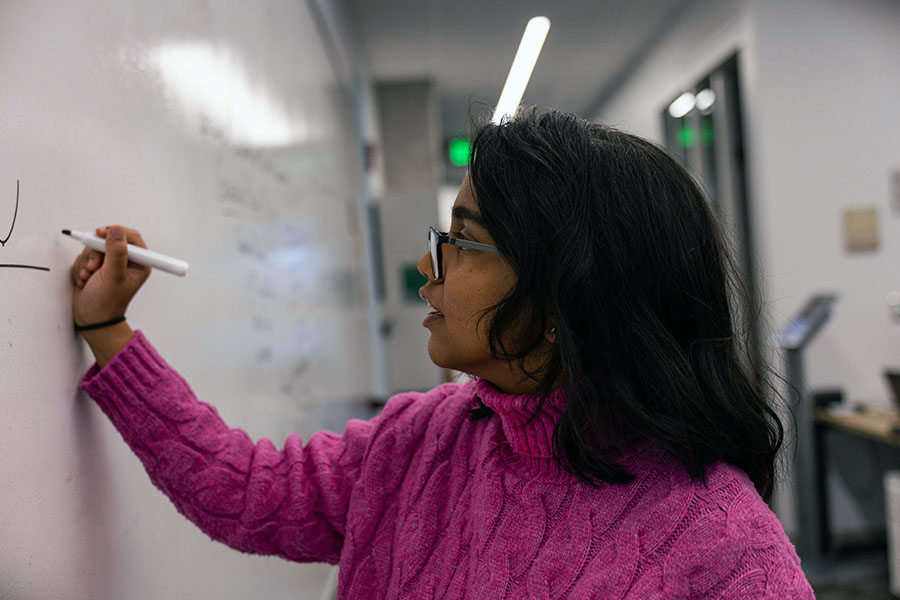
Tarini Ketkar was struggling.
Not alarmingly, she assured. But her midterm grades in her first year studying industrial engineering were certainly not ideal. A high achiever in high school, then-sophomore Ketkar mustered up all her courage to do something that intimidated her more than calculus.
Attend office hours.
The last steps inside were nerve-wracking. But once she started asking questions of the TAs — and later, professors — succeeding at Purdue University didn’t seem as difficult.
“I really liked that the TAs had taken the classes I was struggling with not too long ago,” said Ketkar, a senior studying industrial engineering. “I appreciate being a tutor for that same reason. Knowing someone who has gone through the same classes makes it easier to ask for help.”
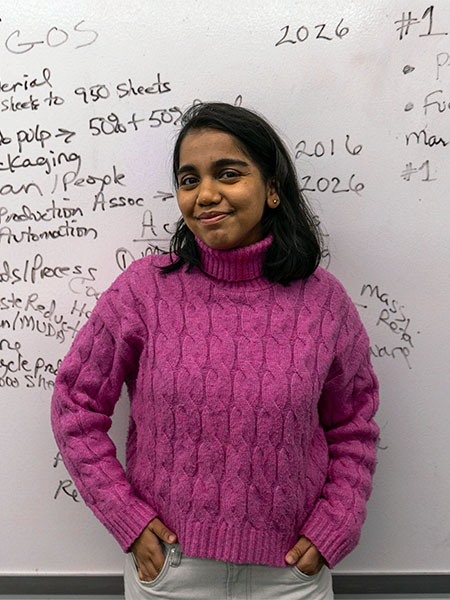
The positive experience was a steppingstone to Ketkar becoming an Engineering Student Success (ESS) tutor in West Lafayette. A route she had informally started in high school, helping friends with homework questions in math and science subjects.
Located in Lambertus Hall 2235, the Engineering Success Center (ESC) where Ketkar tutors is one of two locations facilitated by ESS office for Purdue Engineering students to receive tutoring. The ESC Lambertus location houses 16 tutors covering 36 subjects, 9 a.m.-8 p.m., Monday-Friday. Ketkar tutors 10 subjects, including foundational FYE courses, thermodynamics, Calculus I and II and a variety of industrial engineering courses.
No matter which subject, however, she encourages two actions of her students: Specify which course they’re coming for and prioritize general concept questions over specifics.
Something she picked up from office hours with professors and TAs.
“One thing I've noticed is that students focus a lot on the textbook or the homework questions. It’s a great way to learn, but when it comes to midterms and exams, they tend to struggle with the transition,” she said. “If I can figure out if they’re struggling with a concept or with applying it to test problems, then it becomes easier to give advice.”
A successful session for Ketkar looks like a student confidently approaching a concept they’d been struggling with. When students return for another tutoring session, she is delighted to know that the first one was helpful.
And that the fear of asking for help is being dismantled, little by little, with every visit.
“If you are struggling in classes, it’s OK. Everyone’s been there,” she said. “There’s no shame in asking for help. Engineering starts to feel harder than it really is if you do it alone. So just go up to someone and talk with them. It changes everything.”