Apple Computing Hub prepares next-gen innovators
Apple technology transforms how students learn and create through immersive technologies
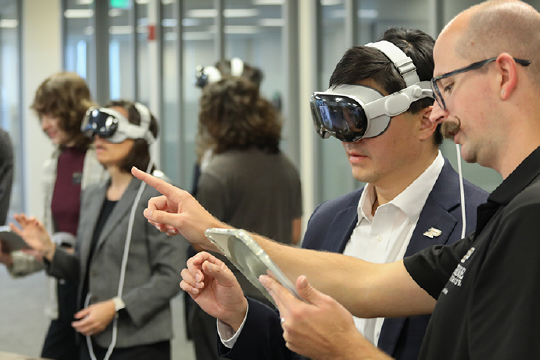
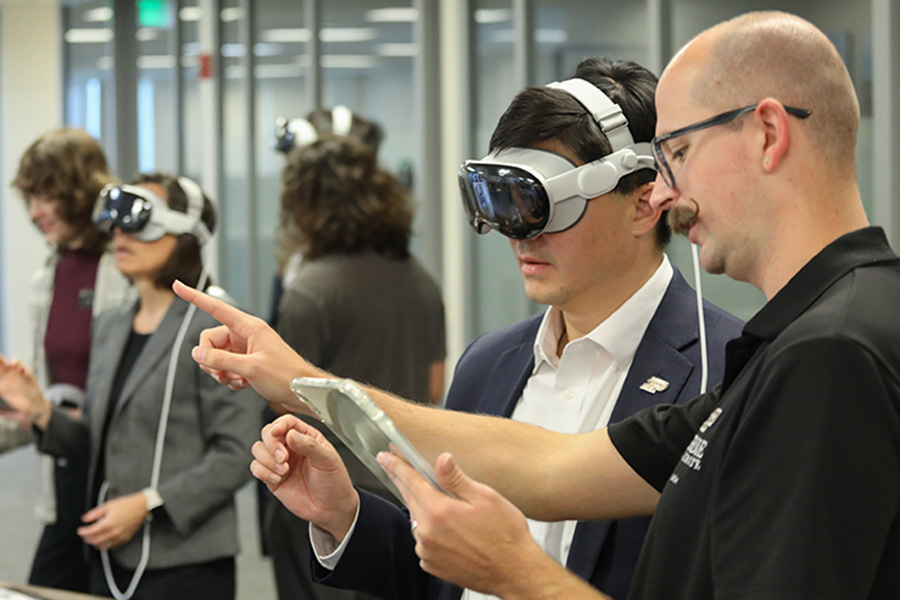
President Mung Chiang (second from right) experiences the possibilities of virtual reality firsthand at Purdue’s new Spatial Computing Hub. (Purdue University photo/Dave Mason)
Purdue University is embracing the future of immersive technology and preparing students to be the next generation of innovators by opening a Spatial Computing Hub utilizing Apple Vision Pro technology. On Monday (Sept. 22) Purdue President Mung Chiang, joined by university leaders, Apple representatives and other members of the campus community, marked the opening of the cutting-edge facility that will bolster Purdue’s constant drive toward harnessing emerging technologies.
Spatial computing blends the physical and digital worlds by using augmented reality, virtual reality, artificial intelligence and 3D mapping to allow people and machines to interact with space in more immersive ways. The hub utilizes Apple Vision Pro technology to enable collaborative research, innovative educational programs and industry engagement.
Dimitrios Peroulis, Purdue’s senior vice president for partnerships and online, said collaborating with Apple further extends Purdue’s digital leadership in tech-driven education.
“This next-generation computing and innovation will provide Purdue students the rare opportunity to explore, learn and master skills that once required million-dollar labs or physical access to restricted facilities,” Peroulis said. “With the Spatial Computing Hub, students will be able to virtually trace the journey of a silicon wafer through chip fabrication or simulate contamination control strategies inside a pharmaceutical facility.”
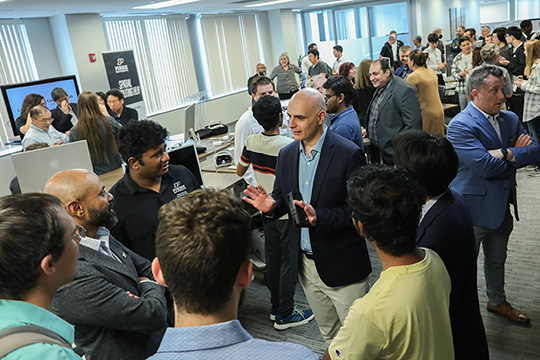
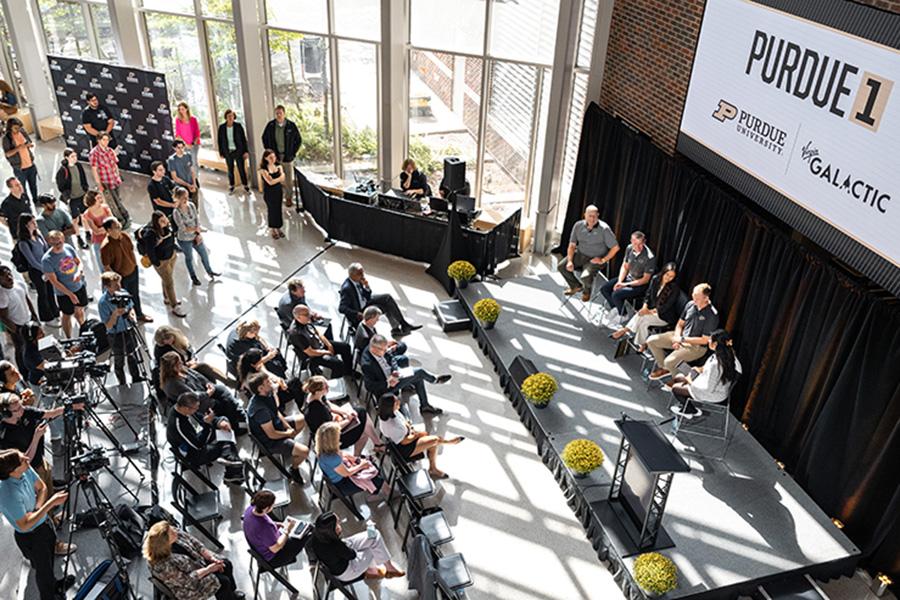
Purdue faculty, staff and students gathered Monday (Sept. 22) for the opening of the new Spatial Computing Hub, where digital and physical worlds converge, enabling breakthroughs in areas like training, design and human–technology interaction. (Purdue University photo/Dave Mason)
Purdue is integrating the future-focused technology into classrooms and laboratories to enhance learning, research and collaboration that will enable innovative training and workforce development for critical fields including semiconductor and pharmaceutical manufacturing.
“Spatial computing is not only a tool for advancing discovery in engineering and science — it also turbocharges collaboration in sectors that are adopting these technologies,” said Milind Kulkarni, the Michael and Katherine Birck Head of Electrical and Computer Engineering. “This hub gives our students the opportunity to experiment with the same technologies that are shaping tomorrow’s industries, ensuring they graduate ready to lead in fast-changing fields.”
Purdue plans to create a specialized online graduate certificate in spatial computing as part of the existing online interdisciplinary master’s degrees in microelectronics and semiconductors and software engineering that are developed and offered jointly by Purdue’s College of Engineering and Department of Computer Science.
Other credit and nondegree courses will also be introduced as the program expands.
About Purdue University
Purdue University is a public research university leading with excellence at scale. Ranked among top 10 public universities in the United States, Purdue discovers, disseminates and deploys knowledge with a quality and at a scale second to none. More than 106,000 students study at Purdue across multiple campuses, locations and modalities, including more than 57,000 at our main campus locations in West Lafayette and Indianapolis. Committed to affordability and accessibility, Purdue’s main campus has frozen tuition 14 years in a row. See how Purdue never stops in the persistent pursuit of the next giant leap — including its integrated, comprehensive Indianapolis urban expansion; the Mitch Daniels School of Business; Purdue Computes; and the One Health initiative — at https://www.purdue.edu/president/strategic-initiatives.“If you spill water on your kitchen counter, you’ll see it spreads more some ways than others,” he said, noting many parameters, including the kind of liquid and the style of surface, come into play. “Is this drinking water in a space station or a liquid packed with nutrients for a plant growth system? We need to get this important data to learn more about these flows to aid in spaceflight hardware design for future long-duration missions and perhaps so that future payloads can be automated, which would make missions even less expensive.”
Media contact: Wes Mills, wemills@purdue.edu
Industry Partnerships
Space Force partnerships open new research, graduate opportunities
January 01, 2026
Advancing innovation for supply chain resilience
January 02, 2026
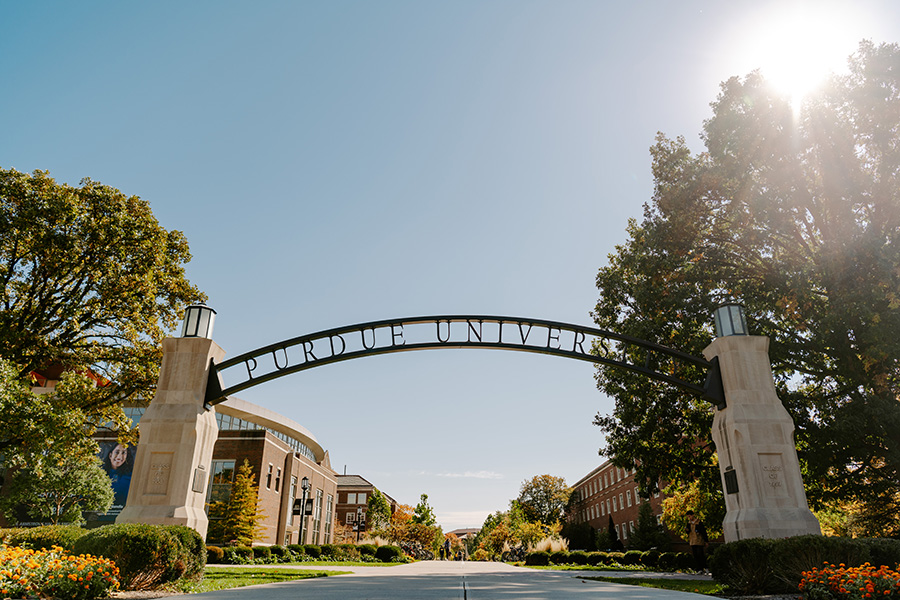
Purdue emerges as America's leading institution in manufacturing and supply chain
January 05, 2026
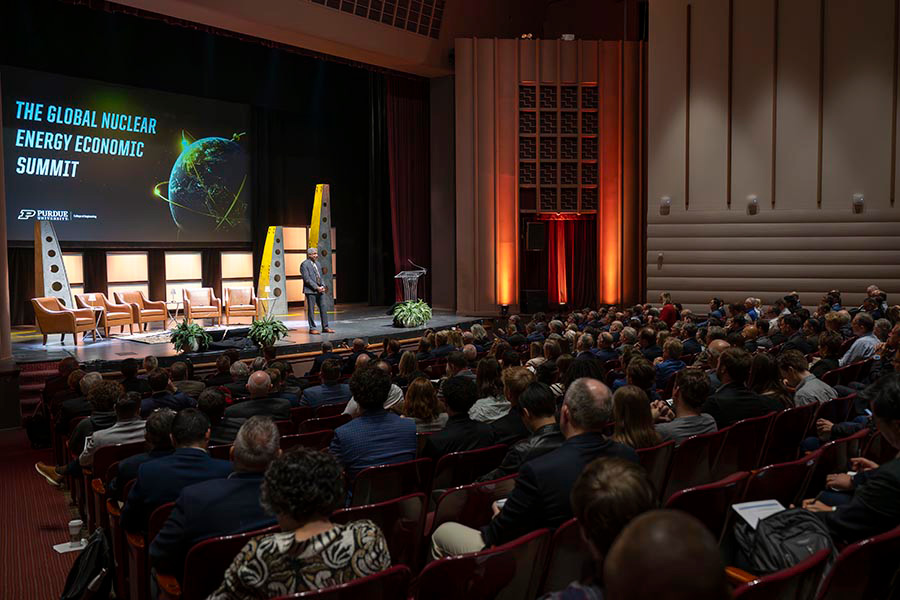
Global Nuclear Energy Economic Summit advances Indiana's role in nuclear innovation
January 06, 2026
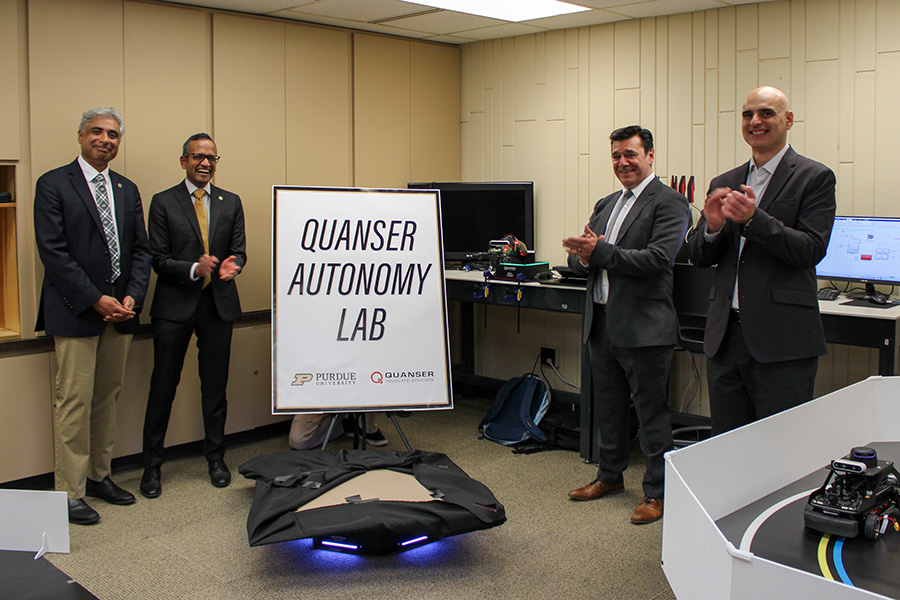
Quanser helps to expand autonomous and connected systems education for engineering students
January 08, 2026
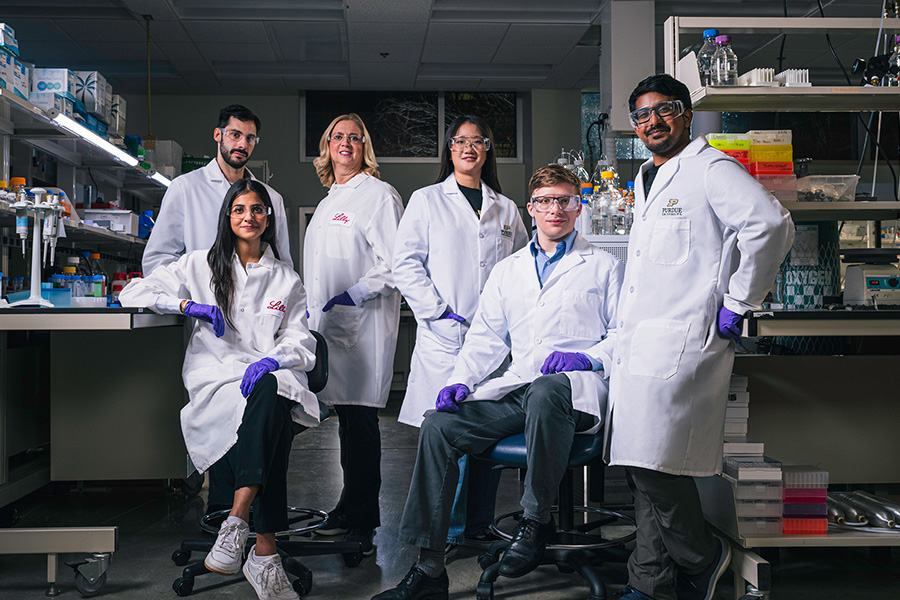
Lilly shares Purdue mission to improve lives worldwide
January 09, 2026
Purdue and ASML partner to advance semiconductor R&D, grow industry workforce
January 10, 2026
Rolls-Royce & Purdue Safeguard the Future
January 11, 2026
BWXT and Purdue forge strategic collaboration to advance nuclear innovation
January 12, 2026
Apple Computing Hub prepares next-gen innovators
January 13, 2026
All-Boilermaker team to crew Virgin Galactic suborbital mission Purdue 1
January 14, 2026

Google collaboration positions Purdue at forefront of AI-driven innovation
January 15, 2026