ABE senior, Engineering Fellow Kessinger maximized Purdue experience
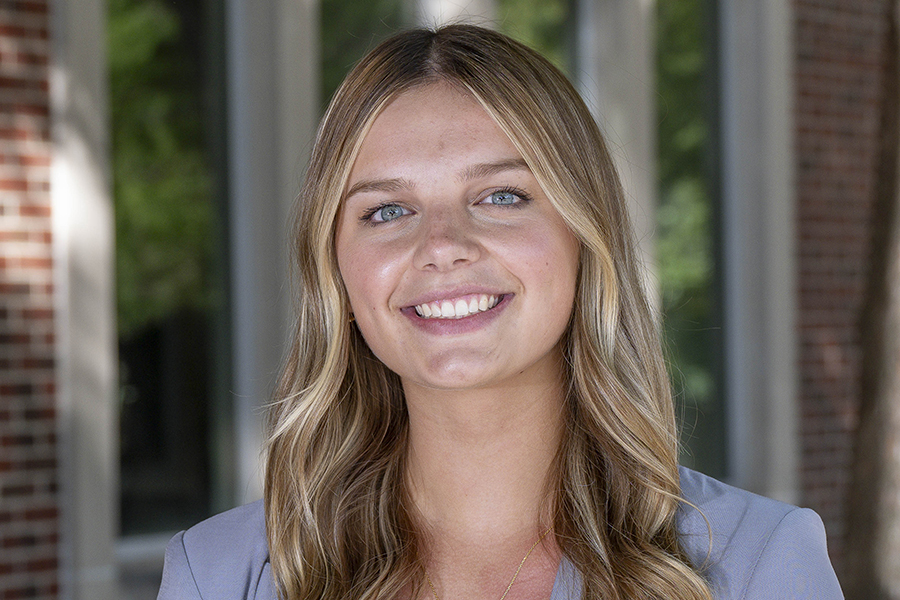
Emma Kessinger was thinking maybe med school, maybe pharmacy.
While attending a third-year biomedical health sciences course in Project Lead the Way through Plainfield High School in Indiana, Kessinger learned about CAR T-cell therapy, an innovative approach to treat cancer. When Kessinger learned there was a personalized form of immunotherapy that trains a patient’s own immune cells to recognize and destroy cancer and that a lot of people behind that work were biomedical engineers, something clicked.
“That sounds really awesome. I want to do that,” she thought. “Then my train of engineering started.”
That switch to major in engineering “on a whim” meant Kessinger wasn’t as prepared as classmates who had been taking appropriate math courses and electives like robotics and coding. The good thing, though, was the university was about 75 miles north.
With its stellar engineering reputation, Purdue University had options, an essential piece to the college puzzle considering Kessinger didn’t know which engineering field best aligned with the new career goal. Was it biomedical? Chemical? Biological?

One small hurdle: Her parents were graduates of another university in the state, one whose primary color is rarely seen on campus in West Lafayette, Indiana, and whose alumni feel a certain kind of way about Boilermakers.
But after participating in a Women in Engineering Program event and Purdue’s for Me during a visit, Kessinger was convinced Purdue was the right fit.
Nearly four years later, Kessinger couldn’t imagine any other choice.
At Purdue, she’s had research opportunities ranging from nanoparticular drug delivery in professor Kurt Ristroph’s lab to protein degradation technologies at Eli Lilly and Company to virology and proteomics at the IU Simon Cancer Center. A peer-reviewed publication on HPV replication, co-authored with leading faculty, showcased her commitment to advancing scientific understanding and an ability to contribute meaningfully to cutting-edge biomedical research.
“Emma has approached her time at Purdue with a great mission,” said Patrick Francis, director of career relations in Indianapolis who was Kessinger’s instructor in ENGR 103 (Introduction to Professional Practice).
Add in a transformative experience with the Purdue Engineering Student Council (PESC) that has provided extensive leadership opportunities, a role as a College of Engineering ambassador, and selection for the senior honor society Mortar Board, and it’s no surprise where Kessinger was in early September 2025: On a stage in Fowler Hall with six other outstanding senior classmates being celebrated as a Purdue Engineering Fellow.
The distinct honor — made possible through benefactors Robert H. Buckman (BSChE ’59) and wife Joyce A. Mollerup — consists of an elite group of high-achieving students who not only demonstrate academic prowess but, just as importantly, impact the college, Purdue and the community broadly.
Kessinger checks all those boxes.
“Engineering Fellows are visible ambassadors of the college, often recognized across campus. As such, they must embody the values and spirit of Purdue Engineering — not only in achievement but in character. In this regard, Emma is exemplary,” wrote a past Fellow who wrote a letter of support for Kessinger’s nomination. “Her accomplishments inside and outside the classroom speak for themselves, but her servant leadership style coupled with her humility and positive energy make her the ideal Purdue Engineering student.
“She is the kind of student a professor wants in their class, the kind of classmate you want as your lab partner and the kind of compassionate friend you want as a random roommate in your freshman year dorm.”
Finding a home
Choosing Purdue was Big Decision No. 1.
But moving to West Lafayette and starting in fall 2022 was only the beginning. Decisions 2 and 3 — choosing a major and finding fit on campus — needed to be made.
Many students come to the College of Engineering with a good idea of which engineering discipline they want to study. But for those who don’t, the First-Year Engineering Program is designed to help, allowing new college students to be exposed to 17 engineering majors through “Engineering Your Major” (EYM) events. Over the first semester, Kessinger hit up sessions in chemical, biomedical and biological engineering.
“I left that biological engineering EYM being like, ‘This is what I want to do,’ ” she said.
The mission of finding fit happened quickly.
In Kessinger’s second week on campus, she joined PESC, an involvement “that has completely changed the trajectory of my life.” One of only a handful of first-year students selected in the fall, Kessinger got involved early. That spring, Kessinger was on the committee for Industrial Roundtable, one of the largest student-run career fairs in the nation. As facilitates coordinator, she helped with planning and logistics and had a pulse on the three-day event that welcomed more than 400 companies and served about 15,000 students.

“After IR, I was like, ‘Oh my gosh, I love career fairs so much,’ ” she said with a laugh.
No surprise, then, as a sophomore, she bounced to another of PESC’s fairs, EXPO. As its director, she led a group of students to plan a two-day fair that attracted more than 175 companies and served 5,000 Purdue STEM students.
An innocuous task during EXPO planning may have produced Kessinger’s biggest role to come, as PESC’s president.
Because EXPO was using a new payment system, one of the first fairs at Purdue to do it, she was involved in higher-level meetings than the EXPO director typically would have been. Kessinger was intent on making the process more efficient and improving the relationship with the employers and recruiters at the event. She worked closely with the IR director to maintain the stability of the system and improve it for the next IR, too.
Quite a role for a self-described “silly little sophomore.”
“I was just super involved, and people could see my unhealthy obsession or love for the system,” Kessinger said. “Career fairs are a huge part of what PESC does, and I think having those relationships with the (Office of Professional Practice), (Center for Career Opportunities), Symplicity, as well as (Purdue) Conferences, which is who processes all our payments, kind of put me up to have best success in the president role.”
During Kessigner’s one-year term as president, which concluded in December 2025, PESC nearly doubled the amount of scholarships it gives to students. That alone would qualify the term as impactful.

Not that Kessinger would feel comfortable using that word to describe herself. But others did it for her during the Fellows nomination process.
A peer described Kessinger as “never one to boast, always eager to uplift others.”
As someone who “fosters a sense of belonging wherever she goes.”
Someone with “an innate ability to make other people feel seen and heard.”
Kessinger cherished the president role not for its prestige. (Which, to be clear, is significant. The PESC president has been selected as an Engineering Fellow every year since the award was established in 2019.) Instead, Kessinger relished the opportunity to support not only PESC members but the engineering student body as a whole.
She credited the 40-member council that is divided into eight teams as doing the “heavy lifting,” while she enjoyed the “behind-the-scenes” work, meeting with people who supported PESC, whether employers, recruiters, alumni or College of Engineering contacts. The PESC president also is co-president with the president of the Purdue Engineering Student Foundation for the Purdue Engineering Presidents' Council (PEPC), which works closely with other student organization presidents to “see how we can make their student org experiences better.” That includes divvying up grant funding from the college and issuing competition and conference travel funds to provide students access to crucial experiences.
“All the people on PESC want to push the boundaries of the impact. I think that’s definitely helped shape me,” Kessinger said. “The passion part helps, too. When you enjoy what you do, it doesn’t feel like work. I’ve been lucky to find enough involvements that sometimes feel like work but most of the time feel like, ‘This is fun, we’re making an impact. We’re helping students, their voices being heard or small impacts through scholarships.’ ”
Kessinger’s voice and presence in the PEPC meetings carried weight, one nominator said.
“Emma consistently goes out of her way to support and connect with her fellow leaders, making space for collaboration and empathy in even the most administrative meetings,” the nominator wrote. “Her kind and warming personality helps other student leaders in these high-stress positions feel supported and heard amidst the chaos they experience within their own organizations.
“Through every outlet possible, Emma is a true servant to the Purdue Engineering Community and its entire student body.”
Ultimate experience
Remember how Kessinger said PESC changed the trajectory of her time at Purdue? It wasn’t just about gaining experience in organization, logistics, developing teamwork skills and growing as a humble leader. Or about cultivating lifelong friendships that will include memories that can’t fade (getting popped in the face and a nosebleed from playing goalball with on PESC's intramural team, for one).
Kessinger was surrounded by high-achieving individuals who had internships at SpaceX, Apple, Amazon and Disney, and she felt pressure to get involved in order to belong.

Imposter syndrome was real.
She applied to a bevy of internships at prestigious companies, hoping to hear back even though she had zero experience as a first-year student who was struggling to learn coding languages and adjusting to the newness of engineering.
Then-PESC president Alexa Stern, a senior in biological engineering, suggested pursuing research instead of a traditional engineering internship. Research would provide an opportunity for hands-on experience and, in some ways, could be more beneficial than an internship, Stern said.
Especially because Stern knew Kessinger had felt drawn to the pharmaceutical industry, specifically from a regulatory standpoint, after one of Kessinger’s loved ones overdosed on prescribed opioids. That weighty situation — though they survived — sparked Kessinger to start thinking, “How can we solve the problems to make sure something like this doesn’t happen again?” and “Where can you make an innovative impact through the types of medicine you create?”
“I like the more behind the scenes of maybe not interacting with the patient directly but also making impact on a patient from a couple steps earlier,” Kessinger said.
Circling back to cancer research, then, seemed apropos.
Kessinger spent three months over her first summer break at the IU Health Simon Cancer Center, using proteolysis targeting chimeras to degrade significant proteins in the replication and transcription of the human papilloma virus (HPV) and quantified the protein degradation and the viral replication. The work ultimately produced a published work, of which Kessinger was a co-author.
The next fall, Kessinger was back on campus, taking the first classes in agricultural and biological (ABE) engineering. The first ABE class was taught by a second-year assistant professor, Ristroph, the same professor whose research lab she’d join that semester.

That undergraduate research work with Ristroph combined with the cancer center summer internship helped land Kessinger a summer internship at Lilly in May 2024. Another with Lilly followed in Summer 2025.
After graduating in May 2026, Kessinger will be back at Lilly in Indianapolis. This time, for a full-time gig.
“It was a lot of small things that ended up being a really huge thing,” Kessinger said. “I’m doing pretty much what I came to Purdue wanting to do. I knew I wanted to work in the pharmaceutical industry. My time at Purdue has solidified what stage.”
By the time Kessinger’s Purdue career is done, she’ll have a bachelor’s degree with Honors in biological engineering with a concentration in cellular and biomolecular, a minor in biotechnology and an Industry Knowledge Certificate in Pharmaceutical Manufacturing.
She’ll also have perspective those research opportunities and student leadership provided — defining what it looks like to help people and how to go about doing it.
“The big impact that all students want to make when they come to Purdue is a great starting point. But also thinking how small impacts can be big impacts as well, that perspective change of how you can play your role (is important),” Kessinger said. “I’ve always wanted to cure cancer. But behind every medication that Lilly or Novo Nordisk or Pfizer make, there are probably 2,000 people that put work into making that medication reality. So it’s at what point is it one person curing cancer or this entire team of people who all work together to make it happen? I like how in Purdue Engineering they emphasize teamwork. Because a lot of these huge engineering challenges that need to be solved are multiple hands working together and not just one person taking credit.
“It’s the same way in student orgs. Industrial Roundtable, yes, we have a director, but under the director are seven people making sure all the day-to-day tasks happen. Without that director, without the team, without the 30 other PESC members who show up for the days of IR doing it, the event doesn’t happen. It’s never one person. Every impact is a good impact, if it leads to the overall goal.”