Engineering Fellow, MDE student Wentz thrived in non-traditional path
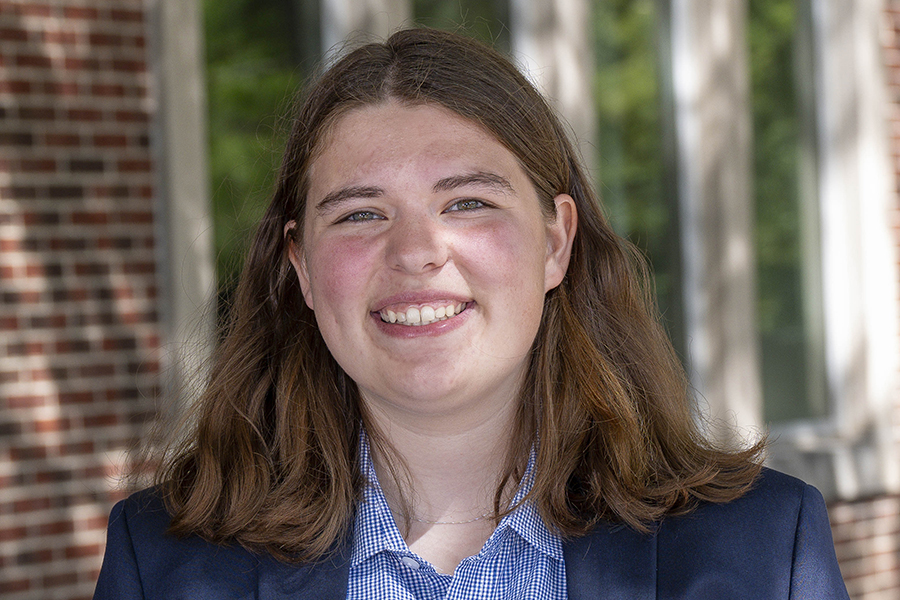
Meg Wentz was done.
The first chemistry exam came back at only 32 percent.
Calculus was hard.
While watching other first-year engineering students excel at Purdue University, Wentz realized she was not prepared for the rigor. She struggled to find a discipline, too. Just when Wentz thought she was sure which major was the destination, she had to pivot.
Imposter syndrome — and all the common refrains associated with it — crept in.
“I don’t think I’m cut out for this.”
“It’s way too hard.”
“I don’t know if I’m going to make it out of these four years.”
Wentz knew she wanted to work in aerospace, specifically with satellites. But the start to her college career left her “down in the dumps.”
What to do?
Transfer out of engineering? Leave Purdue altogether?
Both options were on the table. Until Wentz found champions who altered the course of her Purdue journey. And, ultimately, her life.
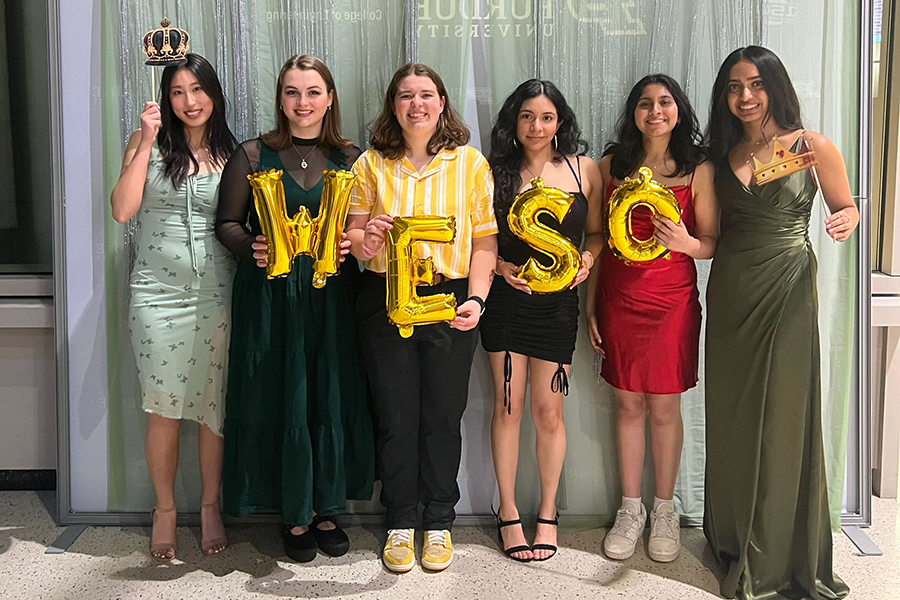
And, seemingly all of a sudden, Wentz had a home in multidisciplinary engineering (MDE), in Purdue’s section of the Society of Women Engineers, with mentors in research and industry.
By September 2025, about two years removed from the anxiety and looming questions, Wentz was on stage in Fowler Hall, standing in front of hundreds of people, talking about “bumpy moments” and underlying that “success is not a linear process” while accepting one of the highest honors for seniors in the College of Engineering. Wentz was selected as a Purdue Engineering Fellow, the first MDE student to receive the distinction since the honor was initiated in 2019.
“It felt awesome. For me, it was more exciting to have MDE represented on a bigger stage. I think we’re forgotten about sometimes,” Wentz said of being selected as a fellow, supported by benefactors Robert H. Buckman (BSChE ’59) and wife Joyce A. Mollerup.
“I’m almost glad (the early struggle) happened because I wouldn’t have stumbled upon MDE without it. It was both a bad thing that I didn’t believe in myself but also in a weird way it was good because it opened the door to MDE, and I’m not sure I would have really deeply considered MDE without it. And I wouldn’t change a bit about being in MDE. It really let me explore all the things I wanted.”
The perfect mix
Naturally when Wentz was at the break-it stage during that first year in engineering, she spoke with her parents about what to do. She spoke with classmates, too, looking for direction and advice. Members of the SWE encouraged Wentz to speak with Beth Holloway, who was the Purdue SWE advisor as well as the Leah H. Jamieson Director of Women in Engineering and a professor of practice in mechanical engineering.
Wentz didn’t know Holloway personally, but Holloway had spoken at a SWEekend event that proved pivotal in Wentz’s decision to attend Purdue. Wentz also had seen communication from the Women in Engineering Program that said, “We are here for you.” And Holloway seemed approachable.
“So I literally was like, ‘OK, I’m going to stop by,’ ” Wentz said.
When she walked into Holloway’s office in the first semester of sophomore year in 2023 and shared the struggle, Wentz cried. And cried. And cried.
“I’m not sure if I want to do engineering, and I also don’t want to leave Purdue. But I don’t know what I’d do here,” Wentz told Holloway.
Holloway reminded Wentz of some of the points of that talk she’d given from years ago: How great a place Purdue Engineering can be, the stepping stone it is, the community that was in engineering.
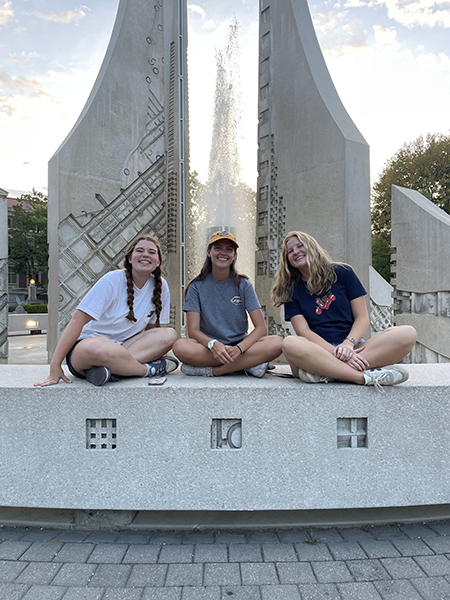
“I didn’t want to lose that,” Wentz said. “The way she talks about the community here, too, and the importance of it and how amazing that is, and you’re not going to find that anywhere else.”
The conversation was influential in determining Wentz’s future.
“She put me along the right path,” Wentz said.
That path was MDE, a major Wentz didn’t know much about until Holloway suggested Wentz reach out to MDE advisor Christine Pekny. Wentz quickly learned MDE would allow her to tailor an academic experience to maximize both personal fulfillment and professional impact.
And, ultimately, excel in ways that left everyone in Wentz’s path struck.
Pekny and MDE professors Justin Hess and Morgan Hynes were impressed seeing Wentz consistently choose courses that challenged her, not for the sake of grades, but for the sake of growth to a career passion.
“The MDE program is at its best when students like Meg capitalize on the interdisciplinary emphasis of the program to take courses aligned with novel career trajectories,” Pekny said in a nomination letter about Wentz’s decision to move on from the initial major she chose after FYE.
With MDE, Wentz was able to explore, without pressure, and enjoy learning the process of learning. That mental shift allowed Wentz to give herself grace. Not getting an “A” didn’t ruin anything. It, actually, was OK.
She took two aeromechanics courses. Admittedly, the grades weren’t the best, but it wasn’t about that. It was about being exposed to a topic she was deeply interested in.
She took an aerospace systems design course, which turned into “the best thing ever.”
She took several programming classes in electrical and computer engineering.
She took three systems engineering classes; several Earth, Atmospheric and Planetary Sciences courses; engineering ethics classes; and, even, a Sports & Feminism course.
“If there was something that sounded interesting to me, I got to take it,” Wentz said. “I pushed myself to take the hard things like aeromechanics that maybe most students wouldn’t willingly take unless they have to take it, but I was like, ‘I want to go learn about this, so I’m going to sign up and go do it.’
“I learned I do really well in actual applied settings and working and that goes with the internships as well. I may not thrive in the academic let’s-sit-down-and-take-a-test setting but in a project-based classes, I explode with it’s awesome and excel and get things done.”
Application, maybe at its best, has come in the form of Wentz’s senior design project: an educational CubeSat for kids.
As she starts to describe the project, Wentz’s demeanor changes.
She’s giddy.
Her face scrunches as a smile widens and out comes the cell phone. Photos must be shown.
The first prototype is an Arduino with various sensors and mission capabilities like temperature, pressure, humidity, gas resistance, position, force and light sensing.
Four times in 20 seconds, Wentz uses the word “cool” to describe the prototype and the experience that it’ll provide.
“Just knowing this is going to help kids and just change people’s understanding and get people more exposed to space exploration and engineering, that just excites me so deeply. I love it,” Wentz said.
She keeps going.
“The idea would be they could do all of this and this would be a mission for earth atmospheric science and gathering data. We’re building in different missions they can plug in and unplug. It’s really cool. I love it,” said Wentz, the smile not fading. “We’re trying to keep it super low cost. We’re going to launch ours on weather balloons so any kid can do it. … It’s so cool what you can do with a weather balloon, and weather balloons aren’t even that expensive.”
Anything related to satellites gets Wentz chattering.
“I know what we’re doing here at Purdue and the opportunities I have, have the potential to change our understanding of the world, and there’s so much excitement on campus, that excites me, too,” Wentz said. “When I was working at L3 this summer, I would wake up so excited to go to work. It’d be Sunday, and I’m like, ‘I cannot wait for Monday.’ This is awesome. I just love knowing, especially when I was at work, touching hardware, working on stuff and being like, ‘This is going to go to space, I touched it. This is so cool.’
“Same thing here at school, with my independent studies.”
That kind of excitement isn’t reserved for research, though.
Digging in
Brock Shipley always wore Purdue gear and had signs on his walls. Even though he’d landed at a high school in North Carolina, leading a STEM team and teaching engineering, a Purdue engineer always represents the alma mater. Shipley wasn’t pushy at all, but seeing Boilermakers was enough to pique Wentz’s interest.
When Wentz started exploring colleges, Purdue made the list alongside closer options like the University of North Carolina and N.C. State. A visit to West Lafayette followed. And a follow-up visit for SWEekend, one of Purdue SWE’s signature events that pairs prospective high school seniors with current SWE students over two days.
At the event, Wentz heard Holloway’s talk about the “10 reasons to pick Purdue Engineering.” Each one resonated.
Wentz and her parents hit up AJ’s for lunch, and “right then and there, I decided, ‘I am coming to Purdue.’”
“I always say SWE is what got me here and what kept me here,” Wentz said. “I could have (transferred) back home (during sophomore year), but I remember thinking their SWE section won’t be the same. I could not leave because I loved these people and the programming.
“I talk to a lot of other SWE presidents and SWE people across the nation, they’re all doing amazing things. But it’s not the same. There’s just a little magic about Purdue’s section. I love it.”
If possible, that love only grew over the years in West Lafayette.
As a first-year student, Wentz was an active general member of SWE’s outreach pillar, volunteering at more than 10 events, immediately solidifying her commitment. By the end of the year, she had been selected as “most involved outreach member.”
As a sophomore, Wentz still was a consistent presence in SWE, working as outreach committee chair and leading bi-weekly meetings for the outreach committee’s 30 members to develop innovative solutions for STEM outreach. She planned and executed two outreach events that served more than 50 students and managed a pen pal program with 88 total students.
As a junior, Wentz moved to outreach director and developed a new role to facilitate stronger connections with local schools that led to 16 new connections within the community. She helped lead the largest outreach event in recent SWE history — a 70th birthday “tea party” that included nearly 100 K-8 students.
That year also is when Wentz pursue the SWE Leadership Development Program (LDP), a competitive nine-month initiative that cultivated leadership competencies among emerging STEM professionals. Wentz earned recognition from the SWE Advance Learning Center for successfully completing all program components, an achievement that reflected discipline and dedication to professional growth.
“As the FY25 coordinator for the program, I had the opportunity to observe Meg’s growth, reflection and initiative firsthand,” Amanda Stone said in a nomination letter. “She distinguished herself early as a standout participant by consistently attending live sessions, engaging thoughtfully with peers and submitting reflective follow-ups based on both personal insight and leadership maturity.”
By the last semester of junior year, Wentz was intent to pursue PSWE’s presidency. To do so, she had to give a presentation that included information about herself, what she envisioned for PSWE and, essentially, why members should vote for her.
Two slides were filled with bullet points of everything Wentz had done in SWE up to that point. (One said “Grand Prix team mom.”) She was honest about the first-year struggles and how SWE, in part, kept her from dropping out of Purdue. She was open about wanting to build on the community SWE already had. She talked about initiatives that were rooted in helping each other, the community and beyond.
“Meg’s presentation was real and genuine — so genuinely her,” Holloway said. “She is just real. That’s one thing I’ve always appreciated about Meg. She has a passion for SWE that is so strong. So, so strong. For the organization. She buys into the mission, of course, but that org for her I think is one of the most important parts about her campus experience and has been.
“She has a servant leader heart. Just the genuineness of wanting to do everything she can to continue to build the community is really what I appreciate so much about Meg.”
Even Wentz wanting to run for president was rooted in love for SWE.
“I almost felt like I owed it to SWE in a way to lead because it had such a deep impact on my life. I wanted to be that extra little bit more involved,” Wentz said. “I so deeply loved our organization, I wanted to help lead us in the right direction and keep us on this really strong path we’d been headed down with past leadership. I owed it to myself and the org to just put myself out there and try.”
Mission accomplished.
In 2025-26 with Wentz as president, SWE started an EV Grand Prix team and worked closely with the newly created graduate SWE section to discuss strategic planning, long-term sustainability and ensure cross-organizational collaboration.
“From Day 1, Meg has embodied the core values and vision of SWE through her professional actions and unwavering commitment to outreach and community impact,” SWE outreach director Hailey Benfield wrote in Wentz’s nomination letter for Purdue Engineering Fellows. “In each role, she has not only accomplished what was expected of her but always brought new ideas to the table.
“She has left an expansive mark on the Purdue Engineering community, which will undoubtedly extend well beyond her years here on campus.”