Engineering Fellow Estrella broke new ground in MSE research
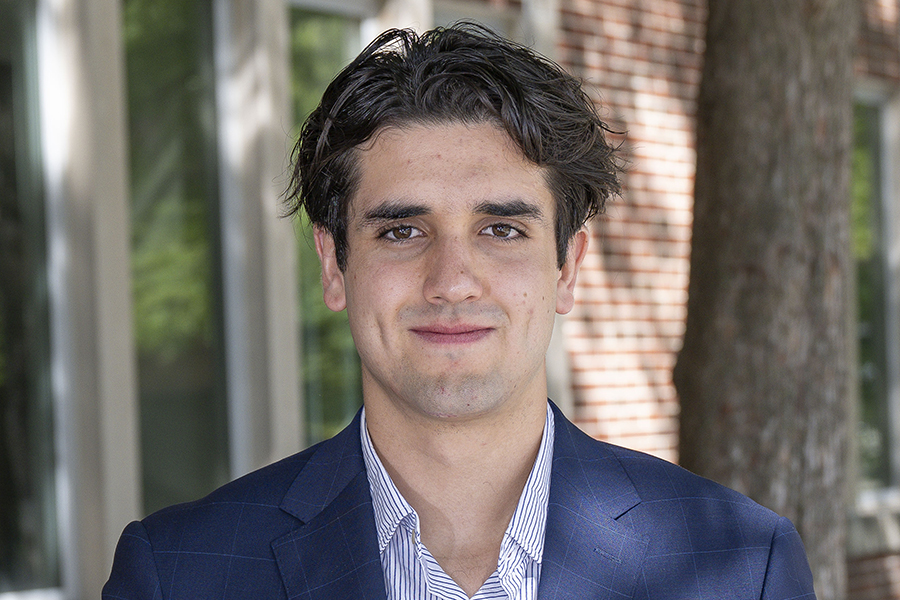
David Estrella had always been interested in the micro-scale of engineering. Materials engineering was the perfect fit, especially at Purdue University.
But he would have to talk to someone about it — probably in English.
Moving to West Lafayette, Indiana, to attend Purdue in fall 2022 was Estrella’s first long-term stay outside of his hometown of Monterrey, Mexico, and he was afraid.
Afraid he wouldn’t find a place at Purdue.
Afraid he’d miss home.
Afraid he'd get lost on campus, or fail a class, or be too confused by American culture.
Estrella just would have to take one small step at a time, a daily act of bravery.
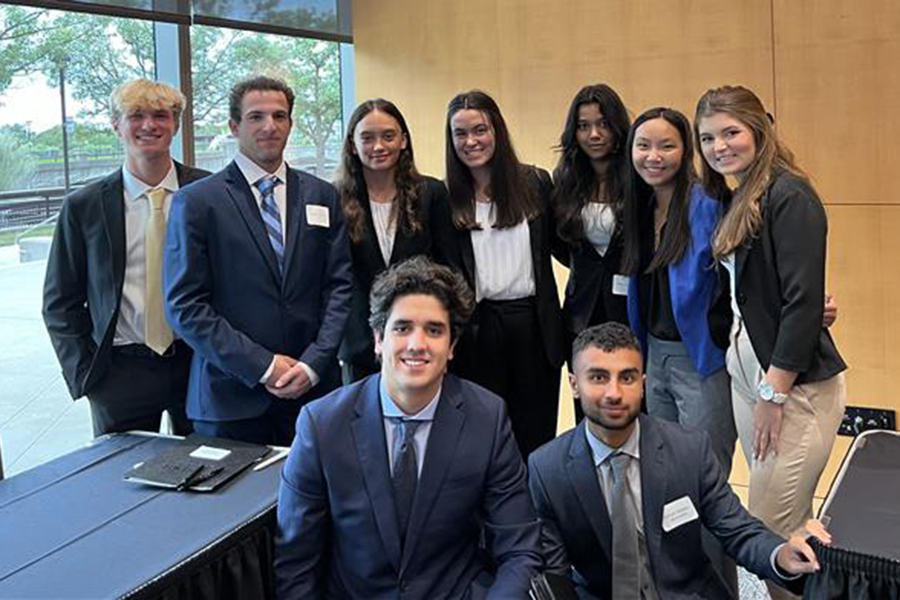
For the next four years, Estrella’s courage formed him into a member of the seventh cohort of Purdue Engineering Fellows, nominated by peers and mentors as “the best of the best” Purdue Engineering has to offer. The award, comprised of a plaque and $25,000 after graduation, is made possible through the generosity of Robert H. Buckman (BSChE ’59) and Joyce A. Mollerup.
Estrella wishes he could have learned sooner that there was nothing to fear. It took him nearly two years to learn that lesson, but the desire to learn and grow inspired him to finally seek out a mentor and the research he had come to Purdue for.
“I was a soldier ready for battle, and I needed a general,” Estrella said with a smile.
To find a mentor in materials engineering — in addition to a packed schedule and double minors in mathematics and physics — certainly meant Estrella would stretch his English, which was mostly learned through media and listening to peers at Purdue. But his first meeting with materials engineering professor R. Edwin García wouldn’t be in English like he anticipated.
It was his first — and only — professional meeting in Spanish.
Estrella admittedly was nervous to talk to García. From what Estrella had learned about the professor from a materials engineering academic advisor, García was “the real deal” among materials engineering researchers.
“(García) gave me a test to see what I could do, and it went well from there,” Estrella said.
The test was an unsolved Monte Carlo algorithm, a computational method that relies on random sampling to generate probabilities. It was a graduate-level test, and Estrella passed.
According to Garcia, multiple graduate students had tried to solve the algorithm for 15 years. He watched Estrella solve it in one week as a researcher.
After nearly two years and four co-authored papers — a feat nearly unheard of for undergraduate students — Estrella earned García’s admiration and a personal nomination for the Purdue Engineering Fellows in spring 2025. García’s nomination spoke to Estrella’s groundbreaking impact in the field of granular science for energy materials and true friendship with García and his team.
“In the 20 years of experience that I have as a professor of materials engineering at Purdue University, I have never met a student as creative, talented, charismatic and nice as Mr. David Estrella,” García wrote in the nomination.
A recipe for research
Estrella thought he was meant to do something profound since childhood. He also loved answering the fundamental “whys” through research, investigating questions as far as he could, even if a question was not yet answerable.
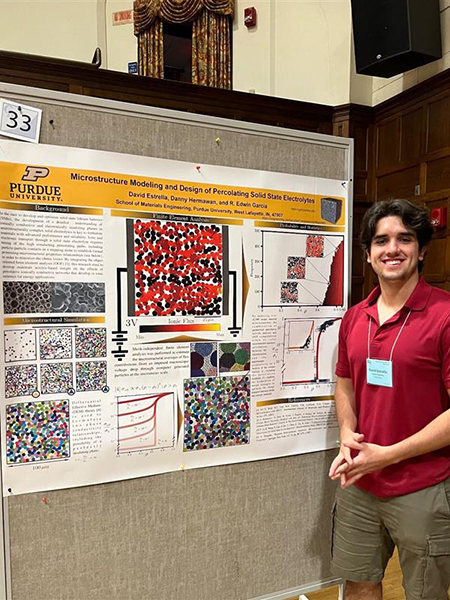
It was a part of Estrella’s future, he deduced, to make the unknown known through research at the nanoscopic level. To create and thrive in a materials engineering career, Estrella had two major pathways: being an experimentalist or being a modeler.
Initially, he thought experimentalist. So he dove into a project with Allegheny Technologies Incorporated, studying the behavior and curvature properties of titanium alloy ATI Titan 23 in heat treatment. In 2023, he also researched and created a biodegradable straw as part of a First Time Researcher Fellowship experience.
“An experimentalist is like a chef,” Estrella said. “They become an expert at a recipe that they create. They understand how to make it and how to change it, but not every single detail about how something comes together.”
Estrella’s introduction to García led him to pivot. Materials engineering, combined with his double minors, pointed Estrella to computational modeling. He phased out of experimental research and into a more relevant project in 2024.
The impact was immediate.
“The few (students) that make it (into research) tend to contribute a small step that eventually sees itself as part of a graduate student project,” García wrote. “In contrast, David ... moved on to apply (the Monte Carlo algorithm) to derive a brand new theory of multi-ionic charge transport in two-phase granular structures by starting from simple elements of percolation theory.
“By itself, this makes Mr. Estrella an outstanding student. However, for David, this is just one more day at school.”
Computational modeling was exactly what Estrella had hoped it would be. He had to understand every bit of the process to recreate any recipe that came his way, something Estrella wanted out of materials engineering. Estrella eagerly anticipated being in the lab, even when he was exhausted from a schedule packed with engineering, mathematics and physics classes.
Of the three materials engineering research avenues — metals, polymers and ceramics — Estrella dove into ceramics and never looked back. Estrella’s research with García began in January 2024 with Python-based 2D and 3D modeling of microstructures’ behaviors, qualities and potential design uses.
Estrella is one of a handful of undergraduate students to be a part of García’s teams in 20 years, and it’s a spot in which he thrives. His creative approach to modeling and well-thought answers to research questions quickly gained respect of the graduate students and professional researchers he worked with. Estrella’s forward thinking led him to become lead on the resubmission of a paper after fielding and answering questions in a one-hour rebuttal meeting about the potential issues in the presented research.
On top of the leadership Estrella took within research teams, he found time to mentor other undergraduate researchers. And he was happy to do it, all through his own initiative.
“It is a pleasure to stand back and see David interact with students and professors,” García wrote. “I can frankly say that he is the most intellectually mature student I have ever had, and one of the most capable ones.”
All four of the high-impact research papers Estrella has co-authored — and four of six presentations and guest-speaking occasions — come from his studies with García. Estrella’s warmth and genuine humility is an asset that makes the research compelling and the team inspiring.
In addition to on-campus research, Estrella also works for the Office of Naval Research, modeling flash sintering — putting high pressure on powders to form a device part — for elemental nanocomposites. He works in a similar role as a paid researcher for the Idaho National Laboratory.
Estrella is constantly busy, and has been since 2023, but he has enjoyed every minute of long days in the lab and running (and often rerunning) data.
“I came (to Purdue) with the perspective that there are different times in life,” Estrella said. “There were going to be a few semesters that I would be under more stress than normal, and that was just part of college. Having a long plan was very helpful, because when I was going to face something very tough, something that would require a lot of focus, I knew I would have another semester where I could have more fun. Like the one I’m having right now.”
In his free time, which Estrella intentionally carves out of his busy schedule, he plays chess with his friends and takes song requests on the guitar. He is learning to enjoy life without worrying about future coursework or research — even though both are things he enjoys as well.
Estrella’s social net is large and active, even though he has an overbooked class schedule. He's even still friends with his first randomly assigned roommate.
“My first roommate brought me home for Thanksgiving my first year, and he’s had me back at his house every year since,” Estrella said. “I feel like I have a home here now. I’m grateful I was received with open arms.”
The next big steps
Estrella is “proud, elated and honored” to be recognized as a Purdue Engineering Fellow.
“Purdue will give you back what you put in it,” Estrella said. “All the work I’ve put in has been reciprocated. I kept asking for challenges and they kept providing.”
He is heading to graduate school to study materials engineering. Purdue is an option, but he’ll know where once he receives offers. After graduating in May 2026 — as many family members as possible plan to attend — Estrella plans to take a brief trip home.
But in case there aren’t enough tickets to go around, Estrella will be sure to visit while home before graduate school, supporting the nonprofit QSEFMG (Que Se Escuche Fuerte mi Grito, or, “Let my cry be heard loudly”) National Suicide-Prevention NGO that he co-founded with his mother, Mayte Herrera.
The organization, founded in 2022 after the loss of Estrella’s brother, offers mental health and suicide prevention resources and community to millions of young people across Latin America, North America and Europe. QSEFMG offers ongoing conferences, both in-person and through online forums, so passionate parents, mentors and affected teens and young adults can learn and apply their skills to save lives.
It costs a lot to maintain these partnerships. Which is why Estrella plans to use most of the $25,000 award to fully cover the costs of a QSEFMG event.
“(QSEFMG) is new, and I want to invite representatives from all over Mexico to come and learn about what we do,” Estrella said. “What we do is big. My mom fully took the reins when I went to college and has made it what it is. So it would feel great to be able to sponsor it, to pay for all of it, and teach more people about empathy and mental health.”