First-year engineering students take first dive into engineering with design competition
Need a fire to be extinguished, even when you’re not home?
How about an electromechanical wheelchair mount?
Or notification of an available study space, right when you need it?
The first-year engineering (FYE) design competition at Purdue University encourages students to ask these questions, collect data and prepare solutions to everyday problems of all sizes. The competition on April 11 gave students the chance to communicate their innovations and ideas to a panel of 20 judges and gain experience presenting in front of an audience.
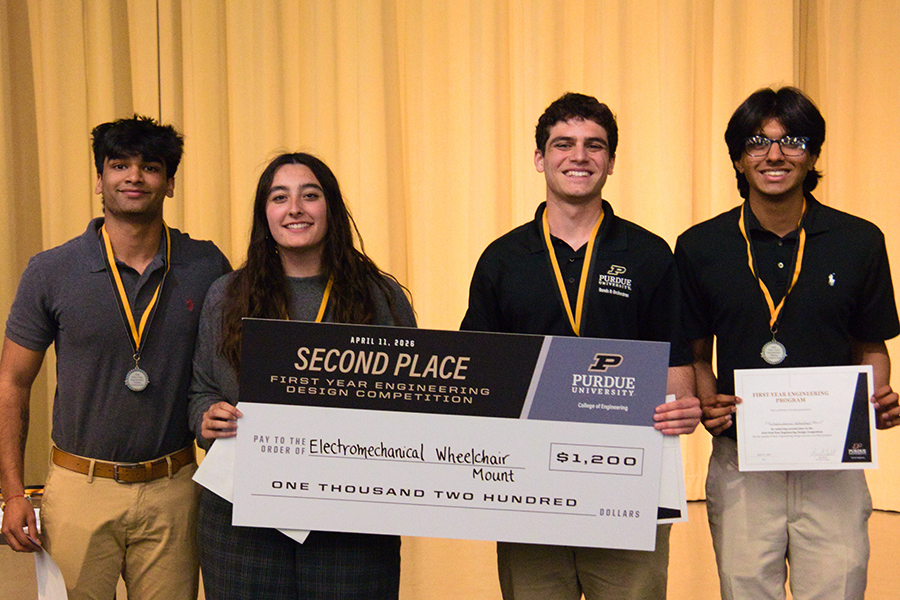
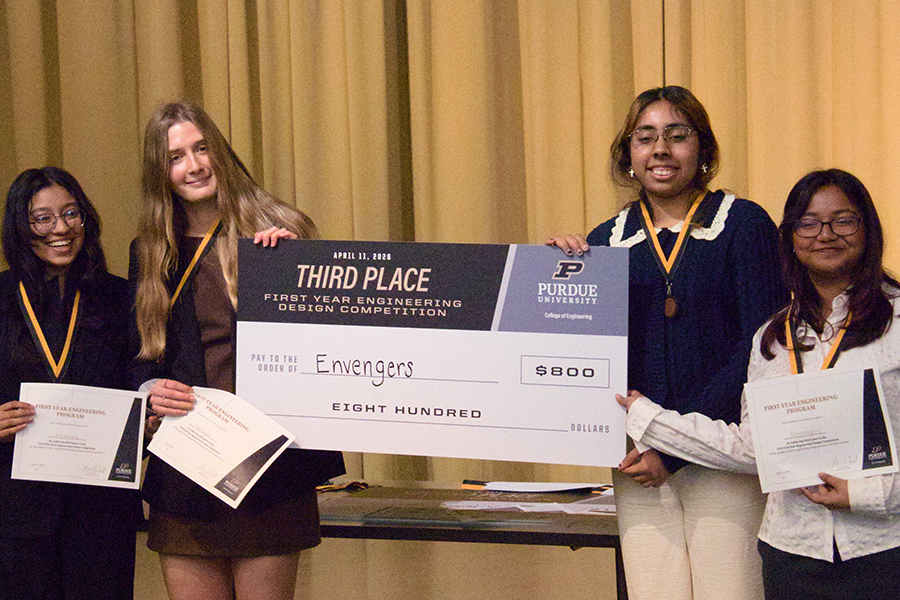
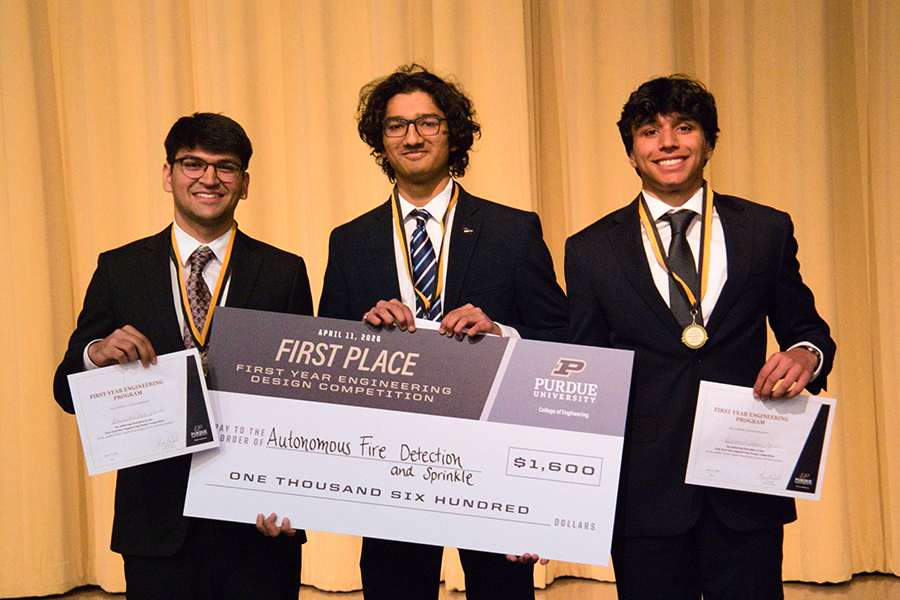
Three teams also walked away with cash.
“At its core, the FYE design competition is about helping students begin to think and act like engineers,” said Mac McFall, senior FYE lecturer. “It’s one of the first opportunities students have to move beyond structured assignments and experience what engineering work actually feels like.”
The design competition process mirrors the process of designing and pitching an engineering project, building directly from FYE coursework. Students in every FYE pathway in West Lafayette completed a design project — and competed.
First-year students assembled teams and defined a problem, with scopes varying from energy conservation to infrastructure to extending small desks in university lecture halls. Teams established criteria and constraints to inform potential engineering solutions to pursue.
Competition results had no effect on final course grades. The experience is designed to let students take risks and try creative solutions without worrying about performance pressures.
Over the course of the spring 2026 semester, students collected real-world data through data banks and surveys and analyzed their work through prototypes and experimentation. They worked under time and resource constraints with a basis in data and intuition. And students needed to communicate their ideas and process to judges and educators who are both engineers and non-engineering professionals.
The competition was optional and completed in two rounds. In March 2026, students uploaded video pitches and a formal report for evaluation by a digital panel of judges. The top teams advanced to the second round: the in-person presentations on April 11.
Student teams presented to a panel of 15-20 external judges, answered questions and anticipated future uses of their prototypes. Students who were judged as the top projects presented a second time and competed for top prizes, including cash awarded to the top three teams by the College of Engineering. The competition was sponsored by Texas Instruments and Mathworks.
The top three teams of the 2026 FYE design competition (in order of finish): automated fire detection and extinguishing system (Mihir Banka, Darsh Patel and Jaswant Singh), electromechanical wheelchair mount (Param Khatri, Dhruv Mehta, Aiden Taheri and Marina Xanthopoulos) and real-time study space tracking site BoilerLocked (Quazi Arisha Mahmud, Stefanie Giurcanu, Samin Sanjana and Alekhya Siragavarapu).
Winning teams weren’t necessarily the ones with the coolest or most cutting-edge idea, McFall noted. They were the ones who could develop an idea, document process, present feasible solutions with data-backed justification and defend ideas and reasoning.
“For many students, this is their first experience seeing how their ideas compare to others across the entire engineering program and presenting their work to external judges,” McFall said. “The competition creates a moment where first-year students begin to see themselves not just as learners, but as emerging engineers.”