First-Year Engineering Program courses prepare students for engineering careers
How can you use two micro:bit computers to solve a huge problem?
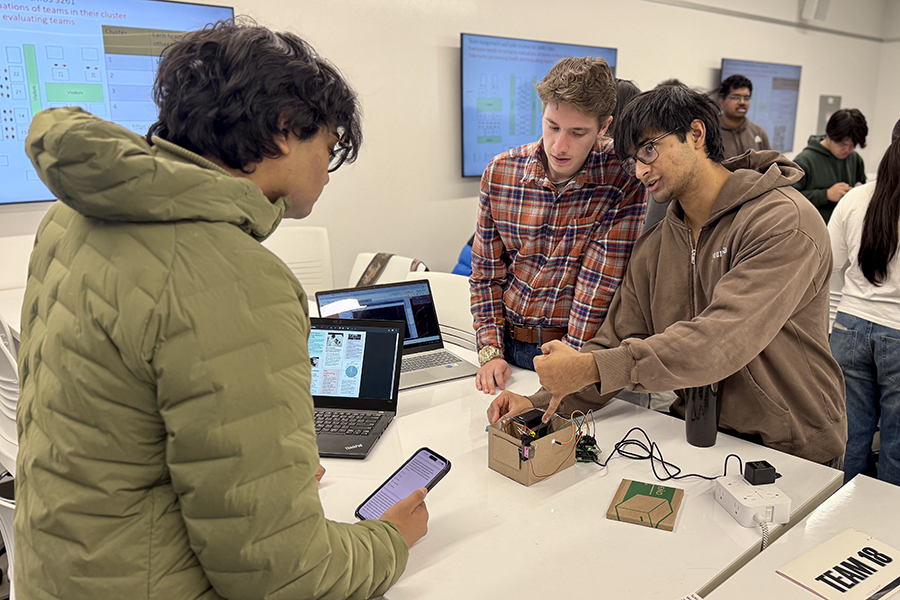
That’s the question Purdue University engineering students in ENGR 13000 (Transforming Ideas to Innovation) answered with the smart device design project. Teams presented their research, designs and an alpha prototype in the annual Technology Fair in November 2025. This year, the showcase was held on Nov. 17 in Lambertus Hall and allowed students in the section to learn about and review each other’s innovations.
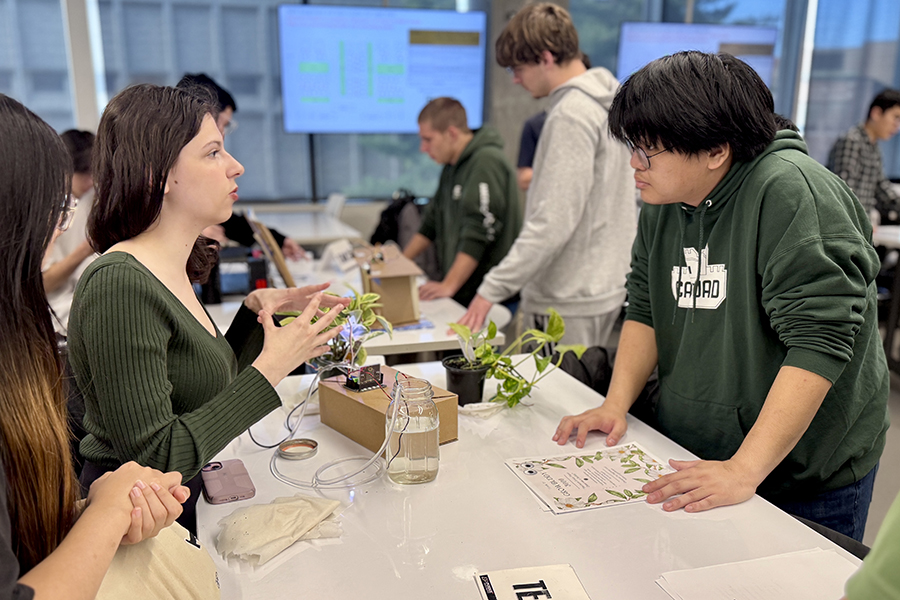
Teams pitched their smart device to peers using visual aids, such as flyers for fictional companies, and the alpha prototype of the concept for demonstration. The smart device project — and all of those in ENGR 130 — develop students’ skills in design, computation, teamwork, project management, logical reasoning, sustainability, and presenting their ideas in oral presentations or written reports.
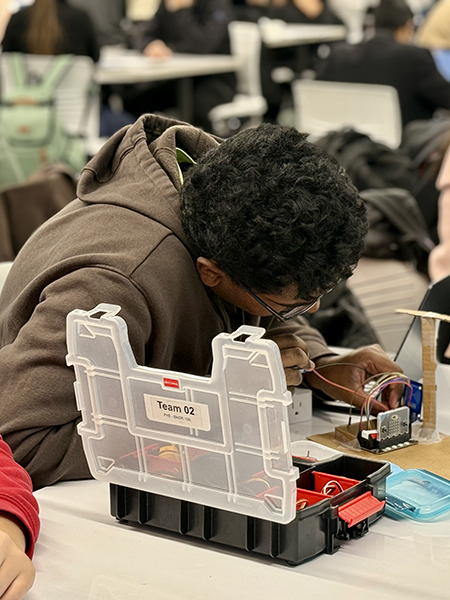
“The smart device project is what’s called a ‘no floor, no ceiling’ project,” said Sean Brophy, an associate professor in engineering education who teaches the course. “The micro:bits provide quick access to understanding microcontrollers and electronics, which makes it easy for all students to contribute. Students with more experience can take an advanced approach to their design to increase its scope and functionality. Some even use Raspberry PIs to include AI applications or internet connectivity. There are no limits.”
ENGR 130 is an introductory required course. But not all students in the course are first-year students at Purdue.
Eric Vasser and his team, called Elder Watch, transitioned into the College of Engineering from other disciplines and were already within engineering majors. Vasser changed from biology to biological engineering over the summer.
“The creativity in engineering was an avenue I liked a lot,” Vasser said. “I joined a club through the Department of Agricultural and Biological Engineering and learned more from students in the program. I was really interested.”
The Elder Watch team shared similar stories and agreed to take the smart device task one step further. The team created a motion-sensing camera that was coded with a Raspberry Pi to send email alerts if a person captured on camera doesn’t move for a length of time.
“There are a lot a lot of elderly people living alone, and the younger (family members) working in a far place, especially in Asian countries,” said Sieun Park, who transferred into civil engineering. “There are a lot of cases where (the elderly family members) die a lonely death. We want to prevent that and let them see someone, or talk to someone, while help is on the way or before they die. This technology could save a life or allow for an emotional exchange with other people.”
Another project, presented across the room, tackled the issue of disrupted circadian rhythms with a unique take on the smart device design project.
The LumenWake team, comprised of four first-year engineering students, noted that the United States loses about $411 billion dollars annually to sleep-related issues and incidents, part of which the team deduced was due to alarms disrupting circadian rhythms. So, they used the two micro:bits to create a wireless remote communication system that would act like an alarm, except instead of noise, it would raise the lights like a sunrise — and raise the temperature of a user’s bed.
“The lights help you with your circadian rhythm, because when it’s light outside, you’re going to be awake,” Arnot Heller, a team member, said. “The warmth and light decrease sleep inertia when you wake up in the morning, which is basically grogginess.”
All student projects gave two presentations within the same week. The first was a product pitch to a general audience on Nov 17. The second was a formal presentation on Nov. 21 to technology teams, their peers), to explain their design rationale and provide evidence their design met its goals.
“A large part of engineering is being able to tell all of your audience, engineers and not, what you’re doing and why it’s important,” Brophy said. “Many teams this year proposed ventures that haven’t been explored by classes before and it’s exciting to watch.”