

A small Washington-based startup, founded by two Purdue alumnae, hopes to be the first organization to ever test a rotating detonation rocket engine (RDRE) in space. The company, Juno Propulsion, won a NASA TechLeap Prize worth up to $500,000 to further develop their engine design, culminating in a NASA-funded flight test later in 2026.
“We’re going to build the full propulsion system — everything from tankage to fuel delivery, to thruster and controller,” says co-founder and CEO Alexis Harroun (MSAAE ’19, PhD AAE ’23). “Obviously the thruster is the secret sauce, and we’re putting in all the experience we got at Zucrow into building this.”
Harroun and co-founder Ari Martinez (BSAAE ‘17, MSAAE ‘19, PhD AAE ‘23) both studied under Purdue’s propulsion legend Steve Heister. Harroun was also named to Aviation Week Network’s 20 Twenties list in 2019. "I’m thrilled that my students are able to further their doctoral work in this detonative propulsion technology. We do feel that these types of systems will first appear in space propulsion applications," Heister says.
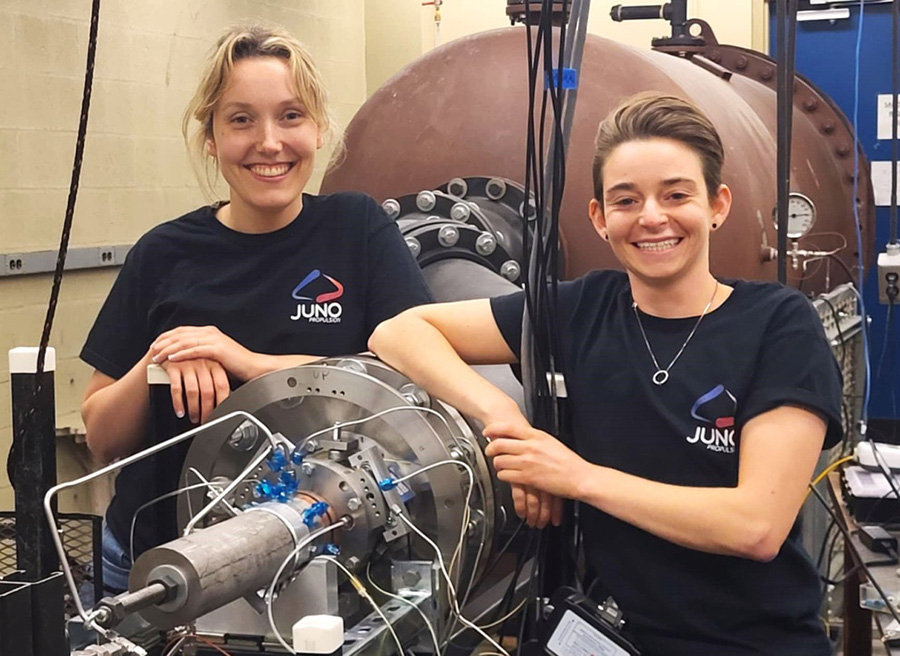
The co-founders of Juno Propulsion, Alexis Harroun (left) and Ari Martinez (right), both of whom are graduates of Purdue University.
Thanks in part to research and collaborations between NASA and Purdue, practical RDRE applications are closer than ever. Martinez’s PhD work at Purdue included designing and testing a liquid-cooled RDRE, with critical components 3D-printed by NASA. “Ari’s experience with additive manufacturing has been a really big piece of our product development,” Harroun says.
Juno Propulsion’s design uses nitrous oxide and ethane as fuel to create a rotating detonation wave. They expect to achieve specific impulses 5% to 10% greater than traditional rocket engines of the same size, according to Harroun. Smaller engines give space vehicles more capacity for cargo and fuel.
If it proves viable, the company’s engine may allow companies to wean themselves off toxic hydrazine fuels, are dangerous and costly to handle.
“There are other non toxic [and] green solutions on the market, but because they’re not using a performance-enhancing tech like ours, they’re not going to be able to compete performance-wise,” Harroun told Payload. “We’re trying to bridge that gap.”
The current highest-altitude test for an RDRE was by a JAXA sounding rocket on a suborbital trajectory, launched in July 2021. In 2023, NASA’s Marshall Space Flight Center conducted a long-duration ground test of a full-scale RDRE. Juno Propulsion would be the first US-based entity to test an RDRE in space and the first ever to fly one on-orbit.
Juno’s long-term vision is to build a suite of engines for different use cases, beginning with in-space prop systems, and graduating to rocket engines down the line. They expect to have the capacity to produce as many as 10 engines in 2027, and dozens more the year after.
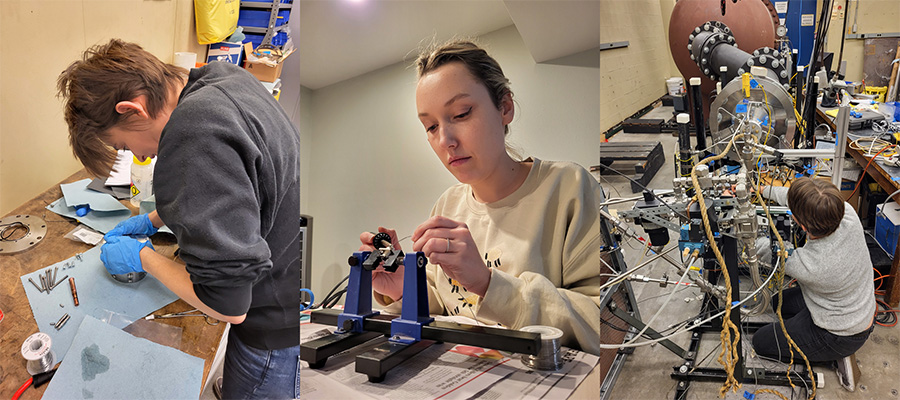
Members of Juno Propulsion can be seen hard at work developing and building the parts of their propulsion system.
The small team, which has included other Purdue interns and employees, is collaborating with the University of Washington on this project. They also earned funding for rotating detonation engine research through the NSF Small Business Innovation Research (SBIR) and Washington state’s JCATI grants program, and have done other product development work with NASA Marshall.
Harroun is thrilled to earn this grant and have the opportunity to send something to space.
“We went to Yellowstone recently with some of our Purdue grad school friends — and when the stars came out at night and we saw satellites orbiting, I was like, ‘Oh my god, we’re gonna be doing that! That’s crazy!’” Harroun says.
