ENGR 296 students engage with cultural impact during spring break abroad experience
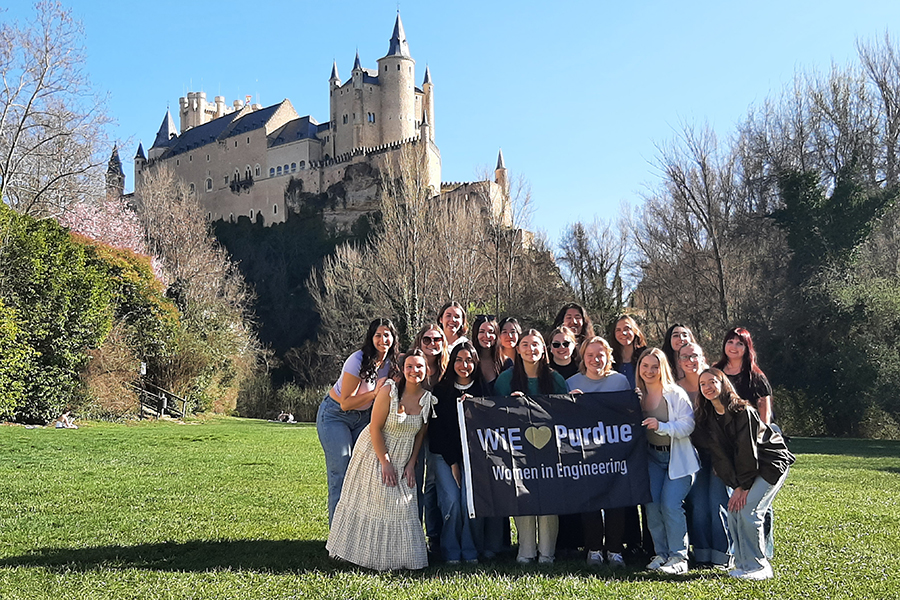
The Gender in the World (ENGR 29600) course focuses on discussion about gender dynamics — the relationship and interactions between and among people, based on gender — in the STEM fields. Over spring break, the students travel abroad to immerse themselves in other cultures and explore international engineering feats to gain a broader view of engineering outside of the U.S.
For first-year engineering (FYE) student Dana Abbring, her broadened view came from meeting an American engineer in the streets of Paris.
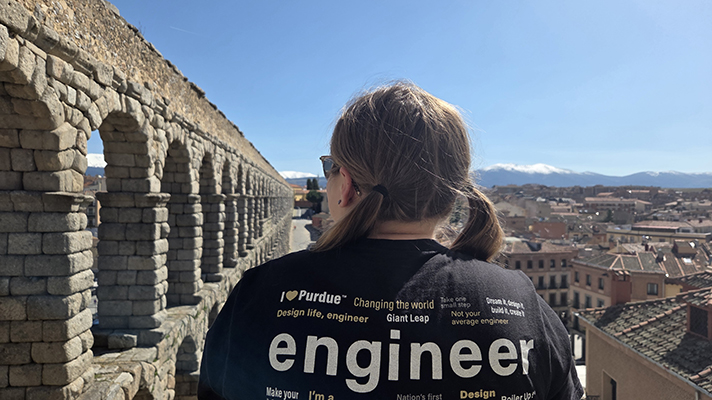
Thanks to the Women in Engineering (WiE) Program T-shirt Abbring was wearing that had “engineer” emblazoned across the back. It was a delight to Abbring to meet someone living what was becoming a dream: traveling across the world for engineering.
The abroad portion of the course examined the impact of engineers and engineering within art, architecture and cultural construction in Spain and France. Where, like Abbring, students could be inspired by their predecessors — and challenge their own thoughts about life abroad firsthand.
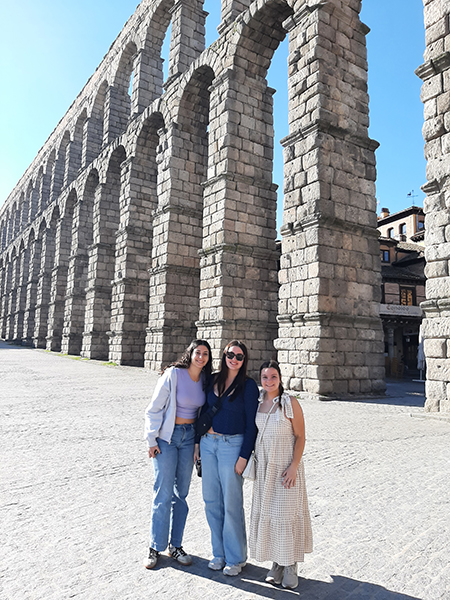
Abbring’s international travel with Purdue — first a trip with Global Leadership in Peru in summer 2025, then the abroad experience with ENGR 296 — has led her to aqueducts. Marvels of engineering, in both South America and Europe, ancient civilizations constructed aqueducts without mortar and without modern convenience.
They’re still standing thousands of years later.
For Abbring, being at the foot of the behemoth feats of engineering was in stark contrast to the phone she took photos on, which would need replaced in two or three years.
“When we think of sustainability, we don’t think about how things are purposely engineered to turn a profit rather than to actually fix problems or last,” Abbring said. “Seeing these aqueducts that were just rocks laid together well, that’s lasted all this time, inspires me to make things that persevere.”
Standing beneath the aqueducts continued to affirm for Abbring that she wants to be a leader in creating long-lasting solutions. Whether in chemical or materials engineering, Abbring hasn’t decided yet. She’s passionate about the makeup of things — on a molecular or atomic level especially — which brought her to Purdue, and to an Access Alum event where a representative of General Mills explained how both disciplines apply in the food industry.
“It could be my whole job one day to figure out how something that research and development creates can be scaled up in quantity without losing nutrition or quality,” Abbring said. “And I can do that in chemical or materials.”
An alleyway of engineers
Visiting the aqueducts was also an awe-inspiring moment for electrical engineering senior Evelyn McCarthy, whose experience with ENGR 296 was her first time abroad. What compounded her inspiration were the walking tours the group participated in throughout the weeklong abroad experience. Some tours touched on the experiences of scientists who’ve made major timeless impacts on society, like Marie Curie and Beatriz Galindo. Other tours contrasted efficiency versus longevity in infrastructure as the group wandered through back alleys and side roads.
“I saw from our walking tours how there have always been obstacles for success, but even as far back as the first century they have worked to overcome these barriers,” McCarthy said. “It was amazing to learn their stories of perseverance that I can apply to my own future challenges.”
One future challenge that McCarthy plans to overcome before going abroad again: learning the language. Any language, actually.
The group traveled to large cities that had substantial English-speaking populations. Plus, McCarthy had some basic Spanish in her lexicon. But when it came to French, even reading the menu was shockingly difficult. The fact that she needed much more language proficiency to feel comfortable in other countries, especially when asking for directions and ordering food, meant that McCarthy came back to West Lafayette with the goal to pick up some French — and some more Spanish.
First steps abroad
Lillian Wrin brought good walking shoes. She would not be caught unaware of how much walking there was to do in Europe. It would be easy-peasy to keep up with the rest of the group and the French tour guide.
So when the group’s regular pace was more of a promenade and less of a jog, Wrin was surprised. She had expected them to move like the fast-paced nature of college. But, as she quickly learned, Spain and France were in no rush to go anywhere.
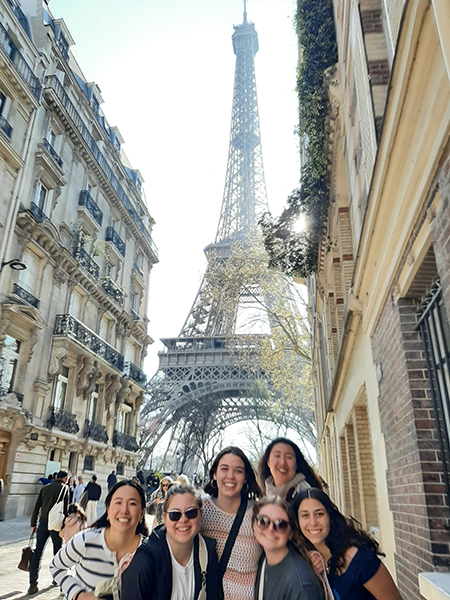
“In the U.S., we want everything to be as efficient and as fast as possible, but (in Europe) we might look like lunatics at that pace,” said Wrin, currently in FYE. “In Spain and France, walking is slow and talkative; their dining is slow and social; and their nightlife starts very late. Everything there is so much smaller and more intentional. I think that it is very beautiful.”
The slower pace let Wrin not only see the sights, but absorb them. As the tour guide described how a building was decaying because it was built with wood for cost efficiency, Wrin was still long enough to see the building’s sag, the seams where wood sat against the stone foundation and could even tell when a building had recently been refurbished with fresh wood or plaster. She could study the metro maps and really take in the narrow streets, the way they connected towns like webs rather than addendums.
“Seeing how thoughtfully everything was designed to support millions every day made me realize engineering directly impacts quality of life,” said Wrin, whose engineering interests lie in nuclear engineering. “That was when I started to see myself as someone who could contribute to making solutions for quality problems.”
Being able to see herself as a problem-solver was a big challenge to Wrin. Mostly, that growing up she hadn’t seen many engineers like her in textbooks, classes or TV. But being surrounded by striving engineers — especially abroad, where many navigated traveling without their families for the first time — suddenly gave Wrin a constant stream of inspiration.
“Being in ENGR 296 made me more aware of how important visibility and support systems are, and it’s something I now really value being a part of,” Wrin said.