Purdue Engineering alum Markey's passion, dedication lead Engineering Student Success program
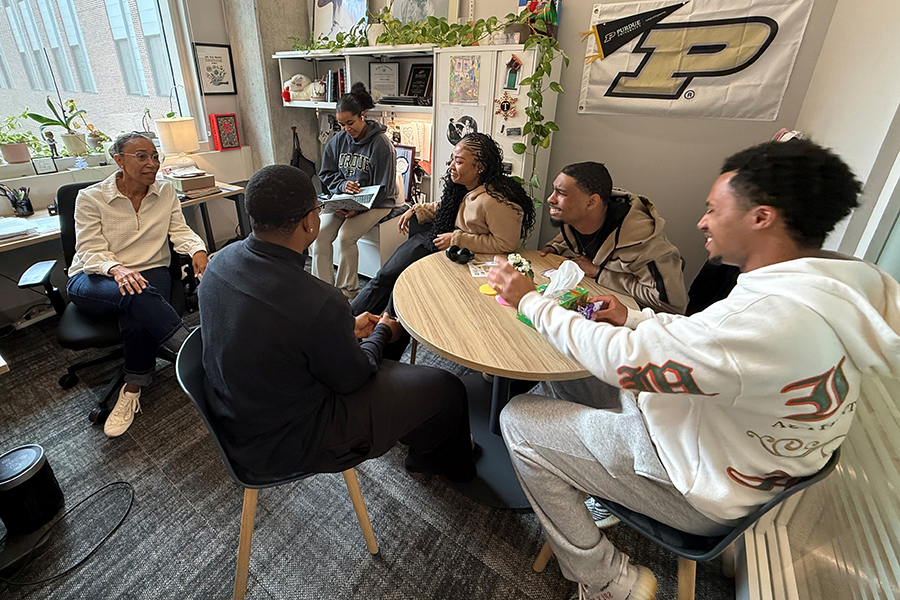
The sliding door is open as much as possible.
Tamara Markey wants it to be.
Students filter in and out of the office in Lambertus Hall on Purdue University’s campus in West Lafayette, needing advice, needing to vent, needing a hug, needing to cry, needing encouragement.
Is being a pseudo counselor, a mentor, a sounding board or a mother figure listed in Markey’s job description as director of the new Engineering Student Success (ESS) program?
Nope.
And does having students regularly crowd her office, taking up both seats at a small round table upon entry, sometimes even taking the cushy chair by her desk, allow Markey appropriate time to get a fledging program started, with the administrative requirements, alumni connections and clarity-offering conversations?
Nope.
But Markey does it anyway.
How can she not?
When Markey was a student at Purdue in the early 1990s, she watched Minority Engineering Program groundbreaking director Marion Williamson Blalock, a powerhouse personality, do the same for students. The same as Virginia Booth Womack, the MEP director who followed Blalock, another larger-than-life figure, did.
The legacy of care, the legacy of attention, the legacy of retention, the legacy of impact.
Exactly as Markey hoped for ESS.
“I really want the students to experience everything that I experienced — the family, the community, the academic help, and even beyond help with particular classes, just seeing students who look like you struggle and yet persevere and graduate,” said Markey, who received an Outstanding Industrial Engineer Award from the School of Industrial Engineering in 2020. “It’s this constant reminder that ‘I can do this’ because there are days when you don’t feel like you can.
“Marion was tough love. I don’t think I’m tough love. I think I’m more just love. Sometimes I am tough on some of the kids when they need it, but I don’t have that tough exterior like Marion had, but I hope I’m delivering the same guidance and support that she delivered. That’s what I want to give the students, the same experience I had.”
ESS created
After the university reorganized the Minority Engineering Program from the College of Engineering into “MEP” in Enrollment Management on May 30, 2025, Markey was asked if she had to choose between student access and student success, which would it be?
Because Markey’s formative experience was as an enrolled student at Purdue, she answered the latter. Weeks later, she was asked to write a proposal for a student success program.
The final proposal included establishing partnerships with schools and programs within the College of Engineering and resources outside of the college. It included continuing a first-year engineering course, ENGR 10301 (Engineering Student Success Seminar), that offers a platform for corporate and alumni supporters to meet students as mentors or prospective employers through workshops, activities and weekly assignments. It included developing and deepening the offerings at the newly named Engineering Success Center (ESC) in West Lafayette, which has a bevy of initiatives designed to prepare students to succeed through a tutoring program, engineering concept workshops and exam preparation sessions. It included creating and building an infrastructure and initiatives at Purdue University in Indianapolis. It included creating a mentorship program, focusing on matching first-year students with upperclassmen, initially piloted with students from Engineering Academic Boot Camp.
“My vision for all students, especially students who have demonstrated the greatest challenges, is that they have an excellent student experience,” Markey said. “That student experience encompasses finding their community, finding their village, finding where they fit. That experience encompasses being academically successful because you can’t stay here if you don’t have a certain level of academic success. It becomes extremely challenging to find a job if you don’t have a certain level of academic success. And, ultimately, graduating, and I hope they remember Purdue as a positive experience.
“We have some foundation because we inherited some things from the work that the Minority Engineering Program was doing, but we’re taking it to a whole ’nother level and really creating infrastructure that is beneficial to a much broader population. So that makes it new.”
Under the restructure, MEP within Boilermaker Opportunity Program Plus is focused on student access — pre-college experiences that introduce students as young as middle school to engineering and educate high school students and families on the academic journey and how to be properly prepared for college.
“Once they get here, that’s when ESS steps in, to support that academic journey and ensure we’re retaining them and that they’re having the best academic outcomes possible and graduating,” Markey said. “So I see us as a continuum.”
An unexpected return
The person selected to lead the transition was a no-brainer.
At least for Womack and Beth Holloway, the senior assistant dean for student access and success in the college.
Not necessarily for Markey, who had little contact with Purdue after graduating with a bachelor’s in industrial engineering in 1994.
Markey worked in the oil industry for 10 years with Amoco Oil and BP Pipelines. It wasn’t the dream career: Markey always wanted to be an educator. But she chose to pursue engineering for a simple reason: earning potential.
“I grew up poor,” said Markey, who lived in Detroit until a late-high school move to Idaho, “and there was no way I was going to go to school and potentially set myself up to be poor. And that’s how I viewed teachers. The career? Rich. But means? Income? It wasn’t going to give me what I desired.
“Engineering gave me the potential to earn what I wanted to. I thought, ‘I’m going to do this engineering thing, I’m going to get my MBA,’ and I had the goal by 30, I wanted to be close to making six figures. That’s what drove those decisions. Education was still something I wanted to do, but I put it in the back of my mind.”
After a decade in industry and with a husband — also a Boilermaker IE alum — rising in his career, Tamara Markey was afforded the opportunity to stay at home and raise kids Myles, Hannah and Gabriel. She says she felt like an educator then, always concerned about the kids’ reading aptitude, scouring various programs to plug them into and searching for educational tools to engage them. By the time they were in school, Markey was active there, too.
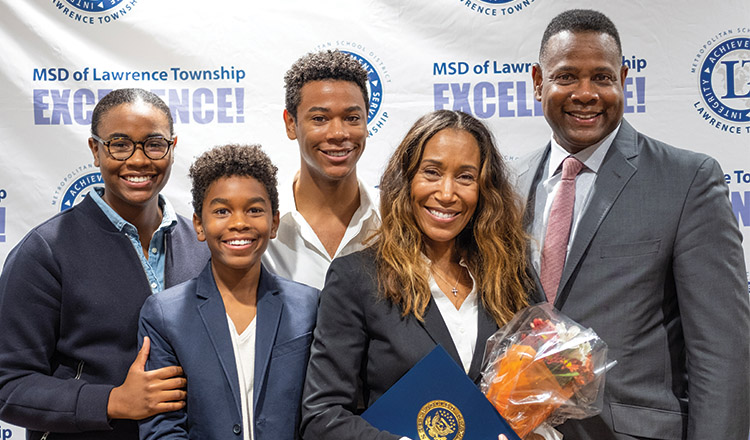
But when Markey was ready to go back to work, it wasn’t as an engineer. This time, she followed her high-school-kid dream: She began a teaching career. Aided by the Woodrow Wilson Teaching Fellowship, which allowed her to pursue a master’s degree, Markey started student teaching at Lawrence Township’s Fall Creek Valley Middle School in Indianapolis. By 2018, she was a Project Lead the Way instructor and teaching pre-engineering at the McKenzie Center for Innovation and Technology (MCIT) in the Lawrence Township Metropolitan School District.
After only three years at MCIT, Markey walked into the cafeteria on what she thought was a normal Thursday. She stood stunned at the entry. There was a celebration — to honor Markey as the 2019 Indiana Teacher of the Year.
At about the same time, a donor was interested in funding Purdue’s Algebra by 7th Grade (Ab7G) program and expanding it to Indianapolis public schools. The donor told Womack, then the Minority Engineering Program director, he wouldn’t do it unless Markey headed the effort. That’s when Womack and Markey reconnected.
Markey said it was the first time anyone from Purdue had reached out to her since graduation. Womack was interested in Markey doing consulting and scaling Ab7G beyond Purdue because “a lot of universities were interested in establishing similar programs.” Markey started working with Womack and the program in the fall of 2019. Soon after, the Markeys left Indianapolis for Columbus, Ohio, after Maurice Markey changed jobs.
Before Tamara Markey found another teaching gig in Ohio, she helped take the Ab7G program virtual during the COVID-19 pandemic. Once she was back in the classroom at Columbus Academy, she had less involvement with Ab7G, but Womack wasn’t done with Markey.
When an opening came up on Womack’s staff at Purdue, she asked Markey to apply. The initial thought: hard no. But the more the offer sat with her, the more Markey’s spirit was convicted. She felt led to apply. She interviewed and was preparing for a second interview when Womack called to tell her a different position — for associate director — was opening up. And Womack wanted to pivot.
“I want to prepare you to be my successor,” Womack told Markey.
Markey’s response this time?
“I was just dumbfounded at that point,” she said with a laugh. “I did the second interview for a totally different role. And here I am.
“Never did I ever dream I would be back at Purdue. I still look back on the Indiana Teacher of the Year (honor) and feel like, ‘What the heck happened?’ But I see God’s handprint in that so much. I know if it hadn’t been for that, I wouldn’t be here at Purdue.”
'Right person for the task'
Markey’s here, hunkered down in LMBS 2230 — door open as much as it can be, students in and out as often as it is — dispensing insight.
Born from experience.
Markey is honest with students about her Purdue experience. She wasn’t immune to the rough first year in engineering. Imposter syndrome was real, supported by her taking MATH 151 instead of Calc I like many of her first-year classmates. Accustomed to getting all A’s, Markey found the first year “devastating” when she didn’t. On a 6.0 sliding scale, Markey had a 4.96 GPA. Not “horrible,” she said, but horrible for someone not accustomed to such results.
To her credit, Markey knew she wasn’t doing school the right way, prioritizing things outside academics that first year.
She resolved to be different for Year 2 and dug in. She didn’t study with friends anymore, opting instead to study with people who were “smarter” and pushed her comfort zone limit. She didn’t study in the same places as before, realizing certain environments enticed socializing instead of learning. She stopped pulling all-nighters and staying up late, shifting to a firm 10 p.m. bedtime and 6 a.m. wake up, regardless of when the first class of the day was.
“I started treating every day like a workday,” Markey said. “After that first semester of my sophomore year, I was recognized as a distinguished student and was on the dean’s list.”
Markey’s told the cycle of students who come into her office all of that.
About the struggle, the grit, the overcoming. About taking too many credit hours to maintain a GPA needed for a scholarship. About the motivations for a career.
About the reality of it all, being a student, being a young professional, being a leader.
And they love her for it.
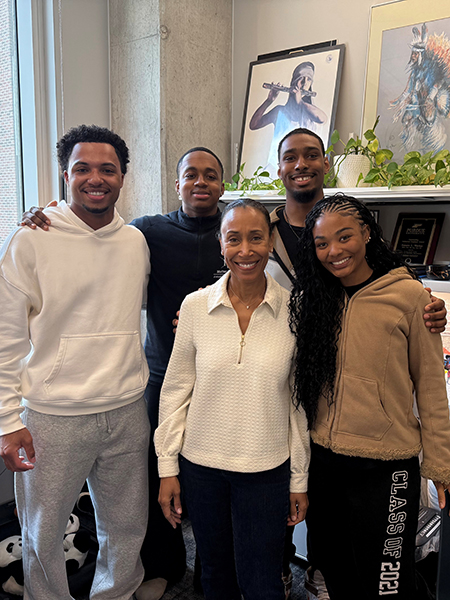
“She makes it so inviting,” said graduating senior Amareah Bead, who considers Markey a second mom. “Even if you have a problem. The other day, what was I crying about? I think it was senior design. But I went straight there. It was like, ‘This is so hard. I can’t do this.’ Or if you just want to check in and talk. Also, you’ll see your friends in there, too, because she’s created a community with all her students. So people just always want to go in there.
“I think that’s so beautiful, too. She’s not just going to lock her door, even though she knows she’s not getting stuff done. She will put in the extra hours and go home so she can be there for us. She does not have to do that at all. She’s just so selfless and actually cares about us.”
That kind of empathy, dedication and experience doesn’t go unnoticed by leadership either.
Holloway cites Markey’s “passion” as a reason she encouraged Markey to pursue the ESS role.
“We know that engineering student success is about academic success, but it is also about building community and bringing people together, and Tam’s experiences are in doing exactly those things,” said Holloway, Markey’s supervisor. “She was definitely the right person for that task of building what it could look like, what it could be in the college, bringing people from across the college together and coordinating with university level efforts to complement and leverage those and not duplicate them.
“I can think of no better person to both understand the engineering side of things, the student success side of things and how we bring all sorts of people together to create something for the benefit of our engineering students.”
And though it’s been emotionally draining at times for Markey, this quest of building infrastructure for a new program in the college, she sees the reward, too.
Every time a college partner shares about the ESC’s offerings.
Every time an alum asks about the program.
Every time the students come into that office.
“I give 100 percent of myself … that’s all we can do, give of ourselves and keep it moving because the students need us,” Markey said. “I know a lot of the times, I feel like probably 10 percent of what I say actually sticks — that’s my own experience with my actual children — but if they’re able to leave with one little nugget, if I was able to plant a seed that someone else later might water or the student might come back and I end up watering the seed I planted, whatever it takes.
“Whatever it takes.”