Chemical engineering junior combines passion with tutoring needs in ESC
Don’t just underline.
Don’t just highlight.
Always rewrite the important details. And go step by step.
That’s how Lily Farmer solves chemistry and calculus problems as a tutor in the Engineering Success Center (ESC). A junior in chemical engineering at Purdue University, Farmer embraces tutoring as an outlet to share her love of a famously complicated subject.
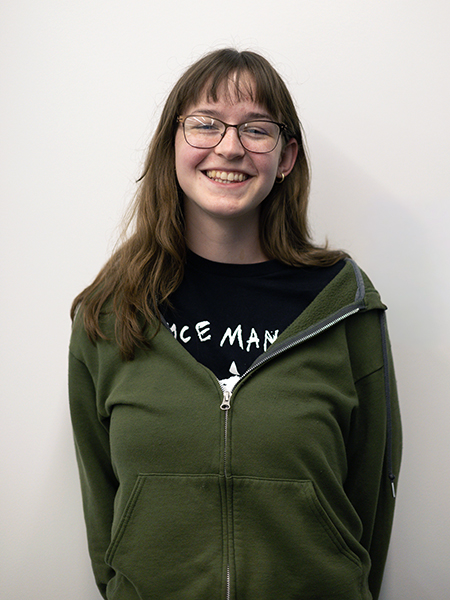
“I love the way that whenever you think about how anything works, it all goes back to chemistry, and no matter how you break it down, you always get to the molecular level,” said Farmer, from New Castle, Indiana. “Chemistry feels so whole.”
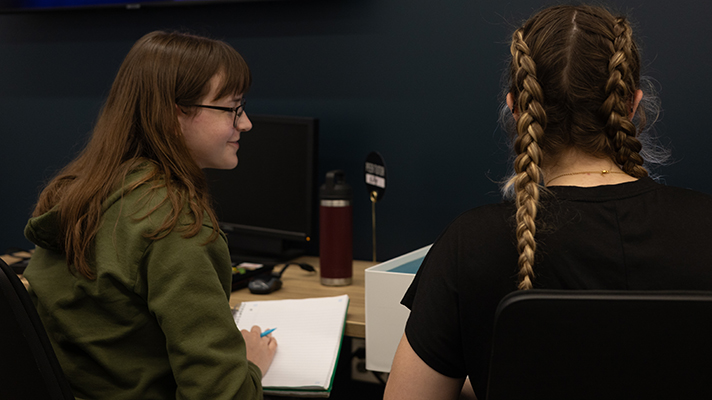
Farmer became a tutor in the ESC in fall 2025, ready to teach. But first, she learned how to walk others through her process in the center’s tutoring workshops. For Farmer, whose thought process does a lot of “zigzagging,” this was a challenge. And she was tutoring first-year courses as a junior: Reviewing would be necessary to teach the foundational courses well. Writing every step — even when the next part felt intuitive — gave Farmer the fresh eyes she needed to walk students through chemistry, calculus and thermodynamic problems.
And extra gratitude for the exceptional chemistry teacher she had in high school.
“I loved chemistry already, and my high school teacher had all these sing-songy pneumatics we used to remember things,” Farmer said. “I still remember them and sometimes I use them.”
In high school, Farmer not only discovered a love for chemistry, but a love for mathematics. She independently studied Calculus II and III, which bolstered her abilities to learn quickly, thoroughly and on her own. Farmer takes this initiative to review subjects before students come to her for tutoring, so that if there’s an obscure question about something in CHE 11500 or 11600 (General Chemistry), CHE 205 (Chemical Engineering Calculations), or organic chemistry of any level, she’s prepared to answer.
Farmer noticed that tutoring is less “a-ha” moments and more “flickering lightbulb” moments with challenging subjects. Students will understand a topic Farmer covers with them — then have more questions a few minutes later. While chemistry may be Farmer’s favorite subject and dream career, she understands that the classes she tutors are packed with information that is foundational for later courses and experiments.
“As you go further in these subjects, you call back to older topics, but don’t really revisit them,” Farmer said. “Tutoring others helps me a lot in my classes now because the classes I help with are the foundational ones. I’m constantly reviewing the fundamentals, and it’s helping my current classes flow better.”
Sessions with Farmer are student-led, less teaching and more wading through the problem together. Farmer will often ask students for notes they have taken or formulas they have been told to use, which she finds helpful with tutoring word problems.
Namely, that every word problem can be broken down into a formula. And it’s much easier to do when you write — and rewrite — the key information. If a problem statement gives a measurement, rewrite it below. Any numbers or units should be gathered below, and from that can be turned into the practice problems or formulas students are trying to work with.
“To keep rehashing problems is fun for me,” Farmer said. “I like tutoring because it’s fun to watch people learn and eventually enjoy what they’re working on.”