
Making it click: ESC tutor guides students through advanced engineering courses

Sydney Phillips’ first “aha” moment in engineering was in a mechanical engineering (ME) help room.
She was stuck on the second homework assignment of the class in fall 2024, right after being handed four dense sheets of data that would be “helpful” for completing the work. While Phillips is a longtime believer in learning through the struggle, it was too early to be so confused. And what was she supposed to do with those papers?
Phillips and a class friend sought the insights of a “super sweet” TA before they became any more lost.
“She walked us through the process, and we asked questions back and forth,” said Phillips, a junior studying ME with a minor in nuclear engineering. “I remember it clicking all of a sudden and thinking, ‘Why didn’t they just say that in the first place?’”
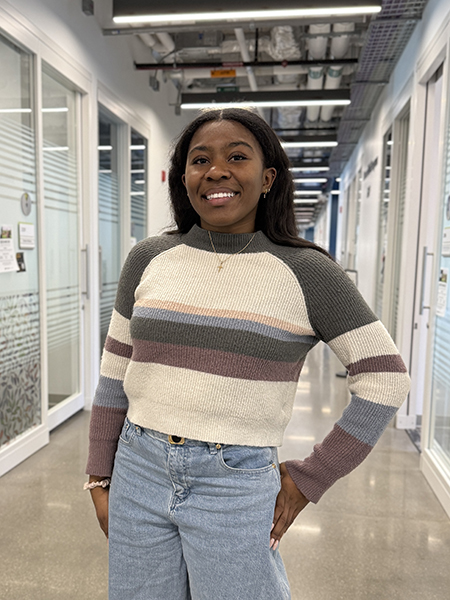
Once Phillips had a grasp on the course fundamentals, she started sharing insights with other confused peers while hanging out in the Engineering Success Center. Soon enough, the topic of tutoring came up. Phillips already was helping with engineering core courses. She was also in LMBS 2235 in West Lafayette every day. Why not get paid for both?
Tutoring was a sweet deal. But Phillips was hesitant.
“I didn’t want helping to be an obligation, and I wasn’t sure I was even qualified (to tutor),” Phillips said. “But tutoring became a nice break from my own work to go help someone else and embrace how much I understood.”
Phillips became a tutor in August 2024 — the same week of the “aha” moment — and burrowed into an underserved space: 200- and 300-level ME courses ME 27000 (Basic Mechanics I), ME 27400 (Basic Mechanics II), ME 30800 (Introductory Fluid Mechanics), ME 32300 (Mechanics of Materials). Her current tutoring offerings also include ME 20000 (Thermodynamics) and ECE 20001 (Electrical Engineering Fundamentals).
The niche also happened to be full of Phillips’ favorite courses.
“A lot of engineering is buildable,” she said. “If you get lost early, you’re lost for the semester. You might have to trick yourself into having so much fun (with your homework) to really learn the basics well, but then you get to actually enjoy (engineering) later.”
Phillips’ parents are both engineers, so her undergrad degree was always going to be the “E” in STEM. To Phillips, enjoying engineering is a bonus to earning a challenging degree with good job prospects.
“My mom was in the energy industry, and my dad was manufacturing,” Phillips said. “I knew I didn’t want to wear boots and be in a workshop like my dad was. My mom’s job seemed so cool, and then I took thermodynamics and I learned that I actually really enjoy energy, too.”
Nuclear engineering was an easy addition to Phillips’ ME degree: Testing out of two levels of calculus her first year freed up her schedule to add the minor.
Which means Phillips still has plenty of time to tutor at the ESC.
Her preferred method of tutoring involves reviewing past exams side by side with students. Looking at the attempted problems show her how a student is thinking — and what a professor is looking for when giving points on exams.
“Criticizing your own work is a really good way to learn,” Phillips said. “It’s been fun to watch my students have their own moments where everything clicks when we’re working with the whiteboards.
“You might not understand everything, but if you know how to use the equations you’re given, you don’t need to know it off the top of your head. You can look at it and see what could work for this problem with a sense of direction.”
Phillips has been pleasantly surprised to hear from previous students about good grades, renewed confidence and boosted GPAs thanks to a tutoring session with her.
“It’s really great to help students who help themselves because a lot of the students recognize that they need help when they’re booking that first appointment with me,” Phillips said. “They take that first step. It’s always really rewarding to help someone find what they’re looking for.”
The Engineering Success Center houses a collaborative learning environment through tutoring, faculty-led concept deep dives and exam preparation sessions. ESC provides a physical space for students to study, ask questions and learn together with 17 available tutors in over 40 engineering and engineering-related subjects. Located in Lambertus 2235, the area is open to students from 8 a.m.-8 p.m. for teamwork and individual study.