ICON Seminar in Learning: Prof. Prashant Mehta (UIUC)
Time: 3-4 pm Eastern Time, Jan 23 (Friday), 2026
Location: MSEE 112
Zoom Link: https://purdue-edu.zoom.us/j/95468302127
Coffee and snacks will be provide.
What can we learn from signals and systems in a transformer? Insights for probabilistic modeling and inference architecture
Abstract:
Transformer is the name of the core algorithm inside a large language model (LLM). In the so-called decoder-only transformer, a finite sequence of symbols (tokens) is mapped to the conditional probability of the next token. In this talk, I situate the transformer within the broader history of the prediction theory: In the early 1940s, Wiener introduced a linear predictor, where the conditional expectation of future data is computed by linearly combining the past data. I argue that a decoder-only transformer generalizes this idea and that a transformer is best understood as a causal nonlinear predictor. The technical results for causal nonlinear prediction are described for the special case where the data is discrete-valued and generated from an underlying hidden Markov model (HMM). The aim of this on-going research is to bridge the classical nonlinear filtering theory with modern inference architectures inspired by transformers. The work is jointly carried out with Heng-Sheng Chang and Jin Won Kim, and the talk is based on the paper: https://www.arxiv.org/abs/2508.20211.
Speaker:
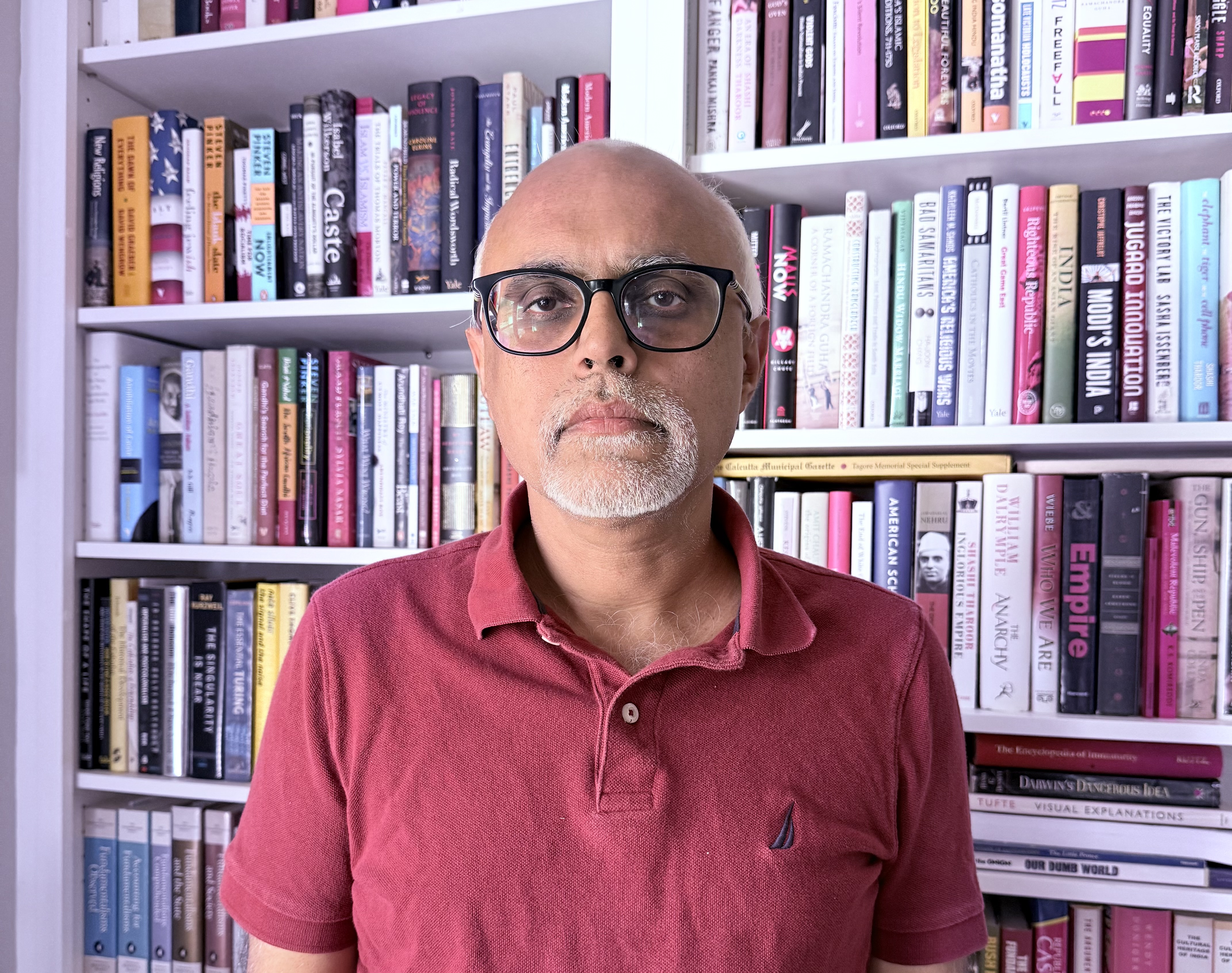
Prashant Mehta is a Professor in the Coordinated Science Laboratory (CSL) and the Department of Mechanical Science and Engineering, University of Illinois at Urbana-Champaign (UIUC). He received his Ph.D. in Applied Mathematics from Cornell University in 2004. He was the co-founder and the Chief Science Officer of the startup Rithmio whose gesture recognition technology was acquired by Bosch Sensortec in 2017. Prior to his academic appointment at UIUC in 2005, he worked at United Technologies Research Center (UTRC) where he co-invented the symmetry-breaking solution to suppress combustion instabilities. This solution — which helped solve a sixty-year old open problem — has since become an industry standard and is widely deployed in jet engines and afterburners sold by Pratt & Whitney. Prashant Mehta received the Outstanding Achievement Award at UTRC for his contributions to modeling and control of combustion instabilities in jet-engines. His students have received the Best Student Paper Awards at the IEEE Conference on Decision and Control in 2007, 2009, and most recently in 2019; and have been finalists for these awards in 2010 and 2012. He serves as a member of the IEEE Control Systems Society (CSS) Awards Board and as an Associate Editor for the IEEE Transactions on Automatic Control (2019-present). He is a Fellow of IEEE and ASME.
Organizers: Ziran Wang (ziran@purdue.edu), Yan Gu (yangu@purdue.edu), Yu She (shey@purdue.edu)
2026-01-23 08:00:00 2026-01-23 17:00:00 America/Indiana/Indianapolis ICON Seminar in Learning: Prof. Prashant Mehta (UIUC) Purdue University