
Driven, motivated student found like-minded community in Engineering Honors Program
Abby Mizzi didn’t want to be comfortable.
At least where academics was concerned.
That meant an important requirement in Mizzi’s college search was identifying ones with Honors colleges. Mizzi wanted a “challenge” — though she usually reframes that word as “opportunity” — and a rigorous addition to an engineering course schedule would qualify.
A nice living situation sounded great, too, maybe one with floors of like-minded first-year students working toward the same goal.
Mizzi checked both boxes after being accepted into Purdue University’s College of Engineering and the John Martinson Honors College and moving into the latter’s residence hall in August 2021. Mizzi was linked with the Engineering Honors Program (EHP) through the Honors College. EHP levels up the Honors experience, engaging in interdisciplinary academics, leadership development, community engagement and undergraduate research.
Mizzi was getting exactly what she sought: the hard thing, the scary thing, the uncomfortable thing.
“That’s how I know when I’m doing the right thing,” she said.
Mizzi’s choice was confirmed early at Purdue. In addition to being in Honor courses, she had additional engineering-specific courses, ENGR 16100 (Honors Introduction to Innovation and the Physical Sciences of Engineering Design 1) and 16200 (Honors Introduction to Innovation and the Physical Sciences of Engineering Design 2). Those provided the stretching she hoped.
And the residence hall provided the environment to thrive.
“Everyone is very driven and motivated and very excited to be there,” Mizzi said. “You could also do homework together in the hallways together, in the study spaces. You’d be doing the same homework, and then you could help each other out. There were whiteboards, so that was nice and made it very easy to write out your homework and really understand what’s going on with your neighbors.
“It was really funny — you could just walk around the floors and find somebody doing the same homework as you. Especially the engineering homework (on) Thursday night. Because it was due Friday morning, everyone was doing it. There’d be groups of people doing the homework and being like, ‘Did I get this right?’ ‘I’m wrong on this.’ It was so fun. I really liked that.”
In the engineering Honors courses, students are assigned teams and work each semester on three projects, including one that requires building a robot. The layers to the robot project are considerable: using computer-aided design first and then building it with a combination of LEGO bricks, sensors and Raspberry Pi controllers, allowing students to understand the software-hardware connection. The final test includes navigating the robot through obstacles with uncertainties in each situation, like a time interval to operate and complete a task.
Mizzi had a long list of lessons learned in the first semester.
First, working on a four-member team with students with a varying degree of skill sets. Mizzi, for one, had never coded, so using Raspberry Pi, a programmable circuit board used to control electronic projects, was a new experience. But she had taken physics, and that discipline was mixed into the course (in lieu of a separate physics class that other first-year engineering students take). Mizzi relied on her teammates to help learn coding, and, in turn, helped teach physics principles.
The group learned how to balance other strengths and weaknesses, as well differing personalities and preferences. If multiple ideas could work, whose idea is better? How do you decide when they could both accomplish the same thing?
Mizzi said it helped having an actual product to create while the team was learning about each other and each topic.
“There was good support within the team,” she said. “We had to go through iterations and testing and failing and having parts not work, parts break or not realizing the battery lifetime. Unexpected occurrences.”
Late in the process, the team realized the importance of being able to test in the environment they’re operating in. The residence hall had carpet and specific lighting. In the France A. Cordova Recreational Sports Center where their final prototype demonstration took place, the floors were smooth and the lighting had a different hue.
That meant the robot’s sensors that looked for white and black on the ground to know when to start and stop didn’t work because they’d been calibrated to a different environment. And the wheels didn’t turn as well because of the friction on the surface.
“Stuff like that was really important to learn in engineering,” Mizzi said. “In that way, I think Engineering Honors gave a lot of good skills that you wouldn’t get in the standard FYE course. That’s why I really appreciated what I did in that course. It is impactful for most students because you’re so new to the situation of everything.
“In the second semester, you’re a bit more familiar with the code and the software, so it goes a bit smoother the second time. Everyone is like, ‘OK, I have a decent handle of what’s going on.’ But there are new challenges to encounter, too. You learn different content, like statistics or more engineering basics.”
In tandem with knowledge gained from other FYE courses, Mizzi was prepared to take on the Honors-required scholarly project immediately after the first year. To meet the requirement, students must create original work and present it publicly. During an internship at Collins Aerospace before Mizzi’s sophomore year, she redesigned a lab space where avionics technicians built black boxes and wiring cable units. To make the space more efficient for product flow in and out and workflow for technicians and engineers, Mizzi reimagined the space for ultimate productivity. She presented to upper-level management, who approved the changes.
Mizzi was well on her way to receiving a medallion, a symbol of completing the program. Though she admitted it can feel intimidating to fit in extra Honors courses with a difficult major like aeronautical and astronautical engineering (AAE), Mizzi was driven to finish what she started.
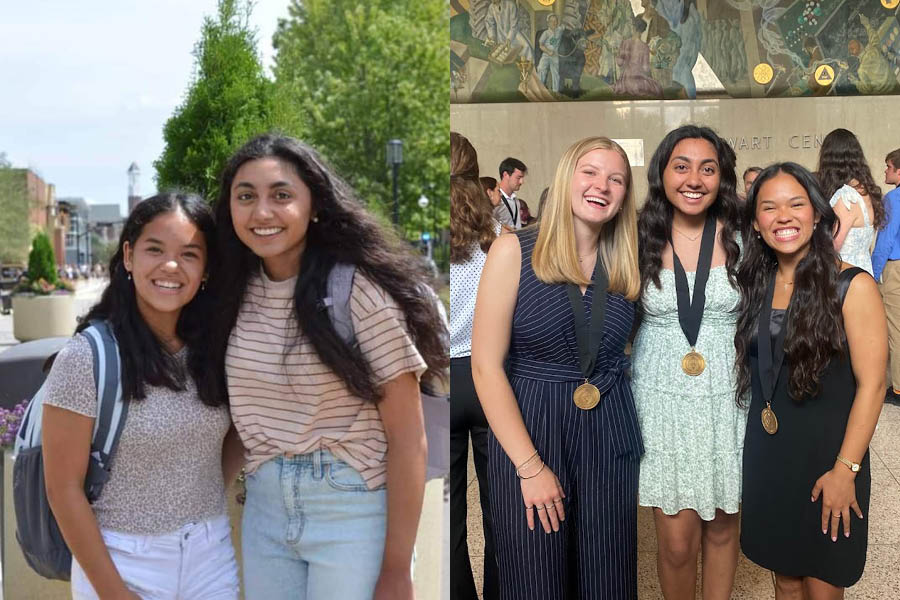
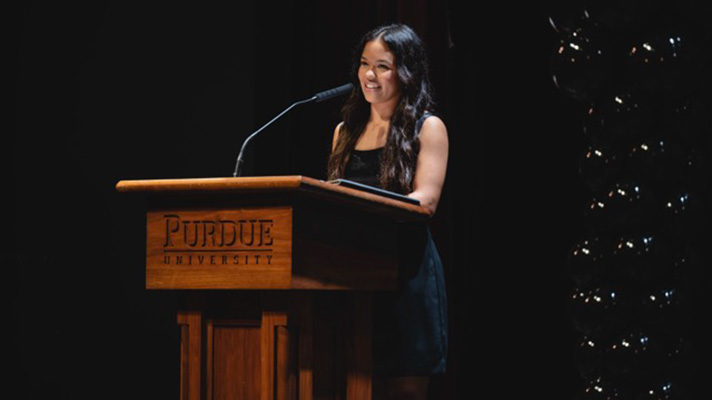
She did that in August 2025, graduating with honors and a bachelor’s in AAE. Mizzi was the student speaker for her graduating class at the medallion ceremony, an honor she called meaningful because “that community had supported me from the very beginning of my time at Purdue.”
Now a master’s student, Mizzi reflects positively on the EHP experience.
“It brought me such good community with engineering students because 161 and 162 are just engineers whereas your other Honors courses are everybody. I felt like it brought me really good friends in engineering,” said Mizzi, who met Maitri Pandya on the first day of ENGR 161 and now the pair are best friends. “We all started together in Engineering Honors, and by the end of our four years, we were off doing many different things. It’s cool to see where my friends are now, working in energy or motors and engines. It’s very cool to say we all started together. We all had those really late nights, doing homework and struggling on building our robot and it breaking and that whole experience when we were freshmen, and now we’re all graduated and gone on our journeys.
“Even when we were in our different schools, it helped you feel more connected to the College of Engineering because you knew people not just in your school, but I had so many friends in mechanical engineering and chemical engineering. So it helped keeping the College of Engineering connections. I really liked it.”