
STEP program introduced AAE student to trustworthy teamwork
Jack Martin didn’t trust teammates. Ever.
But during the weeklong Seminar for Top Engineering Prospects (STEP), he had to. Because it was midnight and his team’s robotic project was due at 3 a.m.
Staying up had been “awful” in the moment, but the excitement of watching the robot work during the next day’s challenge pushed exhaustion out of the memory.
It was a moment that still stays with Martin, six years later.
“STEP takes the accelerated timeline (of Purdue Engineering) to an extreme,” said Martin, from Carmel, Indiana. “Doing a robotics project in three days really prepared me to manage three to four other people’s schedules and build something that works, on top of lecture and on top of homework.”
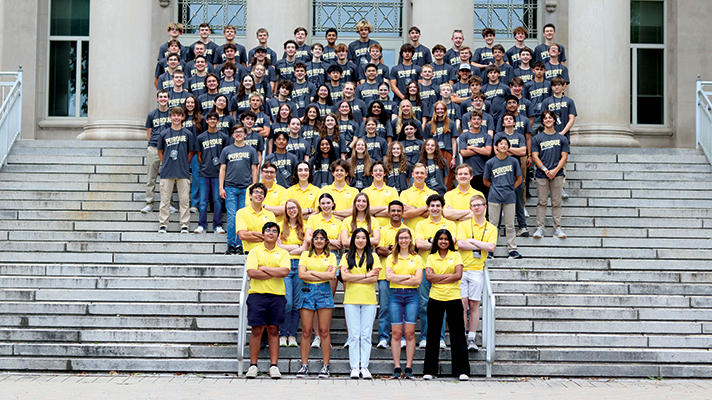
STEP, established in 1985, offers students a unique weeklong summer residential program for rising high school seniors. STEP is run by the Engineering Honors Program (EHP) and lets students sample college life at Purdue University, complete with time-sensitive creative projects, challenging teamwork, and navigating residence halls and dining courts.
STEP was what convinced Martin to come to Purdue in fall 2020. He liked the challenge and, as part of the Honors College, he joined EHP for an extra-rigorous education. With small class sizes and hands-on engineering experiences, EHP offers exclusive access to professional development, academic support, community engagement and mentorship networking.
“Getting to be around a lot of people here that are wicked smart that might have the same passions I do … it was everything I wanted to do in college,” Martin said. “STEP was one of the big reasons why I did (engineering) because it got me so passionate about Purdue.”
Martin grew to trust in Purdue Engineering teams — and the time management skills the curriculum necessitated — over the next five years, especially as he worked on tandem senior design projects: one for his aeronautical and astronautical engineering (AAE) major with rotational slosh research and one to complete an Honors diploma, research in hybrid rocketry at Maurice J. Zucrow Laboratories.
By the time Martin completed undergrad, he had worked with teams, both on a weekly basis and with members he had never seen, to get projects done well and on time. Not only did the experiences increase his confidence in fellow engineering professionals, but Martin was confident in his own abilities, too.
“STEP (as an intern) taught me dissemination of material to a group with high degrees of success,” said Martin, a graduate research assistant in additive manufacturing and energetics. “I onboarded three people (at Zucrow) who work alongside me now. I had to train all of them quickly as we had deadlines that were coming up. During STEP (as an intern), we had to redesign projects for the students and communicate to the TAs in a short amount of time how to answer questions and run the event. Learning the best way to feed people large quantities of complex information and then having them be successful is really hard to do, but STEP gave me that opportunity which I was able to translate to work out at the lab.”
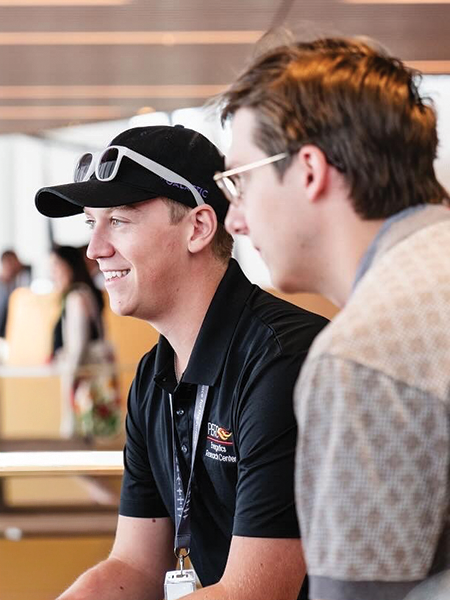
A research assistant at Zucrow since 2022, which would become his EHP senior design project, Martin specializes in propellants and highly energetic — often explosive — material. He studies the effects of differing infill percentages — a spectrum of hollowness to solidness — and ideal internal geometries for the addition of liquid oxidizer to fuel a hybrid rocket. When dealing with energetics, Martin uses 3D-printed models to test the effects of slots, holes and other microstructures that impact the detonation front. His teams are small, but Martin can count on them to pick up information quickly, ask questions, work together to meet deadlines and run successful tests.
“These massive projects have deadlines that seem so far out at first,” Martin said. “However, if you don't work on bits of it every week, you will find yourself behind. The same holds true with research. As most of my projects have deadlines that sneak up on you, you absolutely have to think ahead and plan out your work. Out at the lab, you need equipment reservations, finding someone to assist you, all these additional things that were the equivalent to other classes and exams that you had during (a First-Year Engineering Program) class. Those projects really helped me prepare to deal with a similar experience with research.”
The summer between completing undergrad and beginning a doctoral degree in mechanical engineering, Martin returned to STEP in 2024 as an EHP intern — which meant giving lectures and revamping each challenge with a team of four interns. He was ready to inspire a new wave of young engineers in the same place he had been.
“What is (space research and travel) going to look like for our grandkids?” Martin said. “It might become a class field trip one day. So having students up there doing research, that's one small step in the right direction. It's not everybody going out there, but it's making space more accessible to everyone a little bit at a time.”