
Alejandro H. Strachan Named APS Fellow for Research on Materials Under Extreme Conditions
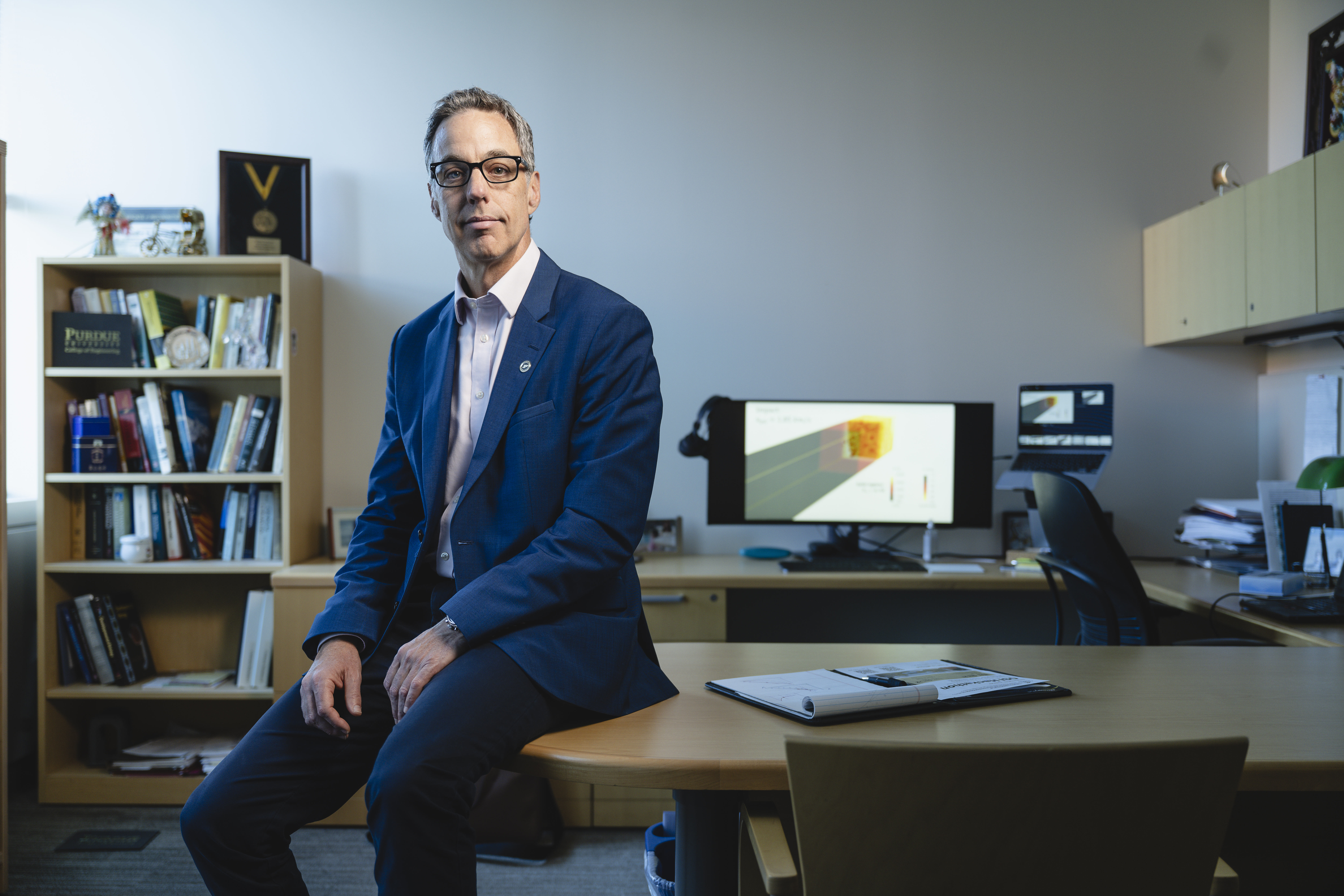
WEST LAFAYETTE, Ind. — Alejandro (Ale) Strachan, Reilly Professor of Materials Engineering in Purdue University's School of Materials Engineering, has been named a 2026 Fellow of the American Physical Society (APS) through the Topical Group on Compression of Condensed Matter. The honor recognizes his pioneering contributions to predictive modeling of shock-induced chemistry in energetic materials and high-pressure physics, spanning initial chemical events, shock-to-deflagration transitions, mechanochemistry and the discovery of novel high-pressure phases.
APS Fellowship is among the highest honors bestowed by the American Physical Society, recognizing excellence in physics and exceptional service to the physics community. Fellowship is a distinct honor awarded through a rigorous peer-review process, with recipients nominated and elected by their scientific peers.
The fellowship recognizes Strachan's decades-long contributions to computational materials science and the study of materials under extreme conditions.
Bryan Huey, the Blacutt-Underwood Head of Materials Engineering, said, "This is a well-deserved recognition for Ale, who has made significant contributions to this field and the broader materials engineering community."
For Strachan, whose academic roots are in physics, the recognition carries special significance.
“My background is in physics, and being recognized by the APS is very humbling. I have been part of the SCCM community for decades, and being recognized by colleagues that I admire and respect is great.”
Strachan's research focuses on developing predictive computational models that help scientists understand how materials behave under extreme conditions, including high pressures, temperatures and shock loading. His work has advanced the understanding of energetic materials, which are critical to technologies ranging from aerospace systems to safety devices.
“Understanding energetic materials is important for the safe operation of important technologies like propellants and explosives,” Strachan said. “For example, many airbags are explosively driven, and these devices need to work in Alaska’s winters and Arizona’s summers even decades after installation.”
Because experimental studies under extreme conditions can be difficult, costly and sometimes impossible, computational modeling plays an essential role in advancing the field.
“One of the challenges in this area is that subjecting materials to extreme conditions experimentally is challenging and costly,” Strachan said. “This is where modeling and simulations using supercomputers can help. We collaborate closely with experimentalists on understanding how materials respond to extreme conditions, like high pressures or temperatures.”
The broader impact of the field extends far beyond explosive and propulsion systems. Research into materials under extreme conditions can reveal entirely new material structures and properties.
“The work our community is doing is important to design better propellants and explosives, but also to understand how pressure can change materials and maybe achieve new properties,” Strachan said. “An example is how compressing graphite can lead to diamond. We can make new materials by applying high pressures, temperature or combinations of the two.”
Strachan noted that Purdue's collaborative environment has been instrumental in advancing this work.
“Purdue is a great place for this type of work, with many collaborators both on the modeling and experimental side to discuss ideas and tackle large problems,” he said. “Purdue is actually among the best places in the world to do this type of work.”
A physicist by training, Strachan traces his interest in science to childhood.
“I was a bit of a geek, I liked reading books on physics and math and coding. My childhood friends still make fun of me about that!”
Today, his motivation comes from the unanswered scientific questions that remain and from mentoring the next generation of researchers.
“There are many questions we do not have answers to,” Strachan said, “and motivated and talented students interested in learning how to ask and answer these questions.”
For students considering careers in computational science and materials research, his advice is simple:
“Go for it. We live in very interesting times with technology that can take research to a whole new level. Join in!”
Ale Strachan is internationally recognized for his work in predictive atomistic and multiscale modeling, integrating physics-based simulations, machine learning and advanced computing to understand and design materials. He serves as Director of the National Science Foundation-support ICoN Programmable Cloud Lab and co-director of nanoHUB and Purdue's Office of Research Fellow for Intelligent Twins and Digital Innovation.
ABOUT THE AMERICAN PHYSICAL SOCIETY
Learn more about the American Physical Society Fellowship Program at the APS Fellowship Program website. APS Fellowship recognizes members who have made exceptional contributions to physics through research, innovation, education or service to the profession.
ABOUT THE SCHOOL OF MATERIALS ENGINEERING
The Purdue University School of Materials Engineering is a global leader in education, research, and innovation across all major classes of engineered materials.
As part of the 3rd ranked College of Engineering, our students, faculty, and industry partners are advancing materials and manufacturing for Aerospace, Computing, Health, Energy, Infrastructure, and Extreme Environments. Learn more at Purdue School of Materials Engineering.