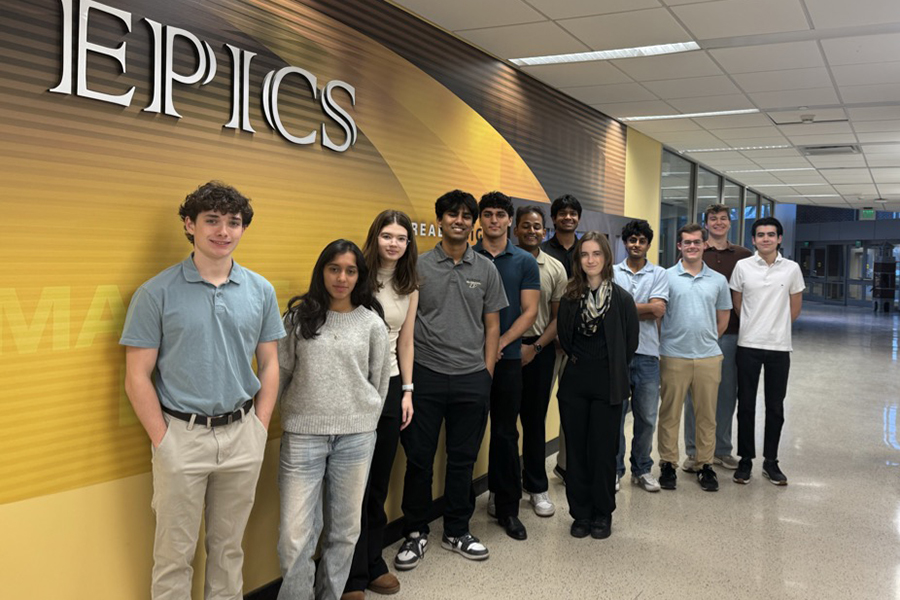
EPICS team delivers new mobile app, website to increase awareness of local crisis resources
In fall 2024, Pranav Ramnath’s EPICS team had a gap in its schedule.
And Jennifer Layton had a need.
Over the next year, the EPICS team would work with Lafayette Transitional Housing Center (LTHC) to create Tippecanoe County Connect (or Tippy County Connect on the Google Play store), an app designed to keep individuals experiencing poverty and homelessness connected to local resources.
The site and connected app were delivered to LTHC in November and December 2025, respectively. Just in time to serve directions to food pantries, charging stations and warm places to sleep during the coldest months of the year.
“It feels good that this product solely exists for the purpose of serving the community,” said Ramnath, a junior in computer engineering. “This takes engineering one step further into not just being a tool for innovation, but also a socially embedded process that lets engineers work with the community.”
Ramnath’s sentiment is exactly what EPICS seeks to teach students. Since 1995, EPICS has exposed students to real-world problems and equips them to create, design, test and deliver solutions to community partners. Projects span from manual work to digital projects, ranging from India to Indiana. The program is celebrating 30 years in 2025.
Both serving and learning about the community of nearly 1,600 individuals who benefit from LTHC’s services — around 400 of whom are homeless — within Greater Lafayette moved the team. The project showed the team of first-year students, Ramnath and advisor Aparajita Jaiswal just how broad the factors leading to homelessness could be. And that, when applicable, individuals experiencing homelessness have phones before they ever have housing.
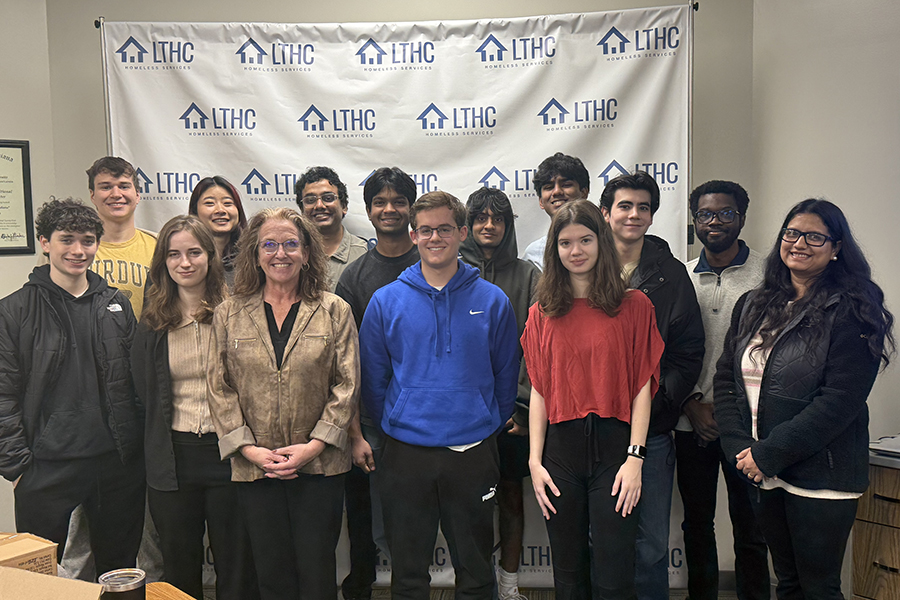
They learned this from Layton, the director and CEO of LTHC, who has been working in services for people experiencing homelessness for 31 years. One of the first times the team met with her in full was on site at the center.
“Most people don't have the contact with people that are experiencing homelessness that I do,” Layton said. “That’s why it’s so important to engage our friends over at Purdue and especially first-year students, because hopefully they’re going to be here for the next few years and can start helping us now.”
At first glance, the team considered phones an absolute win on connection alone. They need internet, they need to be charged frequently and they cannot always withstand extreme heat or extreme cold.
The LTHC is a “safety net” for people experiencing what Layton calls “the worst day of their life,” whether it’s for a night or for years. The center offers meals, computers, restrooms, warm showers, charging stations, Wi-Fi and safe places to sleep, including transitional apartments. And while the center has partners all over Greater Lafayette, from the police forces to churches, Layton knows that there are still people who might not know that they — or the resources they provide — exist.
“Not everybody comes through our doors and not everybody knows all the resources available to them,” Layton said. “This app was made for everyone who might be in need in mind, no matter what that need might be.”
Keeping the app simple was one of the greatest challenges for the tech-savvy team, made up almost entirely of new Purdue students. Besides the issues Ramnath expected from coding and teaching a new team the necessary engineering skills — and ensuring that the new members had a chance to grow into leaders and project managers — Layton would occasionally surprise them with her own challenges with technology.
It turned out to be a great benefit. Many of the individuals Layton encounters daily are her age — in their 40s — with her tech experience or less.
The site and app underwent two rounds of user testing, which resulted in some surprising changes.
Like colors, fonts and button sizes. Things the team wouldn't have considered if the users testing the app hadn’t told them.
“We changed some of the fonts and the colors on the website and app because we directly got feedback from people who are going to use it,” said Jaiswal, a first-time EPICS lecturer overseeing six sections. “Talking to users (at LTHC) also motivated the team to add a voice option as an accessibility feature because of how many people used that instead of typing.”
The team included similar phrases and typos — called fuzzy matching — in the projects’ coding, so that if someone spelled a resource incorrectly or wasn’t quite sure what it was called, the app could make educated guesses to connect them with the service.
“I wanted people to be able to click a button and have the information they need,” Layton said. “In a lot of cases, that means if someone clicks on our center, the app should tell them what bus to get on to get to where they were going. Let’s make sure that it's really client focused and catered to their needs and transportation. There were a lot of aha moments in that.”
Testing started in September, and by November, Tippy County Connect was ready for launch. Layton was impressed and relieved that the collaboration with EPICS had been successful and quickly produced something impactful for the community.
“We've got too much critical work to do to spend a lot of time on (building an app),” she said. “Every day there's a new critical challenge. So now that (the app) is deployed, it’s going to sit and work for us without having a lot of input from anybody. It’s nice to have that resource and be able to focus on the people I see every day, too.”
The positive impact was mutual, Jaiswal assured. As part of EPICS instruction, students write weekly reflections on their project, goals and their own dispositions. Jaiswal saw a gradual, heartwarming change in students from the first week to the last.
“Some reflections I read in Week 1, (students) were just doing the project because they had to do a project,” Jaiswal said. “But now, you can see that community-centered identity is evolving in the students and their perspective has changed. Some were open that they thought that homelessness only happened to somebody with misconduct in their record. But later on, they also understood the scarcity of resources or money can also make someone homeless.
"It was an eye-opening project for a lot of us because it gave us a very different perspective.”