FIRST AND LARGEST IN THE US

TRAILBLAZING SCHOOL

Founded in 2004

PORTFOLIO-BASED LEARNING

APPLIED MASTERY

Learn By Doing

ENGINEERS+EDUCATORS

DIVERSE PATHWAYS

For Every Career Stage

MS ENE

Watch Video
Round, gold play button icon.
Video thumbnail.

ABOUT THE PROGRAM

Our online Master of Science in Engineering Education (MS ENE) program is designed for professional engineers, industry training professionals, university faculty members, and graduate-level STEM students to advance skills without disrupting careers or current studies. Online engineering master's programs at Purdue University are ranked #2 by U.S. News & World Report (2025). The online MSENE was added for students who want to understand the underlying theory and the practical applications of engineering education without pursuing a PhD.
Learn More

Online engineering master's programs at Purdue University are ranked #2 by U.S. News & World Report (2025). Home to the world's first School of Engineering Education, Purdue initially designed its Engineering Education Graduate Programs for doctoral students to pursue rigorous research in how engineering, science, technology, and math, are best taught, learned, and practiced. 

The online MSENE program covers both the theory and the practice of engineering education and is designed to be valuable to four different audiences:

  • PhD students in engineering or a closely related field who are preparing for a faculty career
  • Current engineering or science faculty who would like to become more effective teachers
  • Mid-career engineers and scientists thinking about a second career in education
  • Industry professionals, consultants, and others seeking continuing professional development and additional qualifications to support technical training and education
MS ENE Concentration

AI IN ENGINEERING EDUCATION

Explore the new concentration offered through our Master's of Engineering Education focused on Artificial Intelligence (AI). Combining technical AI and machine learning foundations with STEM teaching, learning, research, and AI ethics, the AI in Engineering Education concentration is built for educators and professionals who want a rigorous, education-centered foundation in AI. Students explore how AI is transforming engineering education while building skills in responsible and effective implementation. The specialization is designed for engineers, STEM educators, technical professionals, current MS ENE students, non-degree learners, and faculty or staff seeking to strengthen AI literacy or gain formal preparation in the growing intersection of AI and engineering education.

CURRICULUM

The 30-credit hour, non-thesis curriculum is carefully designed to provide high quality, convenient versions of on-campus courses. Online courses are taught by the same faculty who offer on-campus sections and provide multiple opportunities for online students to interact with and receive feedback from both faculty members and other students in the course. Online students are expected to participate in weekly seminars, either asynchronously or virtually in real time, and have the option to join the Engineering Education Graduate Student Association (ENEGSA).

Online MSENE Requirements:

  • 15 credit hours of online ENE core courses
  • 6 credit hours of ENE or ENE-relevant elective courses
  • 9 credit hours of ENE or other elective courses
  • Portfolio of ENE-related work

Visit the MS ENE Plan of Study to learn more about the coursework.

For those interested in a more compact program, we offer an online Teaching and Learning in Engineering Graduate Certificate with courses that count toward the master's degree if you subsequently decide to pursue an MS ENE. In addition, students in the master's program who decide to pursue a PhD in Engineering Education (offered on Purdue's main campus in West Lafayette) will benefit from a program designed so that most, if not all, master's degree-level courses count toward the PhD.


  • GPA: Minimum 3.0 or equivalent (A=4.0) cumulative GPA from most recently conferred undergraduate, graduate, or professional degree
  • Background: Preferred undergraduate degree in Engineering, Science, Mathematics, or Technology
  • Test Scores: Graduate Record Examination (GRE) scores are accepted but not required

If you do not meet these criteria, contact Engineering Education, Graduate Programs, to discuss your situation.


SCHOOL OF ENGINEERING EDUCATION SEMINARS

During the fall and spring semesters, the School of Engineering Education (ENE) hosts a weekly research seminar from 3:30–4:20 p.m. most Thursdays. These seminars provide the engineering education community a chance to get together to talk about new ideas, share successes and new research, and support developing research. Please join us! We welcome graduate and undergraduate students, staff, and faculty from across the university with an interest in educating engineers.

Please contact Şenay Purzer, Associate Head of ENE Graduate Programs and Professor of Engineering Education, with any questions or to recommend future speakers.

Visit the ENE Seminars page for the full schedule of events.

STUDENT TESTIMONIAL

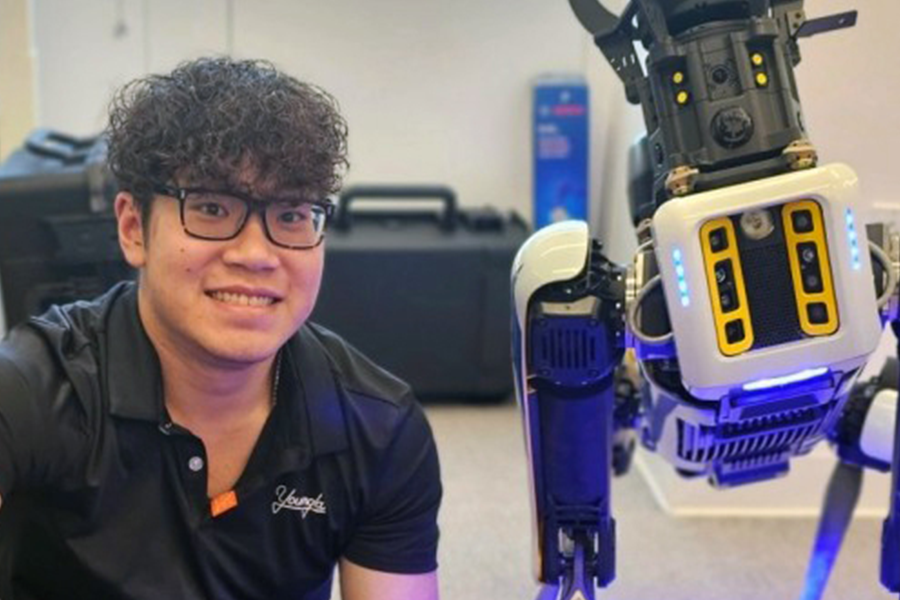
Ryan Tang Dan, MSENE graduate, next to a quadruped robot

Ryan Tang Dan

MSENE Graduate | Program Coordinator for Robotics, NYPA

As a STEM instructor teaching introductory and intermediate robotics courses in New York City, mechatronics engineering graduate Ryan Tang Dan enrolled in Purdue's online MSENE program to further his career. While enrolled in the program, Tang says he learned a lot more than he expected. When he suddenly changed careers (twice) and industries, first to a project manager for a drone company and then to a building management control systems company, his ongoing MSENE coursework helped him in both roles, making him more effective as a trainer and more efficient in moving his projects to completion.

Ryan says the things he learned in pursuit of his MSENE allowed him to mentor people more effectively by understanding how they approached the technical material. He completed the MSENE program in less than 2½ years and attributes his success to the way the program was structured, noting that it allowed him to create his required portfolio piece-by-piece as he progressed through the courses. He adds that support and flexibility from faculty advisors kept him on his academic path while the School's weekly research seminars exposed him to different approaches to teaching and mentoring. Ryan is continuing to leverage his degree and gain professional experience through his recent appointment as a Program Coordinator for Robotics at the New York Power Authority (NYPA).

Frequently Asked Questions

Yes. Our typical student works full time. Most courses are delivered asynchronously, which means you can complete your coursework when it is convenient for you.

Play video: MS in Engineering Education, Work-Life-Study Balance

You would earn a Master of Science in Engineering Education (MSENE).

You need to register for at least one credit to be considered an active student. If you do not enroll for more than two consecutive semesters, you will lose your student status and must reapply.

The MS ENE requires ten 3-credit hour, graded courses; two semesters of the research seminar; and a portfolio providing evidence that you have moved toward mastery of six graduate competencies. The research seminars and portfolio can be completed concurrently with a class. If you take three classes per year, you can finish in a little more than three years. Typical completion time is 2 to 4 years.

You may take a maximum of two consecutive semesters off. If you take more than two semesters, you will need to reapply to the program.

We suggest that you try to get at least one academic reference. If that is not possible, recommendations from employers will be accepted.

The courses are offered both synchronously and asynchronously. Students who are able to participate in weekly class meetings typically join online via Zoom or MS Teams. Otherwise, the faculty member may provide videos covering course materials, or recordings of class meetings, which you can view at your convenience. Some instructors also ask students to meet for small group discussions at mutually agreeable times. Either way, you are expected to keep up with the weekly lectures and readings and submit assignments and projects by the posted due dates.

Scholarships and funding are not available through Purdue as this is a course-based, self-funded master's program. U.S. Citizens and Permanent Residents are eligible for federal financial aid. The Purdue Division of Financial Aid can answer your questions. Veterans can visit the Dorothy Stratton Veteran and Military Success Center to learn more about wrap-around support services for Purdue students who are veterans, members of the military, or benefit-using family members.

Yes, students will have access through the Purdue Center for Career Opportunities.

Play video: Purdue Center for Career Opportunities

Fill out our request information form to receive information on application deadlines, helpful resources, and upcoming informational webinars. If you have specific questions about MS ENE coursework or faculty, email us and we will get back to you promptly.