

How Our Programs Build on Each Other
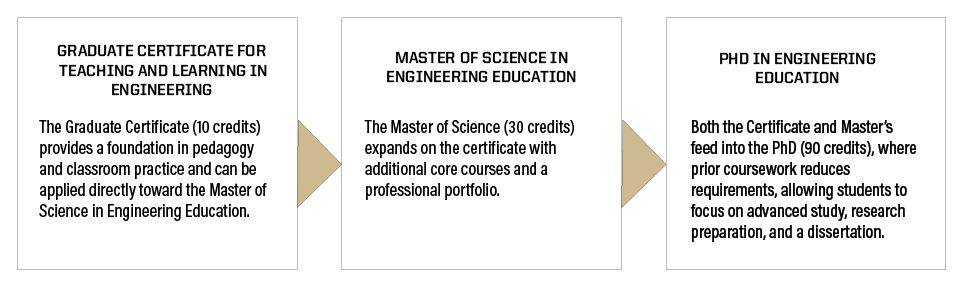
Graduate Certificate for Teaching and Learning in Engineering
Offered both online and in person, the 10-credit Graduate Certificate for Teaching and Learning in Engineering provides a strong foundation in engineering education pedagogy. Students complete one master's-level core course, ENE 50600 Content, Assessment and Pedagogy, along with additional coursework such as ENE 68500 Engineering Education Methods and ENE 68700 Mentored Teaching in Engineering. For the final requirement, students select from electives such as ENE 58600 Exploring Alternative Career Paths as an Engineering Educator, ENE 58700 Teaching Engineering Online, or ENE 68600 Preparing to Be an Engineering Professor. This certificate serves as both a stand-alone credential and the first step toward advanced study.
Explore the Graduate Certificate →
Master of Science in Engineering Education
Offered online, the 30-credit, non-thesis Master of Science in Engineering Education (MS ENE) builds directly on the graduate certificate. Certificate coursework counts toward the degree, allowing students to apply previous credits while expanding into five additional required courses, including ENE 50101 Foundations of Engineering Education, ENE 50200 History and Philosophy of Engineering Education, ENE 50300 Engineering Education Inquiry, and ENE 69000 Seminar in Engineering Education. Students also choose between ENE 50400 Leadership, Policy and Change in STEM Education or ENE 50500 Theories of Development in Engineering Thinking. Several MS ENE electives can be satisfied by previous certificate coursework. In addition to the required and elective courses, students submit a professional portfolio demonstrating their mastery of program competencies.
PhD in Engineering Education
Offered in person, the 90-credit PhD in Engineering Education represents the culminating stage of study, with a plan of study that integrates prior certificate and/or master's coursework. Earning the graduate certificate applies 10 credits, while completing the MS ENE applies 30 credits toward the PhD. The remaining requirements include advanced engineering education courses, courses in a secondary area of expertise, approximately 32 hours of research preparation, and OGSPS-compliant research credits. Students also develop a professional competency portfolio and complete an original dissertation, contributing new knowledge to the field.


