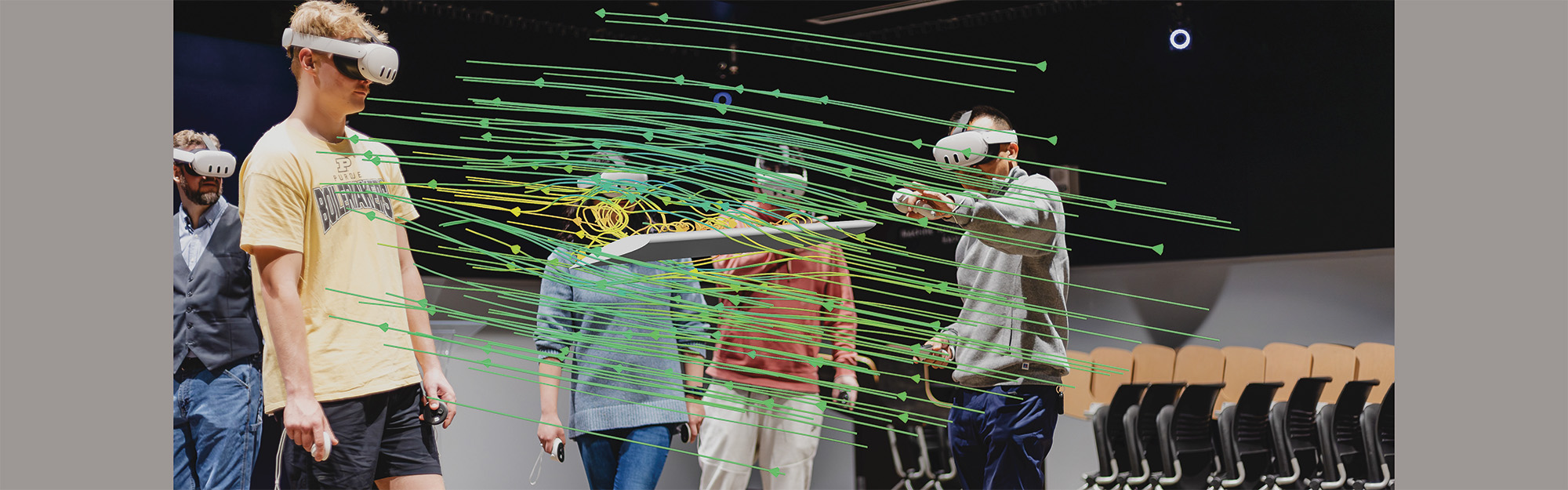
Funding from the National Science Foundation is helping Purdue Engineering researchers to improve educational outcomes for large laboratory courses.
The $743,728 award from NSF’s Division of Undergraduate Education is supporting a threeyear project to improve STEM education, called Scalable Inquiry-Based STEM Instruction: A Blended Virtual-Physical Lab Concept for Large Lab Courses. It aims to address long-standing challenges in delivering self-guided, inquiry-based learning experiences in large lab settings. The project, which runs until August 2028, will be implemented in large fluid mechanics lab courses at Purdue’s West Lafayette and Indianapolis campuses, reaching more than 1,500 students annually.
The project’s principal investigator, Sally Bane, is an associate professor of aeronautics and astronautics and director of the school’s hands-on education. She is collaborating with co-investigators Sean Brophy, associate professor of engineering education, and Jun Chen, professor of mechanical engineering.
“Traditional labs give students valuable hands-on practice, while virtual labs allow for flexibility and scale,” Bane says. “This project combines the best of both worlds, giving students opportunities to experiment, design and problem-solve in ways that would be difficult to achieve with only one format.”
The project introduces a new instructional framework called Scalable Inquiry-Based Lab Experiences (SIBLE). This model blends physical and virtual experiments with AI-driven feedback tools, enabling students to engage in authentic, inquiry-based lab work at scale.
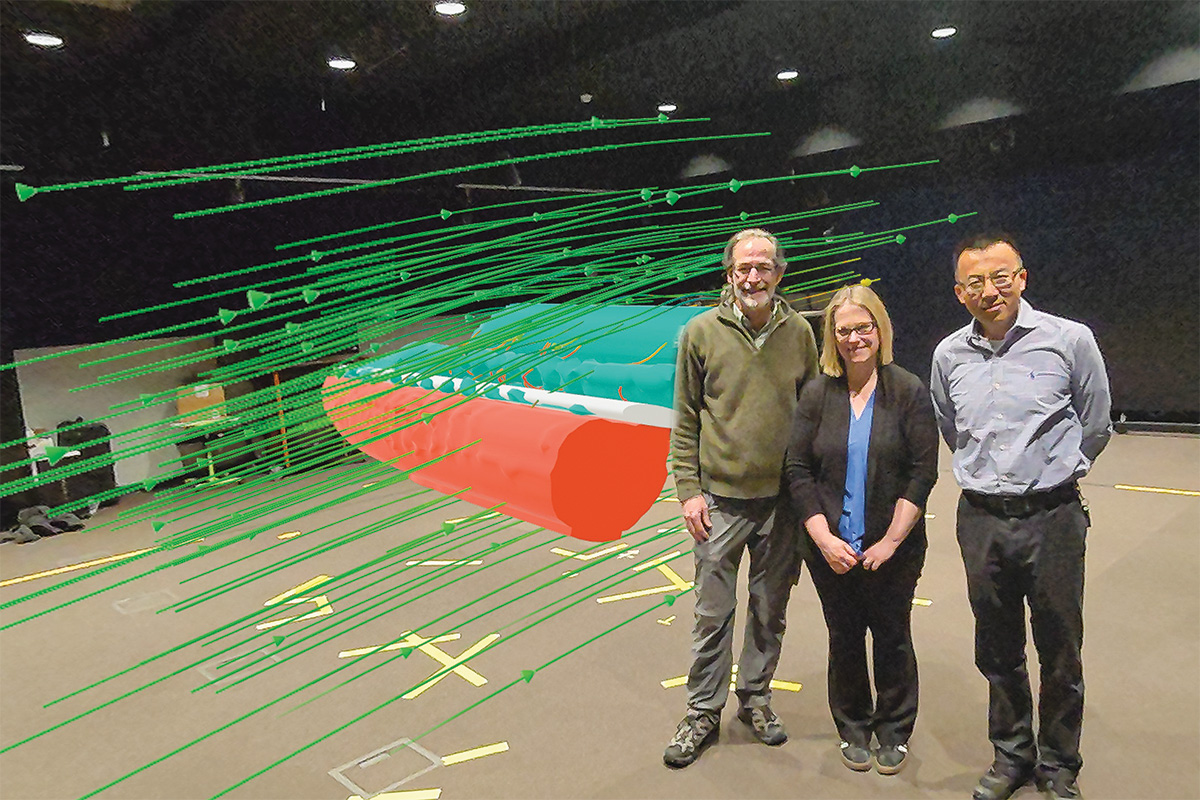
AAE associate professor Sally Bane, center, with co-collaborators Sean Brophy, associate professor of engineering education, and Jun Chen, professor of mechanical engineering
Brophy’s research within the School of Engineering Education focuses on developing adaptive expertise through simulations, analogical reasoning and model-based learning. His work examines how students comprehend, analyze, troubleshoot and design complex systems — and how these proficiencies can be cultivated via thoughtfully designed learning environments.
“Integrating AI-driven feedback into this model allows students to learn more independently while still receiving meaningful guidance,” Brophy says. “This project aims to not only improve student outcomes but also make lab instruction more adaptable across different disciplines.”
The research team will explore three central questions:
The ability to successfully scale up instruction allows more students to learn within the same physical lab space — without compromising the quality of their educational experience. “Scaling up inquiry-based learning has always been a challenge in large STEM labs because of limitations in equipment, space and staff,” says Chen, who also serves as the School of Mechanical Engineering’s associate head for facilities and operations.
“By combining physical experiments with virtual simulations, we’re creating a more accessible, flexible,and effective learning environment.”
