
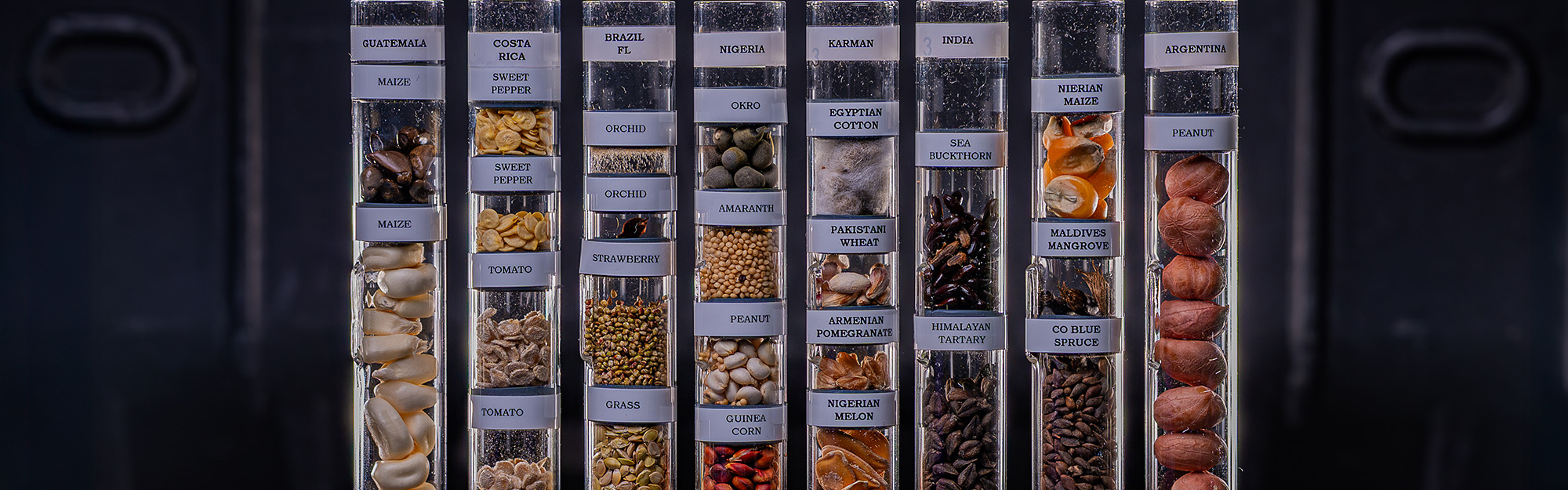
Through an international collaboration, Mahhad Nayyer, an AAE PhD student, helped lead a mission to send culturally significant crop seeds from 11 nations to the International Space Station (ISS). That payload included seeds from Nayyer’s home country, Pakistan — a historic first.
The initiative brought together researchers and space leaders from around the world to explore how native crops respond to microgravity. Nayyer, a 2024 Karman Pioneer, spearheaded Pakistan’scontribution.
“This is quite literally a dream come true,” Nayyer said. “It’s not just about sending seeds to space — it’s about planting the idea that space exploration should be inclusive, culturally grounded and accessible to all.”
The seeds — including Egyptian cotton, Armenian pomegranate, Nigerian egusi melon, and Pakistani wheat — represent more than agricultural staples. They are symbols of national identity and resilience. The mission aims to study how these crops behave in space, generating insights into seed germination, structural changes and adaptive traits under microgravity. These findings could inform future efforts to develop cultivars suited for space farming and extreme Earth environments.
At Purdue, Nayyer is collaborating with graduate research assistant Muhammad Haroon (MS ’25 botany) in the Department of Botany and Plant Pathology to analyze physiological changes in the wheat seeds, including water transport and gas exchange mechanisms. The research builds on Purdue’s legacy of leadership in space exploration and agricultural innovation.
The mission also carries a powerful educational message. Nayyer engaged schools, universities and science outreach programs across Pakistan to connect students with the experiment and inspire future space scientists. “We want young people to see space not just as rockets and astronauts, but as something rooted in their stories, their crops and their ideas,” he said.
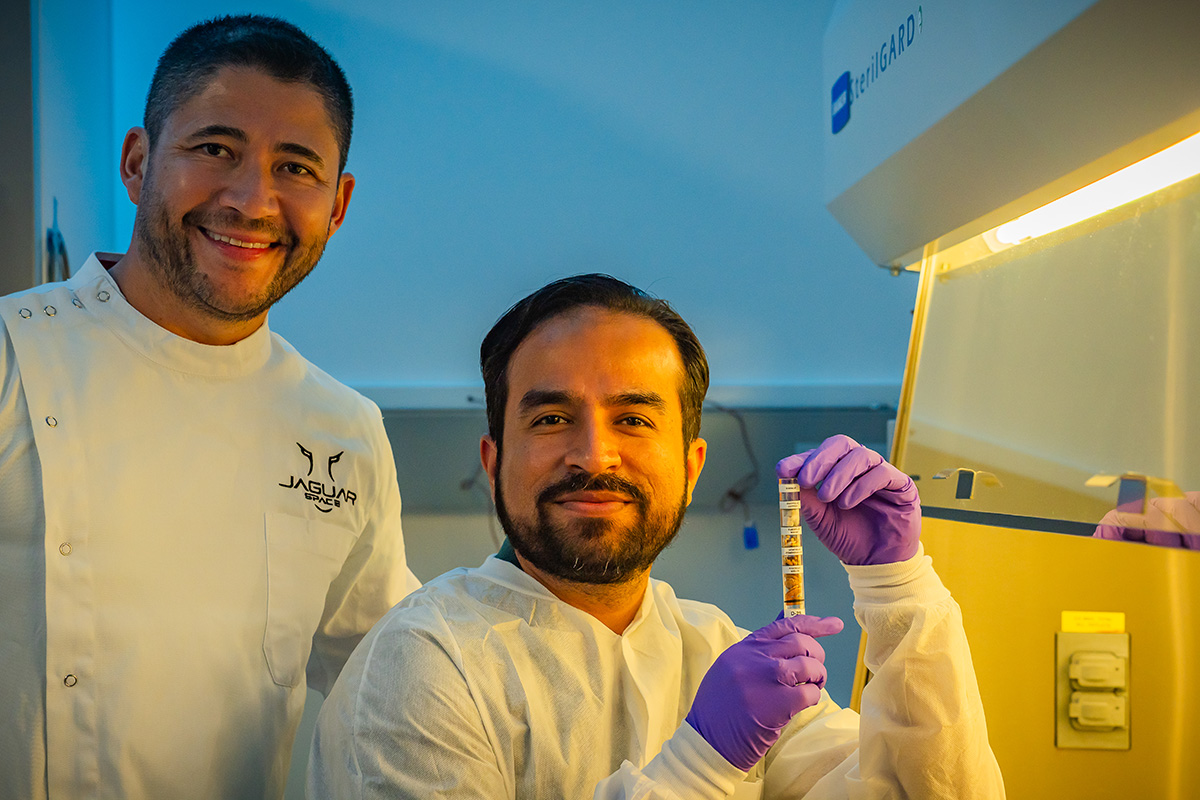
Mahhad Nayyer, right, with Jaguar Space founder Luis Zea, holds seed samples that launched to the ISS with NASA’s SpaceX Crew-11 in July 2025.
The payloads were selected through a competitive process within the Karman Project’s global network, which spans over 70 countries. Jaguar Space, a bioastronautics company founded by Karman Fellow Luis Zea, is providing technical expertise and mission integration. “This mission reflects the action-oriented spirit of our Fellowship,” said Hannah Ashford, managing director of The Karman Project. “It empowers our community to lead impactful projects across borders and build a more inclusive space future.”
The seeds launched to the ISS with NASA’s SpaceX Crew-11 on July 31, 2025, and returned to Earth in August.
Mahhad Nayyer was recognized as one of five Young Space Leaders for 2025 by the International Astronautical Federation (IAF), during a ceremony in Sydney, Australia. This award celebrates individuals who contribute to astronautics and global space sustainability.
“This represents one of the highest honors a young space professional can receive,” Nayyer said. “To be recognized among only five global awardees and as one of just two engineers is an immense source of pride for me, and a moment of deep gratitude toward my current and past alma maters who have shaped my journey.”
Nayyer’s research focuses on Space Situational Awareness and Space Traffic Management, developing analytical frameworks to assess orbital capacity and inform technical, legal, and policy decisions for sustainable space operations.
Nayyer envisions a future where space activities are inclusive, equitable and sustainable. As a Ph.D. student at Purdue, he continues to refine his research in astrodynamics and orbital design, aiming to shape global frameworks for space traffic coordination.
