

A new artificial intelligence platform has been launched to help users more quickly develop composite materials and structures without requiring in-depth technical jargon or knowledge.
AnalySwift LLC, a composite simulation software provider, has partnered with Purdue University researchers to create CompositesAI. CEO Allan Wood says it helps users more quickly create and analyze composite products designed with other AnalySwift software solutions.
Designers and engineers can use the free platform at CompositesAI.com.
Wood says AnalySwift offers software for the burgeoning air mobility industry to design composite rotor blades and propellers, components common to these vehicles. As air mobility companies mature, they encounter difficulty in modeling complex multimaterial, multilayer rotor blades.
“They need blades with very specific shapes and performance characteristics such as inertial, elastic and strength properties,” he says. “While air mobility engineers may have strong knowledge of composite materials and structures, blades often require specialized experience, which meant outsourcing this key component or hiring blade engineers. CompositesAI, paired with AnalySwift’s blade modeling software, VABS, helps overcome this challenge.”
As an example, an engineer could describe a helicopter or air mobility blade in natural languagethrough the platform.
“CompositesAI translates that language into the specialized input files needed to design the blade with VABS,” Wood says. “This helps engineers more quickly develop products without requiring detailed technical knowledge related to using AnalySwift’s tools — VABS and SwiftComp.”

AnalySwift partnered with Wenbin Yu on the CompositesAI project. Yu is the Milton Clauser Professor of Aeronautics and Astronautics and AnalySwift’s chief technology officer.
“AI is rapidly transforming many aspects of our life and will play a major role in advancing composites’ design and manufacturing,” he says. “We are working to stay on the leading edge of these developments by launching CompositesAI, aimed at consolidating and delivering composites expert knowledge using AI.”
The CompositesAI project focused on four objectives:
1. Train CompositesAI to be an AI-powered tech support system for AnalySwift products.
2. Develop a feedback mechanism so users can provide questions and answers to further improve the performance of CompositesAI.
3. Develop an AI-human interactive platform so AnalySwift engineers can collaborate with CompositesAI to answer customers and automatically collect answers to further improve CompositesAI.
4. Develop application programming interfaces so input files can be easily generated and companion software can be invoked for AnalySwift products.
Yu says CompositesAI is initially focused on rotor blades for air mobility, helicopters, unmanned aerial vehicles, drones and wind turbines, but its uses will expand.
“It will soon be able to handle other composite structures such as plates, shells, panels and other 3D structures utilized by engineers in designing the next generation of aerospace, defense, energy, medical and sporting goods applications,” Yu says. “Once fully developed, CompositesAI will be capable of handling all aspects of composites with the precision of validated engineering software and authority of world-leading experts.”
AnalySwift has partnered with Indiana-based Applied Research Institute, an economic development organization whose innovation voucher program provided matching funding to further the objectives of the partnership with Purdue.
AnalySwift licenses some of its innovations through the Purdue Innovates Office of Technology Commercialization.
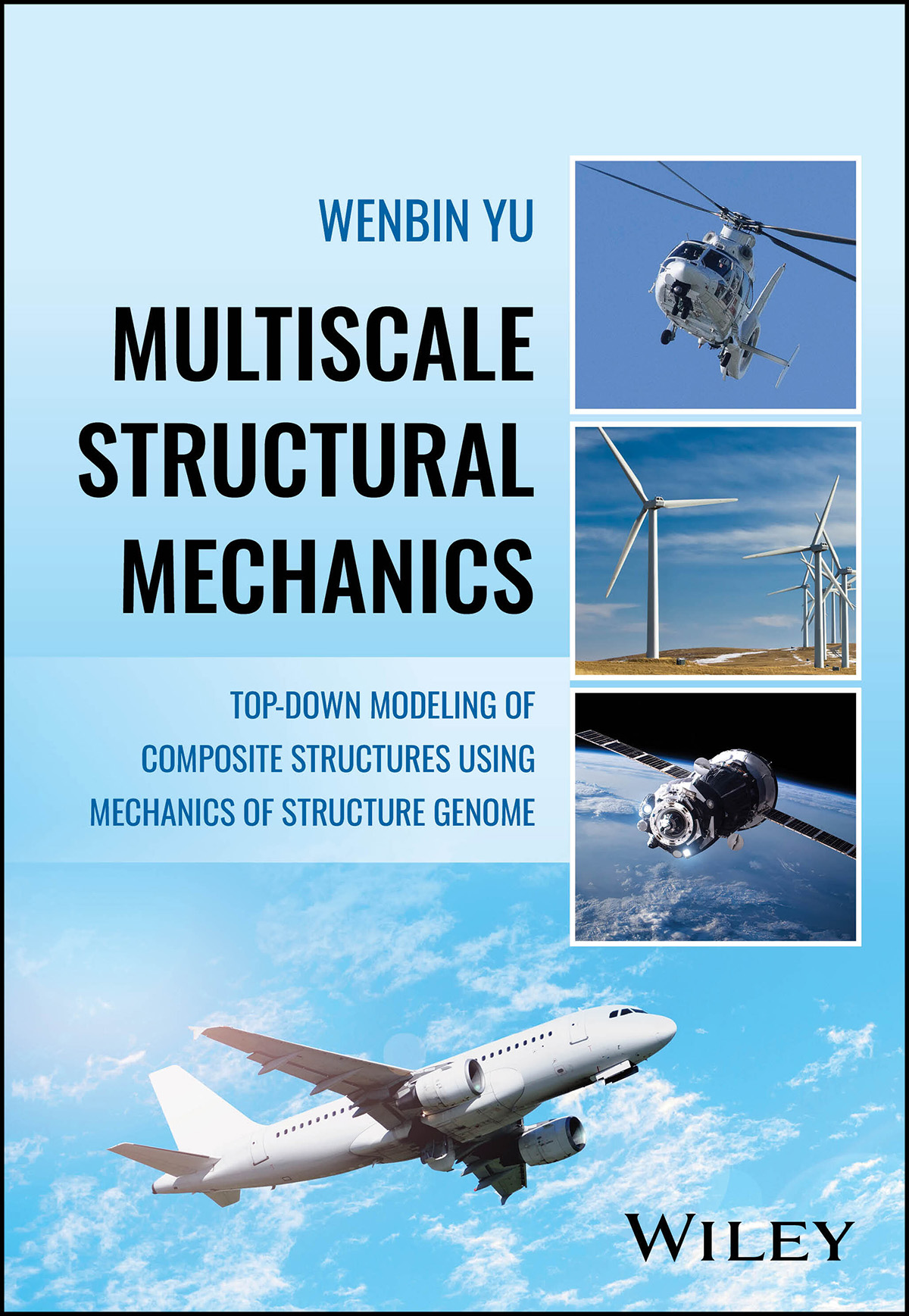
Professor Wenbin Yu is the author of “Multiscale Structural Mechanics: Top-Down Modeling of Composite Structures Using Mechanics of Structure Genome.”
The book, published in January 2026, delivers a unified approach to composite modeling based on the mechanics of structure genome, offering multiscale constitutive modeling for general anisotropic and heterogeneous materials and structures with the simplicity of classical engineering models.
