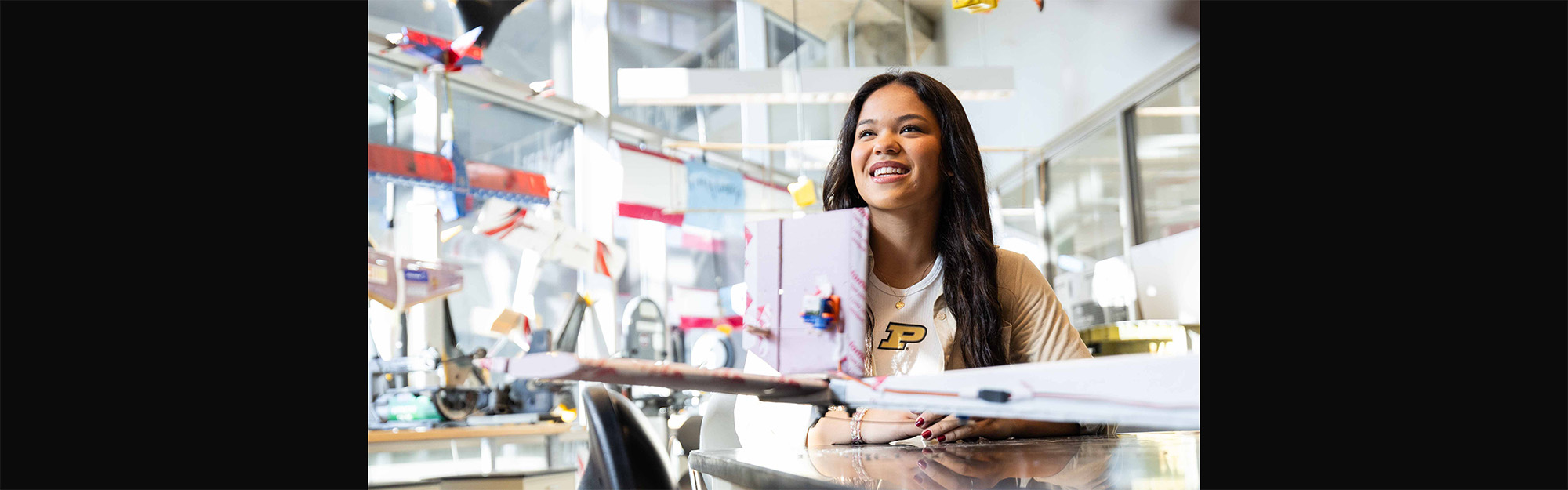
A Purdue student is going to space.
Not as a tourist, but as a researcher.
On a flight scheduled for 2027, Abigail Mizzi (BSAAE ’25) and her faculty advisor, Professor Steven Collicott, will each conduct separate experiments on fluid dynamics in microgravity. They will be part of the world’s first all-Boilermaker flight into suborbital space, aboard Virgin Galactic’s new Delta-class spacecraft.
Mizzi, a graduate student in the School of Aeronautics and Astronautics, was selected by a Purdue faculty committee to join the historic Purdue 1 mission. The flight will be part of Virgin Galactic’s research program, which offers academic institutions direct access to microgravity environments.
“This is a culmination of the skills and knowledge that I learned in the past four years, and now get to apply it in the unique and complex environment of space,” Mizzi says.
Her research, as well as Collicott’s, will focus on how motion in microgravity affects liquids. Modeling fluid motion has directapplications in spacecraft propulsion systems and fuel management. Their experiments will be conducted during the three to six minutes of weightlessness provided by the suborbital flight.
“This is exactly why I want to go to space,” she says. “To gather real data and add to this body of knowledge that researchers, designers and engineers can use on future spacecraft.”
Mizzi has also built a leadership profile at Purdue, serving as president of the Society of Women Engineers and received the organization’s Outstanding Collegiate Member Award in 2025. She’s also an ambassador for AAE, the College of Engineering and the Honors College. She was also awarded a prestigious scholarship from the Wings Club Foundation in 2024.
“She has created positive change on campus,” says Karen Marais, an AAE professor who nominated Mizzi for the scholarship. “Her passionate and driven leadership exemplifies the kind of student who gives back to the Purdue community.”
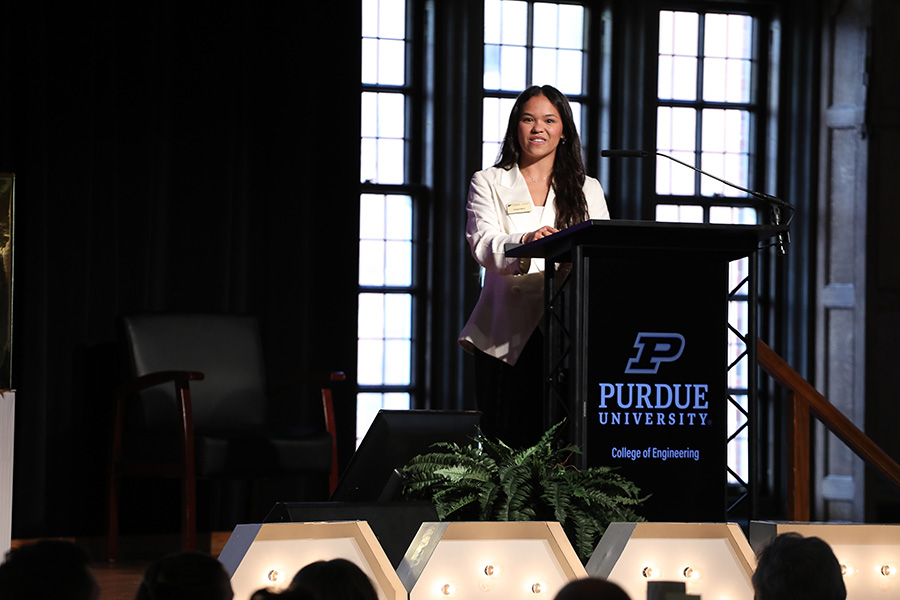
Mizzi’s warm personality and talent as a public speaker has earned her multiple opportunities to speak at Purdue events. She has emceed AAE’s Outstanding Aerospace Engineer awards dinner, and, as seen above, given a speech during the College of Engineering’s Distinguished Engineering Alumni Awards reception.
The Purdue 1 mission is a collaboration between Purdue University and Virgin Galactic, with support from NASA’s Flight Opportunities program. Collicott will be conducting his own NASA-funded fluid dynamics experiment. The remaining passengers are Purdue alumni Jason Williamson (BSCE ’97), senior vice president of the multidisciplinary design firm Dunaway, and two others whose names will be announced later.
Known as the Cradle of Astronauts, Purdue has 30 alumni — 18 from Purdue AAE — who have already flown in space or been selected as NASA astronaut candidates. Collicott, Mizzi and Williamson will be considered part of the Cradle of Astronauts following their Virgin Galactic flight.
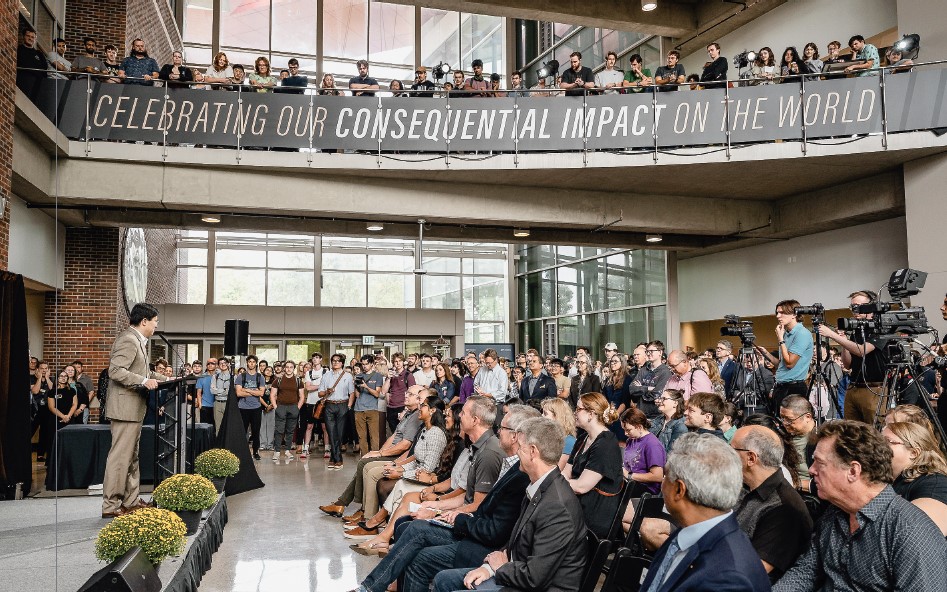
The Purdue 1 suborbital space mission aboard a Virgin Galactic spacecraft was announced on Sept. 23, 2025, to a large crowd gathered at the Neil Armstrong Hall of Engineering.
“We anticipate that this mission with Purdue University will be a powerful demonstration of what can be possible when research institutions and educators gain direct access to the microgravity environment,” says Mike Moses (BS ’89 physics and astronomy, MSAAE ’95), president of Virgin Galactic. “By enabling researchers to accompany and interact with their experiments in real time, we are not just advancing science — we are empowering the next generation of innovators and expanding the frontiers of educational opportunity. We expect Purdue 1 to be a milestone for our spaceline and for the broader research and education community, showing how suborbital spaceflight can transform both scientific inquiry and hands-on STEM education.”
Designed to seat up to six passengers, Virgin Galactic’s next-generation spaceship is customizable and will have one seat removed for this mission to fly the five crew members and allow space for a payload rack to hold the research experiments.
“This flight puts an experienced researcher up there with the experiment,” Collicott says. “It’s not like I’m sitting with the experiment next to the crew and simply watching it. It’ll be a situation where observations and decisions need to be made to maximize the value and amount of data collected in the experiment. I expect to be there and be able to adjust and control the experiment hardware for the duration of the flight.”
Virgin Galactic’s Delta-class spacecraft is designed for frequent flights, with turnaround times as short as one week. This rapid cadence allows researchers to iterate quickly, potentially accelerating scientific discovery.
“We are challenging the notion that a university is restricted to a geographical location on Earth,” says Arvind Raman, dean of the College of Engineering. “A university environment of research, learning and career success can also be continued beyond Earth to space, the next endless frontier.”

Professor Steven Collicott began his AAE418 course, “Zero Gravity Flight Experiments,” 30 years ago with the explicit intent of providing students opportunities few other universities could.
Students from the course have tested spacewalk tools in NASA’s and others’ neutral buoyancy pools. They’ve run experiments aboard parabolic flights in Earth’s atmosphere while experiencing weightlessness themselves — on the appropriately nicknamed “vomit comet.” They’ve traveled the country to watch their experiments launch on suborbital rockets from private aerospace companies.
The 2025-26 academic year marks the 30th anniversary of Collicott starting this course, on the insistence of two of his students. More than a thousand students have taken his course since. Many of them have gone on to become major figures in the aerospace industry — including Sirisha Bandla (BSAAE ’11), former Virgin Galactic vice president and a Purdue astronaut.
