
2026 Recipients
Rohith Chandrasekar
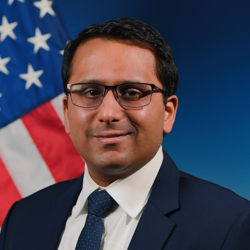
Rohith Chandrasekar | Electrical Engineering
Director of Advanced Materials, Leidos
Through Rohith Chandrasekar’s leadership and management of large research programs at the National Geospatial-Intelligence Agency (NGA) and Defense Advanced Research Projects Agency (DARPA), his work led to the maturation and transition of critical infrared technologies to various Government end users including the Air Force Research Laboratory. One of those technologies, meta-optics, are now being incorporated into military-specific night vision goggles for future military forces as well as defense payloads. His relationship with DARPA began in 2016 when he served as a contracted scientific, engineering and technical advisor (SETA), assisting six program managers and supporting a ~$150 million portfolio. In 2019, he became a program manager at NGA, where he bolstered the scale and efficiency of planar optics to meet intelligence community (IC) needs and established new modeling tools to design them. For his work at the NGA, he was selected as an IC Science and Technology Fellow in 2020.
Next, he was hired as a program manager in DARPA’s Defense Sciences Office, inheriting several of the initiatives he had helped create as a SETA and accelerating them into breakthrough demonstrations. He pitched and secured funding for three large high-risk research programs in infrared materials for defense missions, and his total portfolio during his three-and-a-half-year tenure totaled ~$100 million. As a result of funding from his programs, several startups were created and have advanced to prototype commercialization. In addition, he managed the Young Faculty Award for the Agency, which oversaw research efforts led by ~100 rising stars in academia focused on Defense relevant research.
He joined Leidos in 2024 as director of advanced materials, building strategies for disruptive defense technologies in the areas of meta optics, radiofrequency metamaterials, quantum sensing and photonics. In his first year, he secured $2 million+ in internal R&D funding to advance new materials solutions for space payloads. He was inducted into the Leidos Distinguished Scientists and Engineers Community for his work at DARPA and his leadership across several initiatives at Leidos. In January 2026, he was promoted to branch director of Emerging Space Technologies, leading a team focused on accelerating maturation and integration of mid-TRL technologies into space payloads to yield disruptive capabilities. Chandrasekar said his Purdue professors “established the insatiable curiosity needed for R&D and the passion for transition to real systems.”