
2026 Recipients
Mathew Cherukara
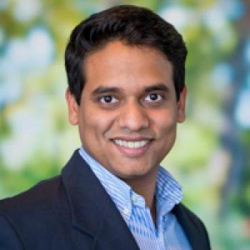
Mathew Cherukara | Materials Engineering
Group Leader & Computational Scientist, Argonne National Laboratory
Modern scientific facilities generate data at a rate that exceeds human capacity for analysis. By deploying high-speed AI models, Mathew Cherukara has enabled “on-the-fly” experimentation, reducing analysis time from weeks to seconds and allowing researchers to pivot their experiments instantly rather than waiting weeks for data processing. Cherukara’s development of “physics-aware” AI framework and digital twins utilize deep learning to process massive scientific datasets in real time.
Five years after earning his PhD, Cherukara — at the age of 32 — was appointed as one of the youngest-ever group leaders in the history of the Advanced Photon Source at Argonne National Laboratory. He was recently appointed co-Director of NAISE, the Northwestern Argonne Institute for Scientific and Engineering Excellence. Also a computational scientist, he leads15 PhDs and serves as the AI point of contact for the entire Photo Sciences Directorate, overseeing AI strategy for a facility of 500+ people. He has served as a public representative for AI applications at Argonne during major events drawing 1,000+ attendees and organized large-scale tutorials on AI for hundreds of scientists. He also leads teams on various Department of Energy projects, including the Genesis Mission, representing $5 million+ in combined grants. At the University of Chicago Booth School of Business, he was selected for the Strategic Laboratory Leadership Program in 2025 and the Strategic Program for Innovation in 2024.
Cherukara has authored 80+ peer-reviewed papers that have garnered 4,400+ citations and an h-index of 36, and his innovations have led to 4 U.S. patents enabling AI-driven materials discovery and characterization. Central during his PhD at Purdue was grasping how to blend foundational materials science with advanced computing. “By mastering massively parallel high-performance computing simulations and data analytics, I learned to bridge the critical gap between theory, data analysis and experiments,” he said.