
See university-level updates: Purdue AI Resources for Instructors
To 9 common questions about AI
Uncommon answersWhat constitutes a fair accusation of AI plagiarism?
Reframe: Shift the conversation away from "Did AI write this?" towards the more important questions of how AI was used, why it was used, where it added value, and what level of human oversight remained throughout the process? Instead of focusing on disciplinary accusations, distinguish between effective uses of AI and ineffective uses that prevent student learning.
- Assess students’ AI use strategies: On the first day, assign a technical homework problem. Instead of asking students to solve it immediately, ask them to plan their problem-solving strategy including their AI-use strategy.
-
Facilitate effective uses of AI emphasizing ways experienced users work with AI.
- Use AI as an iterative collaborator, not an answer machine. It is important to provide additional context and request revisions.
- Ask AI for alternatives, not just a finished product.
- Critique the response and identify gaps. Make the final disciplinary and ethical judgments yourself.
- Use AI to define purpose, audience, constraints, and acceptable evidence.
- Verify facts, calculations, citations, and interpretations independently.
- Document the aspects of the process that require transparency.
- Responsible AI use is not just about knowing what tools are available or what data can be uploaded. It is also about understanding when human expertise, professional judgment, and independent verification are still essential. Brainstorming ideas or generating examples carries relatively low risk, whereas creating assessments, interpreting policies, summarizing research literature, providing student feedback, or making grading decisions requires much more careful review. Plan how you will independently verify factual claims, citations, calculations, source interpretations, and policy-related information before relying on AI-generated outputs.
- Plan each assignment: Before releasing each assignment, run your assignment through two AI platforms. Examine not only the answers, but also the structural and stylistic patterns the model produces.
If AI is encouraged in an assignment:
- Before submission, require each student to create an “AI Preface” or “AI Prologue” as part of a cover page describing exactly how they used AI.
- You can also require prompt logs, initial prompts, raw AI outputs, track changes, version histories from Google Docs or Microsoft Word.
If AI is not allowed in an assignment:
- If there is uncertainty about whether the submitted work reflects the student’s understanding, use a brief follow-up conversation or related task to give the student another way to explain the reasoning and demonstrate learning.
- Follow established academic-integrity procedures when misconduct is suspected. Do not rely on AI plagiarism detectors as your sole evidence; they are prone to false positives. When it is necessary to follow disciplinary action, have multiple sources of evidence to support your position.
What if my students are resistant to using AI?
Reframe: These concerns are healthy and real. What concerns should faculty mitigate? What concerns students should learn to examine? What are the tradeoffs when using and not using AI?
- Discuss when AI use is disproportionate to the benefit of the task.
- Address inequitable access to paid models.
- Make clear that human review is not sufficient unless the reviewer has the expertise and information needed to evaluate the output.
- Require students to verify consequential factual claims against authoritative sources. AI-generated content should be treated as an unverified draft.
- Ask students to identify whose perspectives or data may be absent from an AI response.
- Examine who benefits, who could be harmed, and who remains accountable.
- Discuss copyright, attribution, and ownership of uploaded or generated material.
- It is a paradox because we need the most skeptical to use AI to guide its most ethical applications.
How do I assess genuine learning when students use AI?
Change HOW you teach and assess:
- Transition to a flipped-classroom model. Students can use AI to read, summarize, and explore content at home, while class time is dedicated to formulating, presenting, debating, and collaborative problem-solving.
- Begin class with a five-minute, paper-and-pencil quiz on concepts covered in the homework.
- Convert one major assignment into an in-class presentation or an interactive short video created by the students
- Ask students to submit a one-minute video along with their assignment
- Refer to Purdue Instructional Innovation site for ADA checklist and resources https://www.purdue.edu/innovativelearning/tools-resources/accessibility/
- Check out DocAble created by Dr. James C. Davis (ECE) and see what is possible with GenAI. Please log in with your Purdue email.
Reframe: Which software tools provided by my university include FERPA protections?
Know your Data: Generative AI tools such as free versions of ChatGPT or Gemini are classified for public data only. Do not upload sensitive or restricted data to these tools.
- Sensitive data: PUIDs, grades, course information, related records, etc.
- Restricted data: student Social Security numbers, dates of birth, GPAs, transcripts, enrollment information, etc.
Know your Resources: Purdue provides several options Instructional Technology - Innovative Learning, including the opportunity to request new tool integration New Brightspace Tool Integration - Innovative Learning:
Reframe: Which software tools provided by my university include FERPA protections?
Know your Data: Generative AI tools such as free versions of ChatGPT or Gemini are classified for public data only. Do not upload sensitive or restricted data to these tools.
- Sensitive data: PUIDs, grades, course information, related records, etc.
- Restricted data: student Social Security numbers, dates of birth, GPAs, transcripts, enrollment information, etc.
Know your Resources: Purdue provides several options Instructional Technology - Innovative Learning, including the opportunity to request new tool integration New Brightspace Tool Integration - Innovative Learning:
| Tool | Description |
|---|---|
| Circuit |
Facilitates student peer review; formerly known as Charlie. Circuit - Innovative Learning |
| Gradescope |
Automated grading software for grades. Gradescope - Innovative Learning |
| iClicker |
Automated question generation; FERPA-covered student performance data. iClicker Cloud - Innovative Learning |
| Microsoft Copilot with data protection | Please consult: |
| Google Gemini Project |
Currently public data only. Some tools within the Google AI suite are available and others are not. For Purdue updates see Purdue Knowledge Base - Google Gemini Project. For a summary of Google enterprise products see table below. |
| Purdue GenAI Studio |
Web access to multiple open-source AI models running on Purdue hardware. Models include LLaMA, Mistral, and DeepSeek. Configured to accept sensitive data, excluding FERPA-protected data. https://genai.rcac.purdue.edu |
| Turnitin |
iThenticate; FERPA-covered plagiarism detection. Turnitin Originality - Innovative Learning |
| Variate |
Automated question generation; FERPA-covered grade data. Variate - Innovative Learning |
| And More … | Instructional Technology - Innovative Learning |
Google Enterprise.
| Old Name | Right tool when … | |
|---|---|---|
|
Gemini Notebook https://notebooklm.google/ |
NotebookLM | When you need a closed-source knowledge base (PDFs, transcripts, course documents, teaching notes), synthesize information, audio overviews, or custom study guides. |
|
Google AI Studio https://aistudio.google.com/apps |
n/a, this is new | When you want a sandbox to prototype full apps and instantly host web apps under a custom google ai.studio domain. You can experiment with raw Gemini models and generate API keys. |
|
Google Antigravity https://antigravity.google/ |
Gemini Code Assist or Gemini CLI | When you want an autonomous AI companion in your local development workspace (VS Code, JetBrains, or terminal) to execute terminal commands, orchestrate subagents, and rewrite complex repositories. This is an agentic development desktop app and a multi-agent CLI framework. |
|
Gemini Chat https://gemini.google.com |
Bard | When you need an open-ended web search, a conversational brainstorming partner, image/video generation, or voice-activated smartphone automation. This is a general-purpose conversational assistant and real-time personal AI companion. |
Go Offline: You can download software, such as LM Studio, that runs open-source large language models locally. Download an open-source model, disconnect Wi-Fi and Ethernet, and run the model on your computer. Check the recommended RAM requirements for your hardware.
How do I teach students to cite AI ethically?
Reframe: Avoid treating AI solely as a plagiarism tool. AI platforms can be used in many ways: as assistive technology tools, artifact creation tools, collaboration agents, etc.
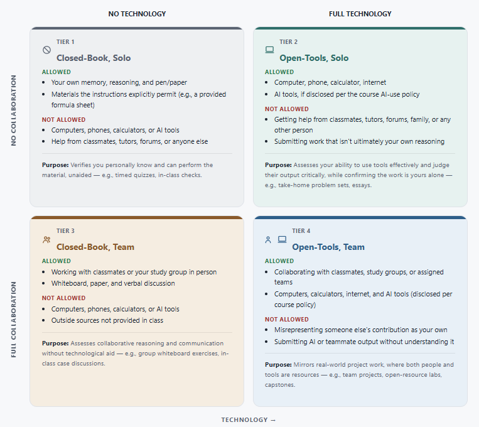
- Create policies that treat AI as both an assistive technology and a collaboration agent. Clearly communicate the purpose of any constraints put on each assignment. Distinguish expectations across levels of technology use and collaboration, as shown below.
- Let students plan. Dedicate the first assignment to developing an AI-use strategy. See Q1.
- Remind students that AI-generated content should be treated as an unverified draft, not an authoritative source
The policy framework below is an example generated with Claude after prompting it to distinguish between technology use and human collaboration. This tool requires further scrutiny, but it illustrates two distinct uses of AI: as an assistive technology or a collaboration tool. It does not cover courses focused on autonomous agents, which require a more elaborate policy.
Four-tier policy framework for technology use and collaboration. (Claude-generated draft)
This question is a tough one but reframing with new questions may help:
Did I use AI to help my students learn concepts that are especially difficult?
Did I engage my students who are most skeptical in tackling tough questions that experts are grappling with when using AI?
Did I shift my focus from content delivery to human judgment (with technical precision) by leveraging competence, autonomy, and relatedness?
Why not involve my students in tackling this dilemma?
- Ask student teams to build artifacts and simulations that teach a particularly difficult engineering principle/concept core to your course.
- Students would need to figure out how to audit, evaluate, control, and direct AI outputs (oversight).
- Teams would need to consult a content expert, you, your TA, and course materials to assess their artifact’s technical accuracy.
- Teams would need to consult peers to assess their artifact’s educational efficacy.
- Teams would need to document their process with prompt logs, initial prompts, raw AI outputs, track changes, version histories etc.
- Assess students’ understanding of disciplinary concepts and AI competencies.
Reframe: No assignment is AI-proof, but they can be modified to be future-proof. Such assignments require authentic human decision-making, debatable or defensible answers, and reflect what the students will be able to do after graduation.
Change WHAT you teach and assess:
- Add hyper-local, recent, and personalized constraints such as a specific event that occurred in the city during the previous week. Ask students to connect theory to everyday experiences.
- Convert textbook problems into authentic problems while maintaining technical competence. Example: Problem Forge
- Design an authentic, complex assessment strategy that mirrors your professional field. Ask students to do what you want them to be able to do after graduation, using the knowledge gained in your course.
- Creating a course website or an interactive web simulation
- Aligning assignments with learning objectives
- Identifying redundancies in course materials
- Identifying essential questions, generating draft rubrics
- Making feedback constructive, Summarizing themes in student feedback
- Creating contextualized, authentic problems
- Drafting announcements, organizing notes,