Oceanus Spacecraft
The Oceanus spacecraft is comprised of an orbiter vehicle and two atmospheric entry probes. The first entry probe is delivered into the atmosphere of Saturn as the spacecraft performs a gravity assist on its way to Uranus. The second entry probe is delivered into the atmosphere of Uranus prior the orbiter capturing into orbit using the impulsive burn of one of its two liquid rocket engines. In order to receive data from the probes and transmit data back to Earth, a 4-meter diameter high gain antenna (HGA) serves as the primary method of communication. The orbiter is powered by a set of 5 enhanced multi-mission radioisotope thermo-electric generators that are designed to sustain the orbiter for up to 3 years after arriving at Uranus.
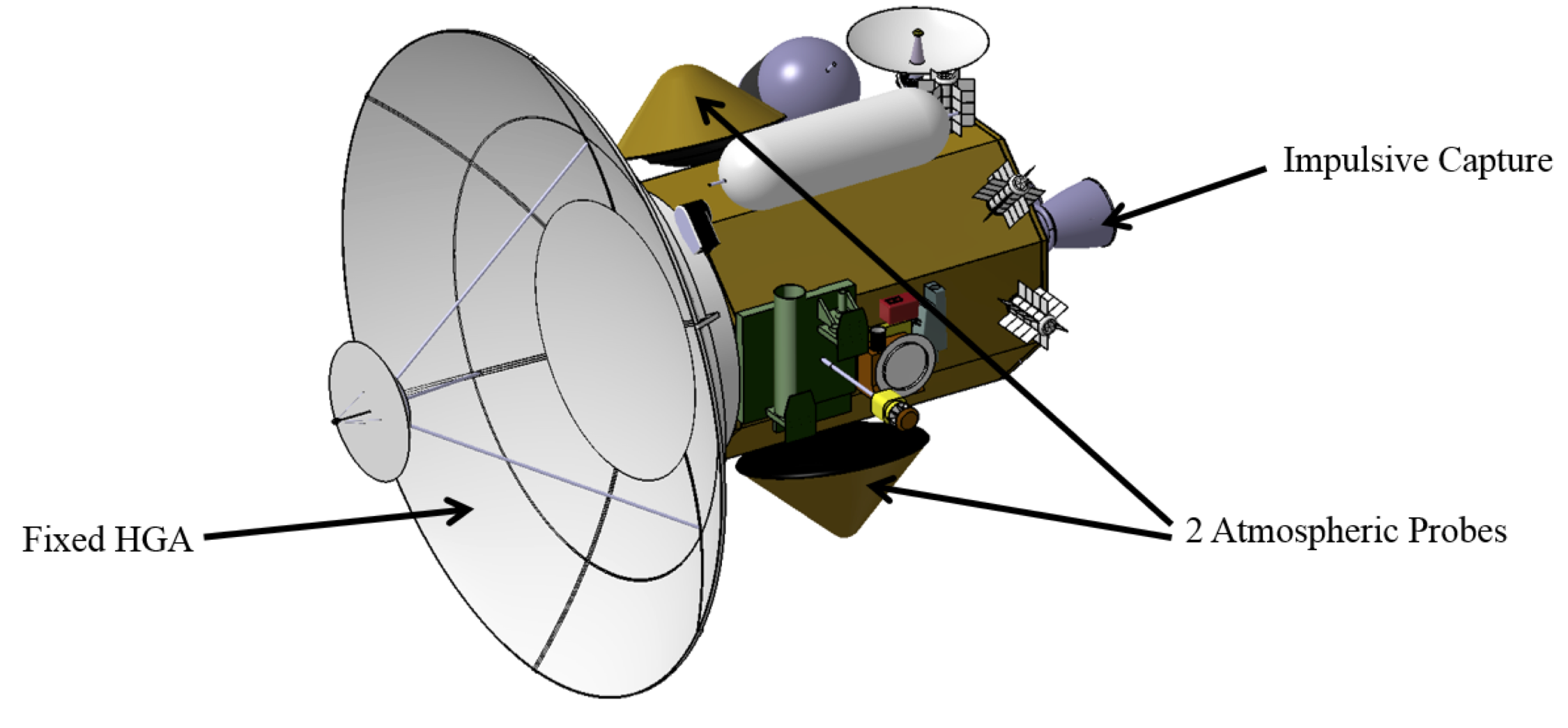
The Oceanus orbiter with its two atmospheric probes. A high gain antenna (HGA) is the main method of communication and a pair of liquid rocket engines provide propulsion.

Oceanus spacecraft with magnetometer (MAG), supra-thermal particle imager (SPI), and plasma waves analyzer (PWA) instruments deployed.
Mounted on the orbiter is a set of 9 science instruments. The suite includes cameras, optical spectrometers, particle sensors, radio antennas, a magnetometer, and even a dust impact detector. The orbiter’s high gain antenna can also be used for science experiments, particularly radio occultations of Uranus’ rings and atmosphere. Instruments are based on successful heritage experiments from previous missions. The spacecraft itself is 3-axis stabilized and is budgeted with additional propellant to allow for targeting satellite flybys.
Oceanus’ atmospheric entry probes contain a payload of 5 atmospheric experiments for measuring the conditions of the shallow atmosphere on Saturn and Uranus. The experiments are contained inside of a pressure vessel that is itself shielded from the extreme heat of atmospheric entry by an aeroshell. The aeroshell is coated in a thermal protection system (TPS) made from an advanced 3D carbon weave. The Saturn and Uranus probes are nearly identical except for slightly different aeroshell sizes, which are optimized for atmospheric entry at their respective destinations.
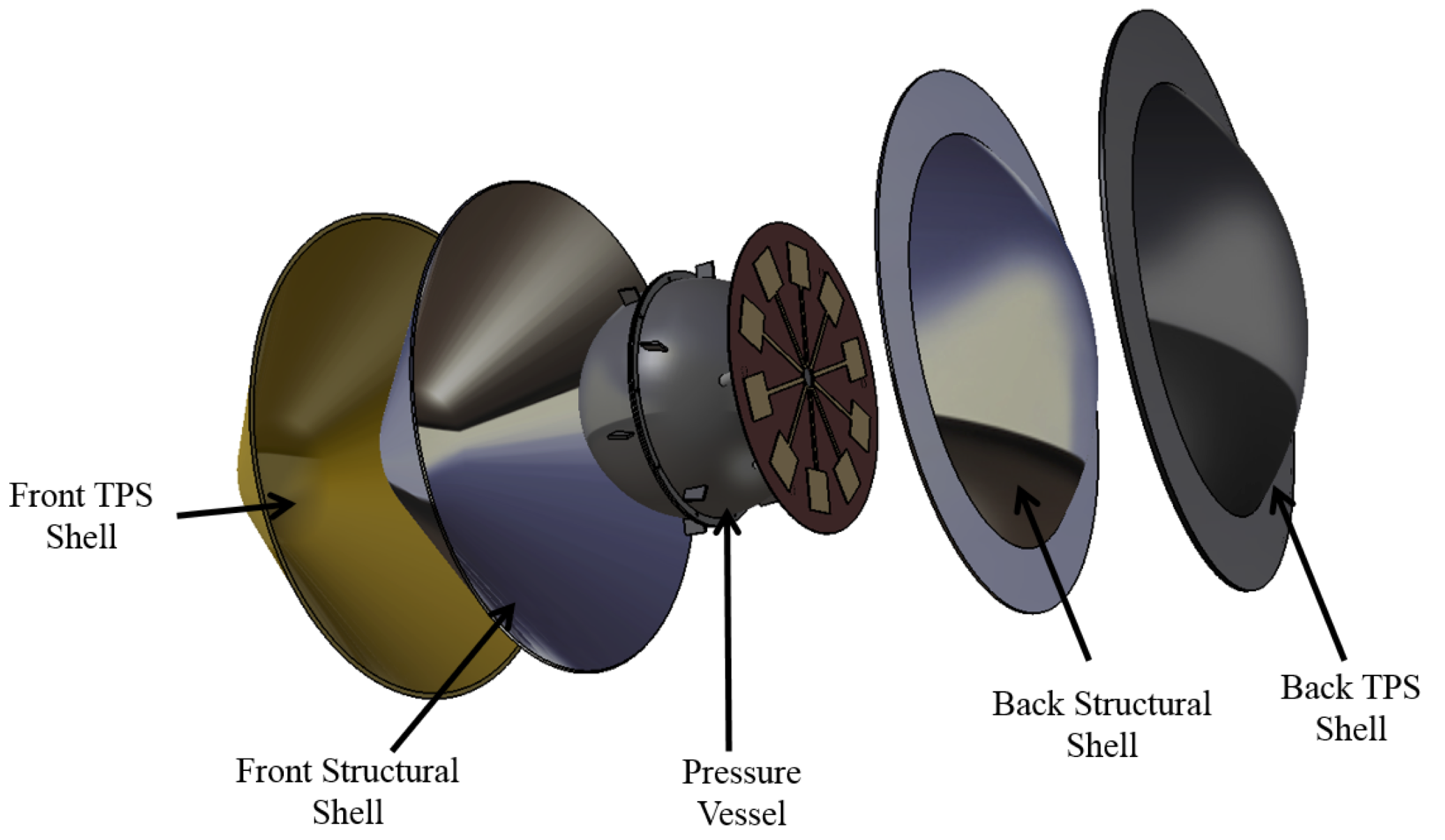
Exploded view of the atmospheric probes structure.
Mission Overview

The Oceanus interplanetary trajectory
The Oceanus mission concept is designed to be launched in mid 2028 using the new Space Launch System (SLS) rocket. The launch places the spacecraft on a ballistic interplanetary trajectory towards Saturn. As the spacecraft approaches its encounter with Saturn, it detaches the first of its two atmospheric entry probes. The interplanetary trajectory is designed such that the probe enters Saturn’s atmosphere within a very narrow range of survivable entry conditions. Even within this survivable entry corridor, the probe must withstand a peak heat rate of 7000 W/cm^2. In order to avoid entering Saturn’s atmosphere itself, the orbiter performs a deflection maneuver to send it on a path to Uranus using a gravity assist from Saturn.

Entry probe sequence of events for atmospheric entry and descent at Saturn
Oceanus arrives at Uranus in early 2040 after delivering its second entry probe into the atmosphere of the planet. To capture into orbit around Uranus, Oceanus must fire its rocket engine and burn over 1000 kg of propellant. The capture burn is performed in full view of Earth. Once captured, Oceanus remains in an elliptical 20-day science orbit for up to 3 years during which it can perform a multitude of detailed investigations about the ice giant.
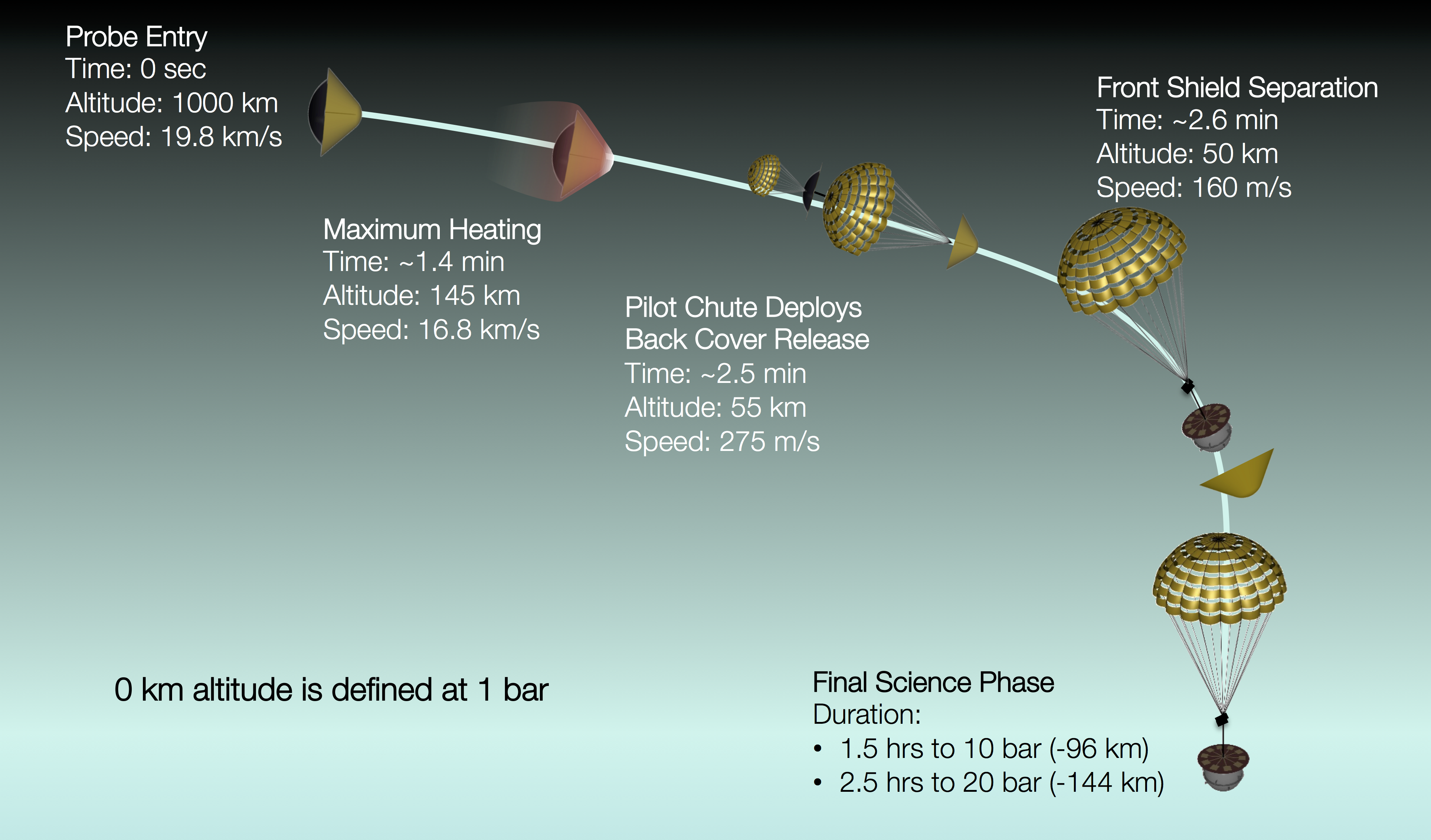
Entry probe sequence of events for atmospheric entry and descent at Uranus
Ice Giant Science
Ice giants are a distinct type of planet that may be common beyond our own Solar System. Their relatively mixed combination of both light and heavy elements sets them apart from terrestrial planets (mostly heavy rock) and gas giants (mostly hydrogen and helium). The heavy elements in the ice giants are believed to be inherited from icy materials in the early Solar System, such as water, ammonia, and methane. Studying the structure and evolution of ice giant planets can therefore provide a unique window into the conditions of the early Solar System and can shed light on the general processes of planetary formation.

Size categories of confirmed extrasolar planets measured in Earth radii. Planets approximately the same radius of Uranus make up the most populous category.
Our Solar System contains two ice giants, Uranus and Neptune, which were briefly explored by the Voyager 2 flybys in 1986 and 1989, respectively. Since then, studies of the ice giants have been limited to ground and space-based telescopes. A New Frontiers or Flagship-class mission to one of the ice giants could dramatically enhance our understanding of these planets by providing a means to study their interiors, atmospheres, magnetospheres, rings, and satellites with unprecedented detail and obtain measurements that are otherwise inaccessible from Earth. Such observations could be expected to yield new insights into the formation of the Solar System and the role that giant planets play in creating a habitable environment for Earth and potentially other Earth-like planets.
Gas Giants Too
Though the Solar System’s gas giants, Jupiter and Saturn, have enjoyed intensive exploration from dedicated spacecraft such as Galileo and Cassini, many questions remain about their origin and evolution. Atmospheric entry probes can provide crucial observations of giant planet atmospheres that are unable to be obtained from orbiting spacecraft. The Galileo mission deployed one such entry probe into Jupiter’s atmosphere and there is much interest in delivering a similar probe to Saturn. Studying the gas giants alongside the ice giants provides an important comparison of two very different types of giant planets.