

Modeling and Simulation of ship system-of-systems with
Wireless and Visual Sensor Network
A ship environment consists of complex interconected systems such as
the infrastructure, crew, and the work flow, which poses a challenge
to capability and systems planning. By studying the real-time
interactions between these systems, one can help make decisions
about new technology to be inserted on a ship such as video networks
or wireless sensor networks.
In the
Video and Image Processing Laboratory (VIPER),
we have developed and deployed a wireless sensor network as well
as a wireless video streaming network to capture, store and view
video data. This work is under the direction of
Prof. Edward Delp.
System of Systems
System of Systems is a relatively new term that is being applied primarily
to government projects for addressing large-scale interdisciplinary problems
involving multiple heterogeneous, distributed systems that are embedded in
networks at multiple levels in multiple domains. The objective of the project
is to develop an agent based methodology for modeling a naval ship environment
as a system-of-systems and by studying the real-time interactions between these
systems be able to decide about new technology to be inserted on a ship.
Two different technologies have been used:
wireless sensor networkin and network cameras.
While the individual systems constituting a system of systems can be very
different and operate independently, their interactions typically expose and
deliver important emergent properties. These emergent patterns have an evolving
nature that stakeholders for these problems must recognize, analyze and
understand. The system-of-systems approach does not advocate particular tools,
methods or practices; instead, it promotes a new way of thinking for solving
grand challenges where the interactions of technology, policy and economics are
the primary drivers. System-of-systems study is related to the general study of
architecting, complexity and systems engineering, but also brings to the
forefront the additional challenge of design. In this project the system-of-systems
theory has been integrated into a Navy Warfighter to evaluate the performance of
different integrated technologies into a ship.

Wireless sensor network is a wireless network consisting of spatially
distributed autonomous devices using sensors to cooperatively monitor
physical or environmental conditions, such as temperature, sound,
vibration, pressure, motion or pollutants, at different locations.
The development of wireless sensor networks was originally motivated by
military applications such as battlefield surveillance. However, wireless
sensor networks are now used in many civilian application areas, including
environment and habitat monitoring, healthcare applications, home automation,
and traffic control. In addition to one or more sensors, each node in a
sensor network is typically equipped with a radio transceiver or other
wireless communications device, a small microcontroller, and an energy
source, usually a battery. The size of a single sensor node can vary from
shoebox-sized nodes down to devices the size of grain of dust. Size and
cost constraints on sensor nodes result in corresponding constraints on
resources such as energy, memory, computational speed and bandwidth.
Visual Sensor Networking
A visual sensor network is a network of spatially distributed smart camera
devices capable of processing and fusing images of a scene from a variety of
viewpoints into some form more useful than the individual images. A visual
sensor network may be a type of wireless sensor network, and much of the
theory and application of the latter applies to the former. The network
generally consists of the cameras themselves, which have some local image
processing, communication and storage capabilities, and possibly one or more
central computers, where image data from multiple cameras is further
processed and fused (this processing may, however, simply take place in a
distributed fashion across the cameras and their local controllers). Visual
sensor networks also provide some high-level services to the user so that the
large amount of data can be distilled into information of interest using
specific queries. The primary difference between visual sensor networks and
other types of sensor networks is the nature and volume of information the
individual sensors acquire: unlike most sensors, cameras are directional in
their field of view, and they capture a large amount of visual information
which may be partially processed independently of data from other cameras in
the network. Alternatively, one may say that while most sensors measure some
value such as temperature or pressure, visual sensors measure patterns. In
light of this, communication in visual sensor networks differs substantially
from traditional sensor networks. Visual sensor networks are most useful in
applications involving area surveillance, tracking, and environmental
monitoring. Of particular use in surveillance applications is the ability to
perform a dense 3D reconstruction of a scene and storing data over a period
of time, so that operators can view events as they unfold over any period of
time (including the current moment) from any arbitrary viewpoint in the
covered area, even allowing them to "fly" around the scene in real time.
High-level analysis using object recognition and other techniques can
intelligently track objects (such as people or cars) through a scene, and
even determine what they are doing so that certain activities could be
automatically brought to the operator's attention. Another possibility is
the use of visual sensor networks in telecommunications, where the network
would automatically select the "best" view (perhaps even an arbitrarily
generated one) of a live event.
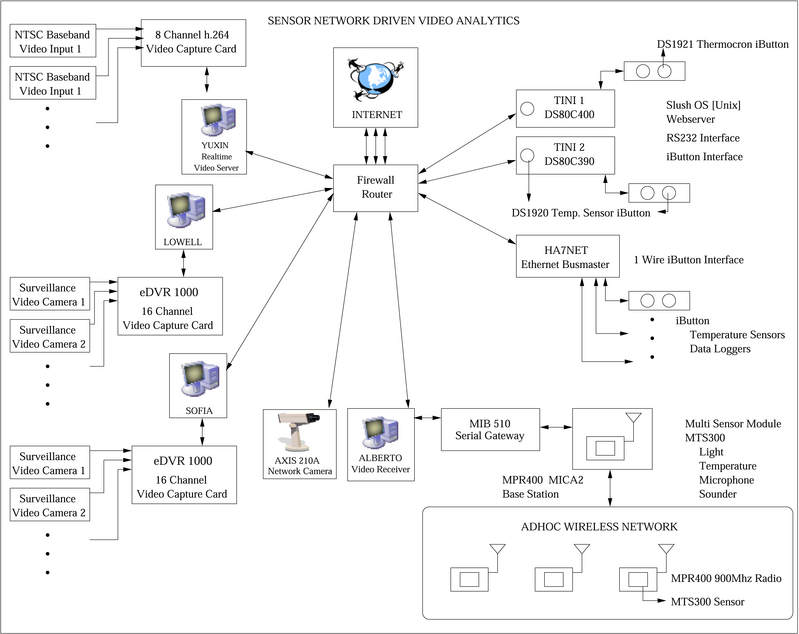
Overview of the network: Wireless Sensor and Visua Sensor networking deployment
This network is part of the modeling and simulation of ship system-of-systems with wireless sensor and visual sensor network for on-ship communications.
The network consists of a D-link 100 Mbps router. There is one domain name assigned for our
network
Publications
The complete list of recent publications in
Image and Video Coding
in the
Video and Image Processing Laboratory (VIPER).
Research Projects ||
Publications ||
VIPER
Address all comments and questions to
Professor Edward J. Delp.