

In data networks, cell or packet loss due to channel error or congestion can cause data to be lost in the channel. When MPEG compressed video is transmitted, cell loss causes macroblocks and motion vectors to be removed from the compressed data stream. Two issues need to be addressed to alleviate this problem: finding the location of the missing data, and processing the sequence to recover the missing data.
In the Video and Image Processing Laboratory (VIPER), we have developed error concealment techniques for compressed digital video streams.
The goal of error concealment is to exploit redundant information in a sequence to recover missing data. Two approaches have been used: active concealment and passive concealment. In active concealment, the video stream is post-processed to reconstruct the missing data. Passive concealment is necessary in many applications where active concealment cannot be used due to compliance with video transmission standards, or when active concealment fails.
All video decoders that will be used in consumer applications, such as set-top decoder boxes, must implement some form of passive concealment. This problem is interesting in that it absolutely requires real-time implementation. Digital signal processors (DSP), such as the Texas Instruments (TI) TMS320C6201 ('C6201), are well-suited for the demands of real-time processing, typical of error concealment.
More information is available on the Error Concealment page.

|
|
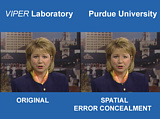
| An original frame, and the frame before error concealment. | A second original frame, and the frame after error concealment. |
The complete list of recent publications in Image and Video Coding in the Video and Image Processing Laboratory (VIPER).
Address all comments and questions to Professor Edward J. Delp.