
Slot: Shortened Loop Overlay Transport

|
|
Slot: Shortened Loop Overlay Transport |
|
Overlay routing has emerged as a promising approach to mitigating many
problems with Internet routing, such as improving the reliability of Internet
paths and supporting multicast communication. As overlay routing is gaining
wider acceptance, we argue that it is time to investigate how overlay networks
can benefit Internet transport. We propose Slot, a framework that leverages
overlay networks to improve the throughput of feedback-based transport
protocols. Slot exploits the observation that the throughput of feedback-based
transport protocols is inversely proportional to the length of their end-to-end
feedback control loop, and effectively shortens an end-to-end control loop by
breaking it up into multiple pipelined shortened sub-loops via intermediaries
carefully chosen from an overlay network. As a result, Slot increases the
throughput of an end-to-end transport connection to that of the longest
sub-loop.
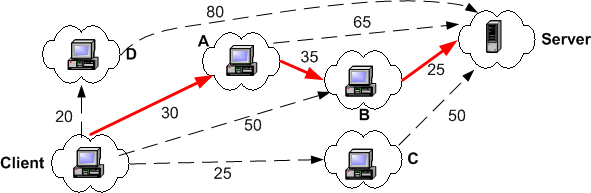 |
A Slot client module transparently hijacks outbound TCP
connections from the applications on the client node to route them through an
overlay path. For each hijacked TCP connection, a Slot client module uses the
following path discovery process: (1) probing the server to obtain the direct
server RTT, (2) requesting the intermediaries to
probe the server to obtain path RTTs to the server via paths through the
intermediaries. The alternate paths probed can range from a minimum of 2-hops
(using 1 intermediary) to multiple hops. Paths with more than 2 hops can be
obtained by having each intermediary probed by the client to repeat the above
process recursively. The path discovery process is depicted in Figure above in
which the client probes multiple paths toward the server. As seen in Figure, the
client chooses the path Client-A-B-Server which has the minimum path RTT (35
msec) out of all possible paths. Note that the sum_{i=0}^n RTT_i of this chosen
path (90 msec) is higher than the direct RTT to the server (70 msec). However,
due to pipelining of data over the TCP sub-connections, this path is expected to
have a higher TCP throughput which corresponds to its 35 msec path RTT.
Interestingly, our wide area measurements from show that a single intermediary
is enough to garner most of the gain from shortened loops.
We have also implemented MeshCache a application layer TCP relay and caching system for 802.11 wireless mesh network. MeshCache builds on the idea of Slot of breaking up long haul TCP connections (from clients to gateways) into multiple shortened sub-loops. MeshCache takes the Slot concept to the extreme and splits the transport connection at each mesh router! It also performs caching along each wireless mesh router to exploit the locality in user traffic. This system has several advantages.(1) It spreads the load in the network and hence alleviates the congestion around the gateway. (2) It promotes local communication between clients and nearby routers (that have a cached copy) which improves the capacity of mesh networks. (3) It also improves client throughput by allowing content to be fetched from nodes closer (in network hops) than the gateway as well as by providing clients the choice of choosing the best cached copy based on link-quality routing metrics. We have extensively evaluated this system through simulation and an implementation extending the squid proxy on our 32 node wireless network testbed and found that it provides significant performance improvements.
Slot is used in MeshCache with a different motivation since long
RTTs are not the main issue in wireless mesh networks. Rather, the hop by hop
transport allows us to cache data for free as it is transported. There is also
no routing detour since the transport is split along the route chosen by the
routing protocol. The throughput of per-hop transport is better than
end-to-end transport under fading channels with lossy links. The reason is that
losses can be recovered from intermediate routers and the TCP window can ramp up
faster in the event of losses since quicker feedback is obtained (from the next
hop instead of the gateway/Internet server).