Purdue University
School of Civil Engineering
CE 361 Introduction to Transportation Engineering
Fri. 2 November 2012
Class on Rigid Pavement Design and Pavement Management Systems
Instructional Objectives:
 By the end of this lesson,
the student will be able to ...
By the end of this lesson,
the student will be able to ...
-
Show how Rigid Pavement design is accomplished using Design Charts.
-
List the elements of a Pavement Management System:
- Pavement Performance Curves
- Pavement Failure modes
- Five major causes of distress
- Measuring pavement condition
- Life Cycle Cost Analysis
Prep:
Read FTE Chapter 9 Sections 4.1, 4.2, 4.4, 4.5, and 4.7, and Section 5.
Bring a photocopy of FTE Figures 9.26 and 9.27 to class,
along with a straightedge.
Theme music:
 Outline of Likely Topics
Rigid Pavement Design
Input data:
-
Expected total ESALs for the design period
-
Modulus of subgrade reaction, k
-
Concrete elastic modulus, E(c)
-
Modulus of rupture, S'(c)
-
Load transfer coefficient, J
-
Drainage coefficient, C(d)
-
Standard deviation, S(o)
-
Reliability, R
-
Initial and terminal PSI
Pavement Management Systems
-
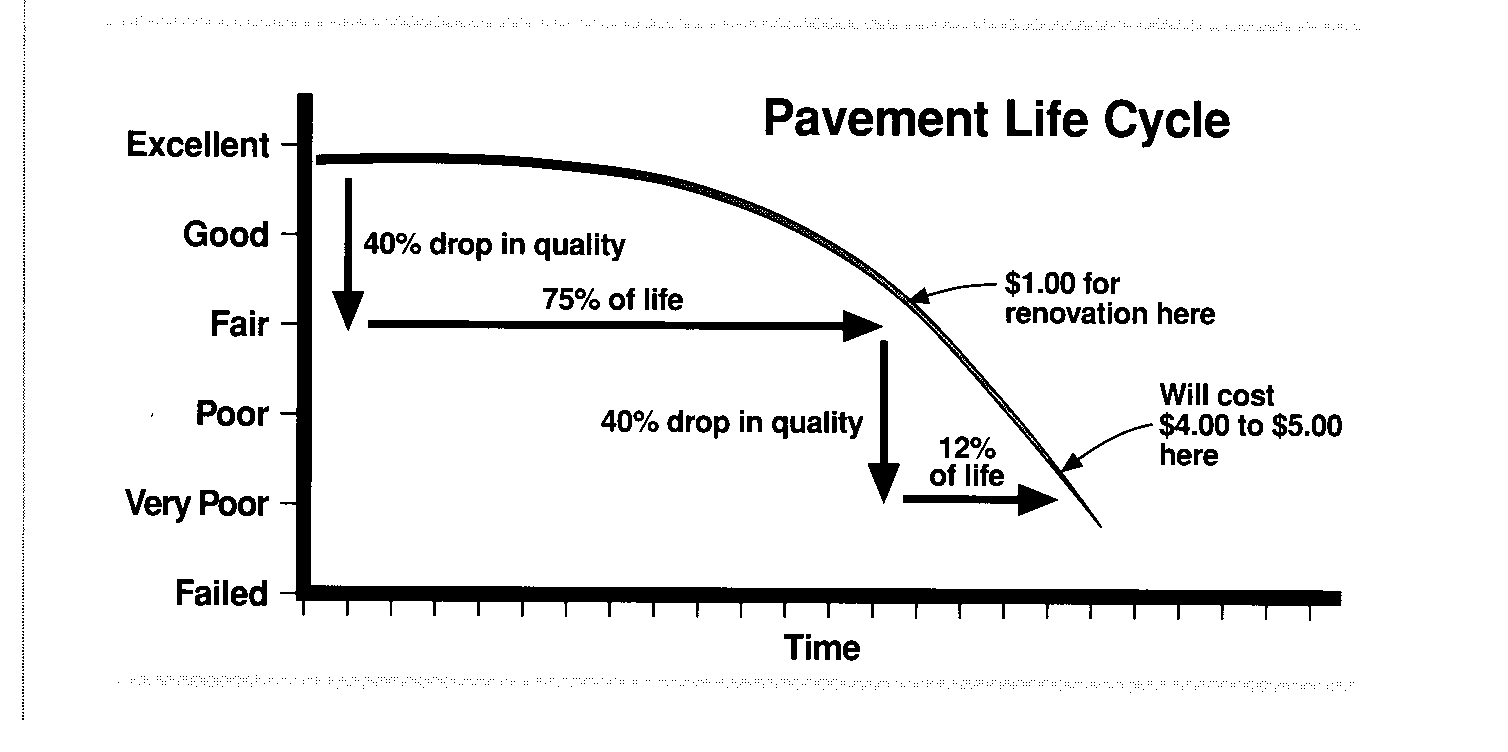
Pavement Performance Curves (FTE Figs 9.5 and 9.32)
-
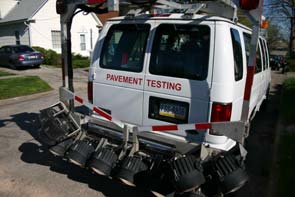
Measuring pavement roughness
-
Pavement Serviceability Rating (PSR) -- experts rate pavement on 0-5 scale
-
Pavement Serviceability Index (PSI) -- based on physical measurements of pavement
-
International Roughness Index (IRI)
-
Car-mounted Mays ride meter --> in/mi of cumulative deflections.
<165 in/mi is desirable; >256 in/mi is undesirable.
-
Pavement condition indicators
-
(1) Visual distresses (FTE Figs 9.33 and 9.34)
-
(2) Roughness
-
(3) Skid resistance
-
(4) Structural capacity
-
Life Cycle Cost Analysis -- Options:
-
Cheap pavement, 4 cycles (failure + reconstruction)
-
Expensive pavement, 1 cycle (to failure)
-
Worst First startegy or
alternatives?

