School of Civil Engineering
Faculty of Geotechnical Engineering
Engineering Geology - Underground Construction - Rock Mechanics

| Purdue University School of Civil Engineering Faculty of Geotechnical Engineering Engineering Geology - Underground Construction - Rock Mechanics |
|
|
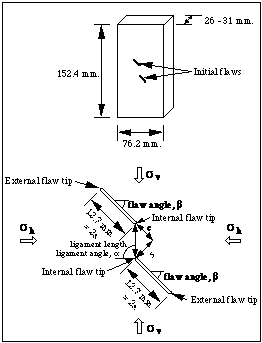
Model rock specimens of 152.4 x 76.2 x 30.0 mm are prepared using a mixture of hydrocal B-11 (gypsum), diatomaceous earth and water at mass ratios of: 700:8:280. The specimens are fabricated with two initial flaws 12.7 mm long. These flaws can either be open or closed. Open flaws are obtained by placing two metallic shims of 0.1 mm thick in the mold during specimen fabrication and pulling them out the next day. Closed flaws are obtained by placing two video tape strips at the location of the flaws and pulling the tape half an hour later. Each specimen is cast in a mold with internal dimensions of 6 inches by 3 inches. The preparation follows a strict timetable to limit changes of strength due to the fabrication process; it consists of the following steps: (1) The water and diatomaceous earth are poured into a blender and mixed for twenty seconds. (2) The gypsum is gradually added to the water-celite mixture and blended for four minutes. (3) The mixture is poured into the mold. To remove entrapped air in the mixture, the mold is vibrated for two minutes on a vibrating table. |
(4) The mold is then transported to a provisional storage, at room temperature. The mold is accurately leveled to ensure that it rests on a perfectly horizontal position; this is necessary to obtain specimens with uniform thickness.
(5) Closed flaws: 30 minutes after vibration, the videotape strips are pulled out of the mold.
(6) The gypsum blocks are taken out of the molds one hour after vibration, and stored at room temperature overnight.
(7) Open flaws: The day after casting, the metallic shims are pulled out of the gypsum blocks (the metallic shims are greased to prevent them from sticking to the gypsum, so they can be pulled out easily).
(8) The two 76.2x152.4 mm faces of the specimens are polished in a rotary grinding machine until a smooth surface is obtained.
(9) The gypsum blocks are cured in an oven at 40° C for four days. After that, the specimens are taken out of the oven and tested.
Different geometries are obtained by changing the flaw angle, flaw spacing and continuity. In all cases, both flaws have the same angle.
Uniaxial tests are performed with an Instron servo-controlled hydraulic loading machine, and biaxial tests with a biaxial machine especially designed and built for this investigation. During loading, the specimen surface is observed with a microscope of up to 40 times magnification. A camera attached to the microscope captures the images which are recorded with a VCR.
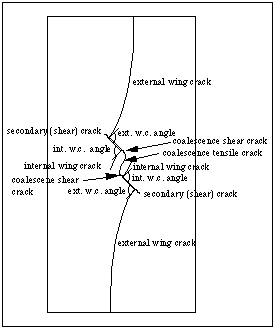
The crack propagation and -coalescence pattern obtained in the uniaxial compression tests is shown in the figure to the right. Two types of cracks appear during compression: wing cracks and secondary cracks. In these tests, external and internal wing cracks appear at the same time and with the same initiation angle, independently of the geometry tested, and of the flaw type (open ore closed). The stresses at wing crack initiation increase with flaw angle, and ligament length, but reach a constant value for ligament lengths greater than '3a' (a="1/2" flaw length). If one relates the wing crack initiation direction to the loading direction, one obtains for open flaws always a value of approximately 45°. Similarly, for closed flaws one obtains always an angle of approximately 66° with the loading direction. Of special interest are the initiation and propagation of secondary cracks in our experiments, since this of type of crack is not well documented in the literature. |
|
The surface of the secondary cracks is rough, with abundant gypsum powder and crushed gypsum, in opposition to wing cracks which have a clean and smooth surface; on the microscope secondary cracks are always associated with some bulging and spalling on the surface of the specimen. All these surface characteristics indicate that secondary cracks initiate under a compressive field; indeed, stress analyses around the tips of the flaws indicate that these cracks initiate within a compressive area. Thus, secondary cracks can be classified as shear cracks, in opposition to wing cracks which are tensile cracks.
Secondary cracks appear at the internal and external tips of the flaws; they always propagate in a stable manner, and in a plane co-planar to the flaw. Eventually the internal secondary cracks develop into coalescence cracks. Similar to the wing cracks, internal and external secondary cracks always appear at the same time. Furthermore, secondary and wing cracks always appear at the same applied stress, irrespective of the flaw geometry or the flaw type. Secondary cracks from closed flaws initiate at higher stresses than those from open flaws.
|
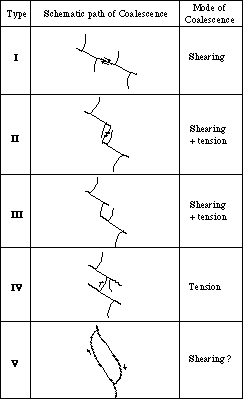
Coalescence, which is the problem of main interest in this study, is an unstable process produced by the rapid propagation of one or two cracks until linkage. Flaw coalescence has been classified into types I through V depending on the crack pattern obtained (see table on the left). For non-overlapping geometries (ligament angle less than 90°) coalescence is always caused by the linkage of two internal cracks; an internal secondary crack with an internal secondary crack (types I and II), or an internal wing crack with an internal secondary crack (type III). Type IV is produced when one of the internal wing cracks reaches the other flaw, and coalescence type V is produced by any other crack linkage combination. Coalescence types IV and V occur for overlapping geometries (ligament angle larger than 90°), only. Type I coalescence occurs when the ratio of spacing to continuity is less than 1/3; i.e. the two flaws are coplanar or almost coplanar. In this case the linkage of the flaws is through the connection of the internal secondary cracks which, although stable after initiation, grow unstably near coalescence until they link. Type II coalescence is produced by an out of plane propagation and linkage of the two internal secondary cracks, and it occurs when the spacing to continuity ratios are greater than 1/3. The internal secondary cracks propagate in a stable manner up to some point; afterwards, they become unstable and propagate outside their own plane as a tensile crack producing coalescence. |
The coalescence stresses for open flaws increase with the ligament length, and with the flaw angle; coalescence stresses for closed flaws are higher than for open flaws, but they are rather insensitive to the flaw geometry.
In uniaxial compression tests, failure of the specimens is reached immediately after coalescence.
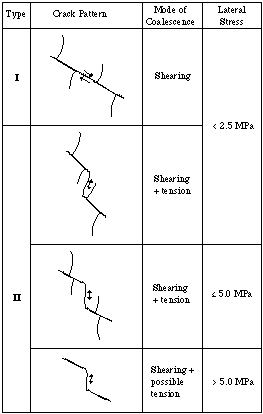
The most important difference between uniaxial and biaxial compression tests with respect to the crack pattern generated is that with increasing confining stresses, the wing cracks tend to disappear. The table to the right shows the different crack patterns observed in these tests. In uniaxial tests, the wing cracks grow stably until failure is reached; in biaxial tests, the wing cracks, if they appear, grow up to a certain point, and then arrest. As the confinement stress increases, wing cracks tend to initiate far from the flaw tips and towards the center of the flaw; for higher confinement stresses, wing cracks do no appear at all. Internal and external wing cracks initiate at the same time. Wing crack initiation loads increase with the confinement stress, with the flaw angle, and with the ligament length. Secondary cracks appear in all the specimens, and for all the confinement stresses. In fact at confinement stresses greater than 5.0 MPa, they are the only observable cracks. Secondary cracks initiate, as they do in uniaxial test, at the tips of the flaws and propagate in the plane of the flaw. Fractographic observations of their surfaces, and stress analyses lead to the same conclusions as in uniaxial compression: secondary cracks are shear cracks. Initiation stresses increase with the confinement stress, with the flaw angle, and with the ligament length. |
|
Unlike uniaxial tests, coalescence and failure do not occur at the same time in biaxial compression. After coalescence, and prior to failure, as the load increases, no new cracks are observed but the external secondary cracks continue to grow. Failure is reached in a brittle manner with multiple new cracks all over the specimen.
This research confirms that secondary cracks are an important part of the crack propagation mechanism from pre-existing flaws. Unlike wing cracks, secondary cracks have been observed in all the tests. The wide range of geometries used in this investigation makes the observations significant when interpreting crack propagation and coalescence. However, more research has to be done to generalize the conclusions of the present work. In particular, other materials, including natural rock should be tested.
Page Up Resume Teaching Research Home