Shown here is a multiresolution approach to edge detection using a sequential search algorithm. The use of a multiresolution image pyramid allows integration of global edge information contained in lower resolutions to guide the sequential search at higher resolutions. As a consequence, dependence on a priori knowledge about the image edges is greatly reduced. Estimating the sequential search parameters from lower resolution images provides for a more accurate and less costly search of edge paths in the image.
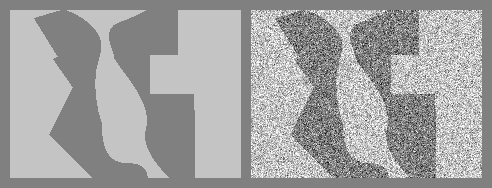
Figure 1:
On the left is the orignal image, with edge step size
of 64. On the right is the original image
corrupted with clipped, additive gaussian noise
with a standard deviation of 40.
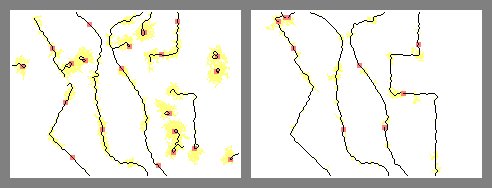
Figure 2:
The left image shows the result of using a sequential edge linking algorithm on the right image in Figure 1. The yellow color indicates the areas searched by the algorithm and the red square indicates the location of a root or start node. The right image shows the improvement when using a multiresolution approach. Note the reduction in search area and in the number of requried root nodes. More detailed information, software, and test images may be found in:
Many of these papers include source code and images used in the work. The README files in each directory at the ftp site provide the needed details including the correct citations for each paper.
Address all comments and questions to Professor Edward J. Delp.
G. W. Cook and E. J. Delp,
"Multiresolution Sequential Edge Linking,"
Proceedings of the
IEEE International Conference on Image Processing,
October 23-26, 1995, Washington, DC.,
pp. 41-44.
The
readme file ,
compressed postscript file,
PDF file, and the
ftp site.
Accompanying software (ANSI C using Solaris 2.3) is available. Raw and TIFF formated test images are also available.