ME 200 – Thermodynamics I – Spring 2020
HW 9: 1st Law for Closed Systems with Real Fluid Properties
Part (i): Constant pressure vaporization of water
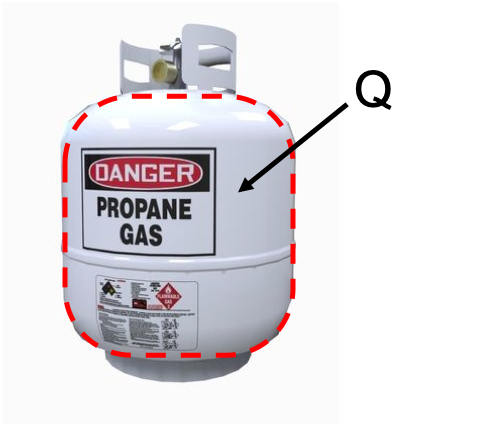
Part (ii): Propane tank
Part (iii): Piston-cylinder apparatus
#Given Inputs
m = 0.2                            # water mass in the tank after unit conversion from g to kg [kg]
P = 100                            # pressure inside the tank [kPa]
Find:
Volume change ($m^3$) and heat transfer (kJ);
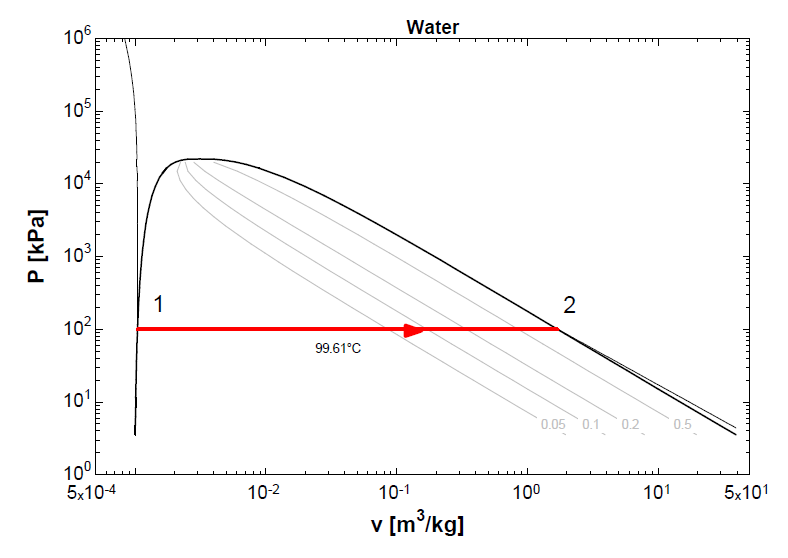
P-v diagram including the saturation dome with beginning and end states labeled.
System Sketch:
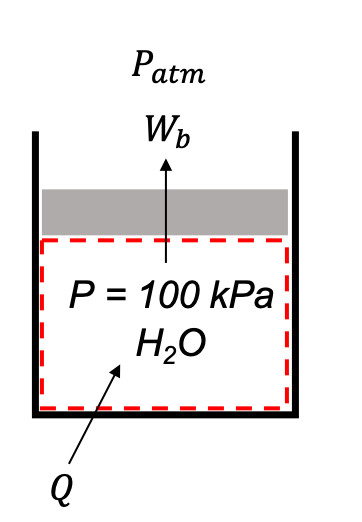
Water in the tank is the system. Note that to have a constant pressure process requires that the volume of a closed container must expand. This is depicted as a piston cylinder apparatus expanding against the atmosphere.
Assumptions:
1) closed system, 2) negligible changes in KE and PE, 3) quasi-equilibrum expansion process
Basic Equations:
$$\dfrac{dE}{dt} = \dot Q- \dot W + \displaystyle\sum_{in} \dot m_{in} (h+ke+pe)_{in}-\displaystyle\sum_{out} \dot m_{out}(h+ke+pe)_{out}$$$$E = m(u+ke+pe)$$$$v = \dfrac{V}{m}$$$$W_{boundary}=\int PdV$$Solution:
In order to find the volume change and heat transfer during the process, the initial and final states of the water inside the tank are first determined using the given information. Then an energy balance is used to calculate the heat transfer.
State 1:
The water inside the tank is saturated liquid at $P=100kPa$. The Sat Water-Temp Table in the file SLVM_Tables is used to look up the saturation temperature, specific volume, and internal energy for this state.
T_1 = 99.61                 # saturation temperature of water at initial state [°C]
v_1 = 0.0010432             # specific voloume of water at initial state, SL [m^3/kg]
u_1 = 417.40                # internal energy of water at initial state, SL [kJ/kg]
State 2:
At state 2, the water is completely vaporized and at the initial pressure of 100 kPa. The Sat Water-Pressure Table in the file SLVM_Tables is used to determine the saturated vapor properties.
T_2 = T_1                   # saturation temperature of water is constant for this process [C]
v_2 = 1.6939                # specific voloume of water at final state [m^3/kg]
u_2 = 2505.6                # internal energy of water at final state [kJ/kg]
Change of volume:
The mass of the water does not change from state 1 to 2 and the volume of each state can be calculated from $V = {v}{m}$. Thus, the change of volume is
$$\Delta V_{12} = V_2 - V_1 = m(v_2-v_1)$$DV_12 = m*(v_2-v_1) # Calculation block for the change of volume
print('V_2 - V_1 = ',round(DV_12,3),'m^3')
Heat transfer:
For a closed system, the mass is constant. Then, for negligible changes in kinetic and potential energy, integration of the 1st law energy balance results in the following.
$$\Delta U_{12} = Q_{12} - W_{12}$$where: $$\Delta U_{12} = m (u_2 - u_1)$$
The boundary work for a constant pressure process leads to:
$$W_{12}=\int_{V_1}^{V_2} PdV = P \Delta V_{12}$$Then, the heat transfer is determined as
$$Q_{12} = \Delta U_{12} + W_{12} = m (u_2 - u_1) + P \Delta V_{12}$$Q_12 = m*(u_2-u_1) + P*DV_12 # Calculation block for the heat transfer
print('Q_12 = ',round(Q_12,1),'kJ')
Heat Transfer using enthalpy difference for constant pressure process:
Based on the definition of enthalpy, the change in enthaply can be written as:
$$\Delta H_{12} = H_2 - H_1 = (U_2 + P_2V_2) - (U_1 + P_1V_1) $$Then, for a constant pressure process:
$$\Delta H_{12} = H_2 - H_1 = U_2 - U_1 + P(V_2 - V_1) $$such that the first law energy balance result can be rewritten as
$$Q_{12} = \Delta U_{12} + W_{12} = U_2 - U_1 + P(V_2 - V_1) = \Delta H_{12} = m (h_2 - h_1)$$where $h_2$ and $h_1$ are found in the Sat Water-Pressure table within the file SLVM_Tables:
h_1 = 417.50                # enthalpy of water at initial state [kJ/kg]
h_2 = 2674.9                # enthalpy of water at initial state [kJ/kg]
Q_12_alt = m*(h_2-h_1)      # Calculation block for the heat transfer using enthalpy change
print('Q_12_alt = ',round(Q_12_alt,1),'kJ')
#Given Inputs
V_t = 5*0.00378541         # tank volume with unit conversion from gal to m^3 [m^3]
V_ch = 4.3*0.00378541      # liquid volume of propane added to the tank at 20°C during charging [m^3]
T_1 = 20                   # state 1 temperature [°C]
T_2 = 48                   # state 2 temperature [°C]
Find:
a) initial pressure (kPa),
b) final pressure (kPa),
c) heat transfer to the propane (kJ)
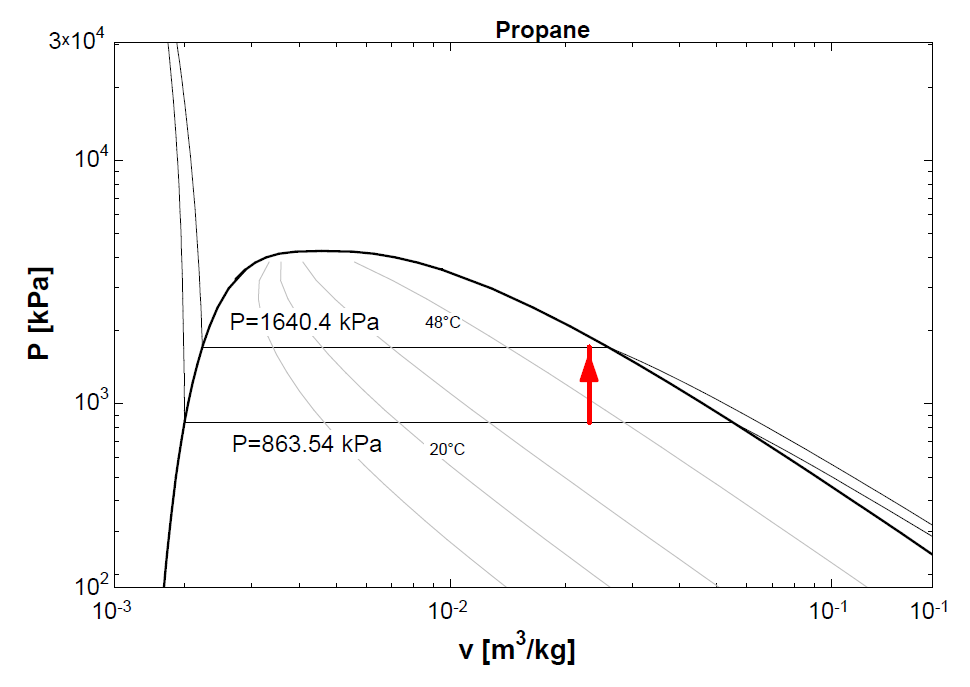
d) P-v diagram to show the process
Assumptions:
1) closed system, 2) negligible changes in KE and PE
Note that a quasi-equilibrium process is NOT a required assumption.
Basic Equations:
$$\dfrac{dE}{dt} = \dot{Q}- \dot{W} + \displaystyle\sum_{in} \dot m_{in} (h+ke+pe)_{in}-\displaystyle\sum_{out} \dot m_{out}(h+ke+pe)_{out}$$$$E = m(u+ke+pe)$$$$v = \dfrac{V}{m}$$Solution:
Part a: Initial pressure
The total volume of the tank is larger than the liquid volume of propane that was added to the evacuated tank. Thus, some of that liquid must have vaporized to fill the remaining volume. Thus, the initial phase is a SLVM. However, we can check that by comparing the specific volume to the saturated liquid and vaport specific volumes. The specific volume is
$$m = \dfrac{V_{ch}}{v_{f,1}}$$where $V_{ch}$ is a volume of liquid at 20°C that was charged into the evacuated tank and $v_{f,1}$ is the specific volume of the liquid at 20°C. Then, the specific volume of the mixture within the tank at state 1 is:
$$v = \dfrac{V_t}{m}$$These calculations appear below along with other saturation properties needed for state 1 that were obtained for $T=20°C$ from the Propane-Temp Table within the file SLVM_Tables.
P_1 = 836.54                # saturation pressure of propane at 20 °C [kPa]
v_f_1 = 0.0019996           # specific voloume of saturared liquid propane at 20 °C [m^3/kg]
v_g_1 = 0.055317            # specific voloume of saturared vapor propane at 20 °C [m^3/kg]
u_f_1 = 145.3               # internal energy of saturared liquid propane at 20 °C [kJ/kg]
u_g_1 = 445.25              # internal energy of saturared vapor propane at 20 °C [kJ/kg]

m = V_ch/v_f_1              # mass of propane [kg]
v_1 = V_t/m                 # specific volume at state 1 [m^3/kg]

print('m = ',round(m,2),'kg')
print('v_1 = ',round(v_1,6),'m^3/kg')
print('P_1 = ',round(P_1,2),'kPa')
The specific volume is indeed between the saturated liquid and vapor values, so the initial pressure is the saturation pressure of 836.54 kPa.
Part b: final pressure
In addition to the final temperature, another indepedent property is needed to determine the final state. Since the tank is closed and rigid, both the mass and volume are constant for this heating process, meaning the specific volume is also constant.
v_2 = v_1 # final specific volume [m^3/kg]
In order to determine the phase for state 2, the specific volume is compared to the saturated liquid and vapor specific volumes at the known temperature of $T=48°C$. Saturation properties are given as:
P_2 = 1640.4                 # saturation pressure of propane at 48 °C [kPa]
v_f_2 = 0.0022085            # specific voloume for saturared liquid propane at 48 °C [m^3/kg]
v_g_2 = 0.027190             # specific voloume for saturared vapor propane at 48 °C [m^3/kg]
u_f_2 = 222.75               # internal energy for saturared liquid propane at 48 °C [kJ/kg]
u_g_2 = 471.42               # internal energy for saturared vapor propane at 48 °C [kJ/kg]
Since $v_2$ is between the saturated vapor and liquid values, the propane is still a SLVM. The pressure at state 2 is then the saturation pressure at 48°C.
print('P_2 =',round(P_2,6),'kPa')
Part (c): Heat Transfer:
For a closed rigid tank, the mass is constant and there is no boundary work. Since there are no changes in KE and PE, the integrated form of the energy balance reduces to
$$\Delta U_{12} = Q_{12}$$where: $$\Delta U_{12} = m(u_2 - u_1)$$
Both state 1 and 2 are SLVMs, so that the specific internal energies are determined with
$$ u = u_f + \chi (u_g-u_f)$$where the quality is determined from the know specific volume as:
$$ \chi = \dfrac{v - v_f}{v_g-v_f}$$# Calculation block for the quality. internal energy, and heat transfer
x_1 = (v_1 - v_f_1)/(v_g_1 - v_f_1)
x_2 = (v_2 - v_f_2)/(v_g_2 - v_f_2)
u_1 = u_f_1 + x_1 * (u_g_1 - u_f_1)
u_2 = u_f_2 + x_2 * (u_g_2 - u_f_2)
Q_12 = m * (u_2-u_1)
print('x_1 = ',round(x_1,6))
print('x_2 = ',round(x_2,6))
print('u_1 = ',round(u_1,2),'kJ/kg')
print('u_2 = ',round(u_2,2),'kJ/kg')
print('Q_12 = ',round(Q_12,2),'kJ')
Process on a P-v diagram
A constant volume process with at $v=0.002312 m^3/kg$ and pressure increasing from $P_1 = 836.54 kPa$ to $P_2 = 1714.95 kPa$. Note that the x axis is a log scale.
Part(iii): Piston-Cylinder Apparatus
Given:
A mass of 0.295 kg of water is contained in a closed piston-cylinder at 0.04 bar with an initial volume of 0.5 $m^3$. Initially, the piston is resting on a set of stops. Then, heat transfer occurs and the pressure increases to 1 bar at which point the piston begins to move. The heat transfer continues until the volume expands to 0.75 $m^3$.
# Given Inputs
m = 0.295                          # water mass [kg]
P_1 = 0.04 * 100                   # pressure at state 1 with unit conversion from bar to kPa [kPa]
V_1 = 0.5                          # volume at state 1 [m^3]
P_2 = 1 * 100                      # pressure at state 2 with unit conversion from bar to kPa [kPa]
V_3 = 0.75                         # volume at state 3 [m^3]
Find:
a) draw the process in p-v diagram
b) final temperature (°C)
c) work performed by the water (kJ)
d) heat transfer (kJ)
Basic Equations:
$$v = \dfrac{V}{m}, W_{boundary}=\int PdV$$$$\dfrac{dE}{dt} = \dot Q- \dot W + \displaystyle\sum_{in} \dot m_{in} (h+ke+pe)_{in}-\displaystyle\sum_{out} \dot m_{out}(h+ke+pe)_{out}, E = U + KE + PE$$Assumptions:
1) closed system, 2) negligible changes in KE and PE, 3) quasi-equilibrum expansion process
Solution:
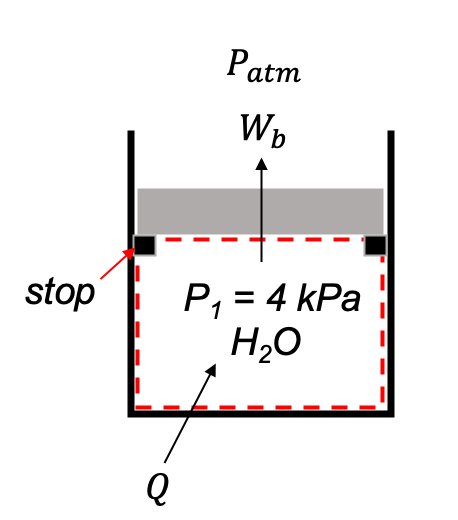
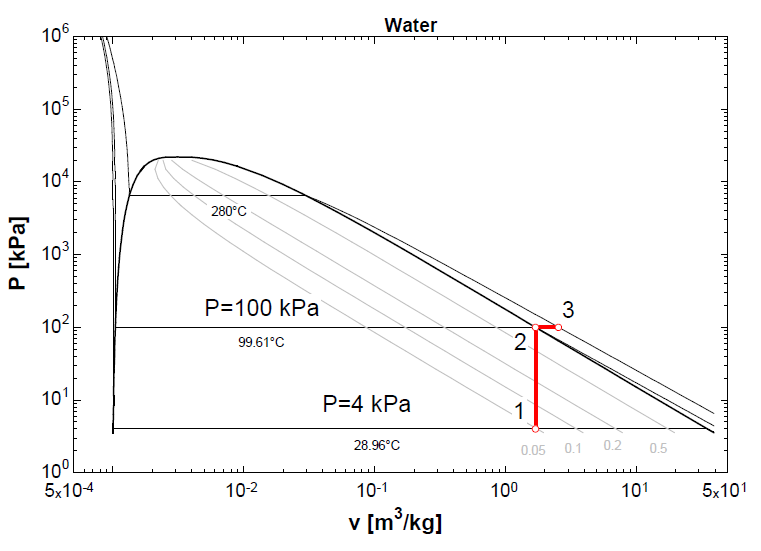
There are two distinct types of processes for this problem due to the existance of the stops. In the first process, heat transfer occurs at constant volume and the pressure increases to 100 kPa. In the second process, the pressure is constant and the piston moves until the volume is 0.75 $m^3$. This is sufficient information to determine the initial and final specific volume from $v=V/m$ and to then prepare a P-v plot showing the processes.
# Determine specific volume for state 1 & 3
P_3 = P_2                          # pressure in state 3 is same as state 2 [kPa]
v_1 = V_1/m                        # specific volume for state 1 [m^3/kg]
v_2 = v_1                          # specific volume for state 2 [m^3/kg]
v_3 = V_3/m                        # specific volume for state 3 [m^3/kg]
print('v_1 = ',round(v_1,3),'m^3/kg')
print('v_2 = ',round(v_2,3),'m^3/kg')
print('v_3 = ',round(v_3,3),'m^3/kg')
Part (a): P-v diagram with saturation dome:
Part (b): Final Temperature
The phase of state 3 can be determined by comparing the specific volume with the saturated vapor and liquid values at the specified pressure.
T_sat_3 = 99.61             # saturation temperature at 100 kPa [°C]
v_f_3 = 0.0010432           # specific volume of saturated liquid at 100 kPa [m^3/kg]
v_g_3 = 1.6939              # specific volume of saturated vapor at 100 kPa [m^3/kg]
The specific volume is higher than the value for saturated vapor, meaning that state 3 is a superheated vapor. From the superheated water vapor table in SHV_Tables for 100 kPa, the specific volume for state 3 can be found at a temperature of about 280 °C (e.g., linear interpolation would result in a final temperature of 279.3 °C).
T_3 = 280                         # temperature at state 3 [°C]
u_3 = 2779.8                      # internal energy of state 3 [kJ/kg]
Part (c): Boundary Work
For the first process from state 1 to 2, there is no boundary work since the volume does not change and there is no other work device, so $W_{12}=0$. Boundary work only occurs between states 2 and 3 at a constant pressure. The resulting boundary work for this constant pressure process is $ W_{23} = P_{2} (V_3 - V_2)$.
# Calculation block for boundary work
V_2 = V_1
W_12 = 0
W_23 = P_2*(V_3-V_1)
W_13 = W_12 + W_23
print('W_13 = ',round(W_13),'kJ.')
Part (d): Heat Transfer
The heat transfer can be determined from an energy balance on the water between states 1 and 3. With the assumption of negligible of changes in KE and PE and closed system with no mass in or out, then $$ \Delta{U_{13}} = U_3 - U_1 = Q_{13} - W_{13} $$ So $$ Q_{13} = \Delta{U_{13}} + W_{13} = m (u_3 - u_1) + W_{13}$$
The only remaining unknown is $u_1$. It is necessary to determine the condition at state 1. This is accomplished by comparing $v_1$ to saturated liquid and vapor values at $P_1$ using the Sat Water-Pressure Table in SLVM_Tables.
# The specific volume of state 1 has been calcualted before
v_f_1 = 0.0010041           # specific volume for saturated liquid at 4 kPa [m^3/kg]
v_g_1 = 34.791              # specific volume for saturated vapor at 4 kPa [m^3/kg]
u_f_1 = 121.38              # internal energy for saturated liquid at 4 kPa [kJ/kg]
u_g_1 = 2414.5              # internal energy for saturated vapor at 4 kPa [kJ/kg]
print('v_1 = ',round(v_1,3),'m^3/kg')
Since $v_1$ is between the saturated values, the initial condition is a saturated liquid vapor mixture (SLVM) and the quality can be calculated:
$$ \chi_1 = \dfrac{v_1 - v_{f,1}}{v_{g,1}-v_{f,1}}$$# Calculation block for the quality
x_1 = (v_1 - v_f_1)/(v_g_1 - v_f_1)
print('x_1 = ',round(x_1,6))
The internal energy for the SLVM can be calculated as:
$$ u_1 = u_{f_1} + \chi_1 (u_{g,1}-u_{f,1}) $$The following code determines $u_1$ and $Q_{13}$.
# Calculation block for the internal energy and heat transfer rate
u_1 = u_f_1 + x_1 * (u_g_1 - u_f_1)
Q_13 = m * (u_3-u_1) + W_13
print('u_1 = ',round(u_1,3),'kJ/kg')
print('Q_13 = ',round(Q_13,2),'kJ')