ME 200 – Thermodynamics I – Spring 2020
Homework 30: More Entropy Generation Problems
Part (i): Steady-Flow Device
Part (ii): Leaking Tank
#Given Inputs:
T_1 = 310         # inlet air temperature [K]
P_1 = 30          # inlet air pressure [bar]
P_2 = 2           # exit air pressure [bar]
P_3 = P_2         # exit air pressure [bar]
T_2 = 390         # exit air temperature for the hot side [K]
T_3 = 210         # exit air temperature for the cold side [K]
T_b = 300         # surrounding temperature for entropy transfer due to heat transfer [K]
R = 0.287         # specific gas constant of air [kJ/kg-K]
Find:
Determine if the given operating condition are possible.
System Diagram:
The system is extends slightly beyond the device to include the thermal layer so that the boundary temperature for heat transfer is the environmental temperature.

Assumptions:
1) open system, 2) steady state, steady flow (SSSF) 3) neglect changes in kinetic and potential energy, 4) air is an ideal gas, 5) no work
Basic Equations:
$$\dfrac{dm}{dt}=\Sigma \dot m_{in}-\Sigma \dot m_{out}$$$$\dfrac{dS}{dt} = \displaystyle\sum_{j} \dfrac{\dot Q_j}{T_{j,boundary}}+ \displaystyle\sum_{in} \dot m_{in} s_{in}-\displaystyle\sum_{out} \dot m_{out}s_{out}+\dot \sigma _{generation}$$$$\dfrac{dE}{dt} = \dot Q- \dot W + \displaystyle\sum_{in} \dot m_{in} (h+ke+pe)_{in}-\displaystyle\sum_{out} \dot m_{out}(h+ke+pe)_{out}$$$$s_2-s_1=s_2^o-s_1^o-R \cdot ln \Bigg(\dfrac{P_2}{P_1}\Bigg)$$Solution:
A mass balance is applied to the system, air enters the single inlet and leaves through the two outlets with the assumption of steady flow ($dm/dt=0$).
$$\dfrac{dm}{dt}=\Sigma \dot m_{in}-\Sigma \dot m_{out}$$$$0=\dot m_{1}-\dot m_{2}-\dot m_{3}$$$$\dot m_{1}=\dot m_{2}+\dot m_{3}$$Entropy and energy balances are applied to the entire system with the assumptions of SSSF ($dS/dt=dE/dt=0$), negligible kinetic and potential energy, and no work device.The simplified entropy and energy equations become
$$0 = \dfrac{\dot Q}{T_{boundary}}+ \dot m_{1} s_{1}- \dot m_{2}s_{2}-\dot m_{3}s_{3}+\dot \sigma _{generation}$$$$0 = \dot Q+ \dot m_{1} h_1-\dot m_{2}h_2-\dot m_{3}h_3$$The problem statement indicates that half the air leaves through each exit:
$$\dot m_2=\dot m_3=\dot m_1/2$$The mass balance can then be used to simplify the entropy and energy balances to express the entropy genreation and heat transfer per unit mass flow as
$$\dot \sigma _{generation}/\dot m_1 = 0.5(s_3-s_1)+0.5(s_2-s_1)-\dfrac{\dot Q/\dot m_1}{T_{boundary}}$$$$q= \dot Q/\dot m_1 = 0.5(h_3-h_1)+0.5(h_2-h_1)$$The temperature-dependent properties for each air state are taken from the ideal gas tables at the given temperatures
$$h_1=310.2kJ/kg,s^o_1=1.736kJ/kg-K$$$$h_2=390.9kJ/kg,s^o_2=1.967kJ/kg-K$$$$h_3=210kJ/kg,s^o_3=1.352kJ/kg-K$$The changes in entropy for the air between the outlet and inlet states are then
$$s_2-s_1=s_2^o-s_1^o-R \cdot ln\Bigg(\dfrac{P_2}{P_1}\Bigg)$$$$s_3-s_1=s_3^o-s_1^o-R \cdot ln\Bigg(\dfrac{P_3}{P_1}\Bigg)$$import numpy as np
s_1_o = 1.736 # temperature-dependent portion of entropy for air at state 1 [kJ/kg-K]
s_2_o = 1.967 # temperature-dependent portion of entropy for air at state 2 [kJ/kg-K]
s_3_o = 1.352 # temperature-dependent portion of entropy for air at state 3 [kJ/kg-K]
h_1 = 310.2 # specific enthalpy of air at state 1 [kJ/kg]
h_2 = 390.9 # specific enthalpy of air at state 2 [kJ/kg]
h_3 = 210 # specific enthalpy of air at state 3 [kJ/kg]
q = 0.5*(h_3-h_1)+0.5*(h_2-h_1)
Delta_s13 = s_3_o-s_1_o-R*np.log(P_3/P_1)
Delta_s12 = s_2_o-s_1_o-R*np.log(P_2/P_1)
sigma_gen = 0.5*Delta_s13 +0.5*Delta_s12 - q/T_b
print('q = ',round(q,5),'kJ/kg')
print('sigma_gen = ',round(sigma_gen,5),'kJ/kg-K')
Since the entropy generation is positive, the process is possible.
#Given Inputs:
T_1 = 293.15      # intial temperature of the R134a [K]
x_1 = 0.1         # initial quality of the R134a
V_tank = 0.0189   # volume of the tank filled with R134a [m^3]
T_2 = T_1         # final temperature of the R134a [K]
m_1 =  4.361      # initial mass of the R134a [kg]
m_2 =  0.525      # final mass of the R134a [kg]
m_out =  3.836    # mass leaving the system
Q_12 =  715.4     # heat transfer into the system [kJ]
P_out = 100       # pressure of the air in the room [kPa]
Find:
Determine the total entropy generation (kJ/K).
System Diagram: The system includes the tank and the leaky valve.
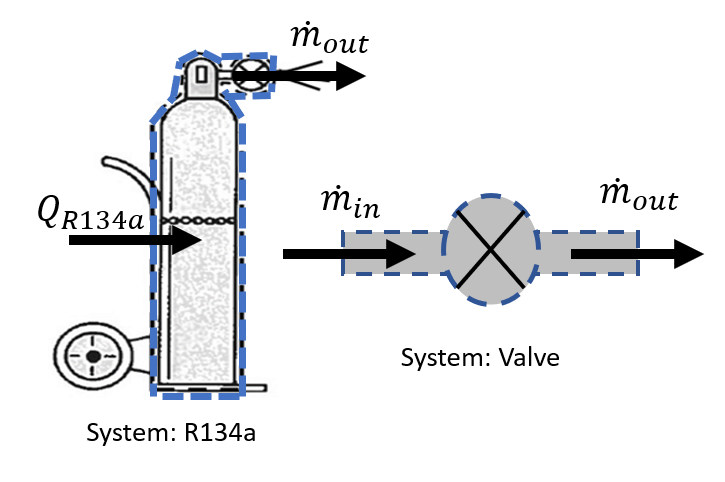
Assumptions:
1) quasi-equlibrium process within the tank, 2) isenthalpic throttling across the leaking valve.
Basic Equation:
$$\dfrac{dm}{dt}=\Sigma \dot m_{in}-\Sigma \dot m_{out}$$$$\dfrac{dS}{dt} = \displaystyle\sum_{j} \dfrac{\dot Q_j}{T_{j,boundary}}+ \displaystyle\sum_{in} \dot m_{in} s_{in}-\displaystyle\sum_{out} \dot m_{out}s_{out}+\dot \sigma _{generation}$$Solution:
Conservation of mass applied to the R134a in the tank results in
$$\dfrac{dm}{dt} = -\dot m_{out}$$This differential equation can be rearranged and integrated to determine the total mass leaving the tank ($m_{out})$ as
$$m_{out} = \int\limits_{t_1}^{t_2}{\dot m_{out}dt} = -\int\limits_{m_1}^{m_2}{dm}$$or
$$m_{out} = m_1 - m_2 $$The values for each mass and the mass leaving the system come from HW 19 (ii)
Now consider an entropy balance applied to the R-134a in the tank
$$\dfrac{dS_{cv}}{dt} = \dfrac{\dot Q}{T_{boundary}} - \dot m_{out}s_{out}+\dot \sigma$$Since the leakage is slow, then the tank temperature remains constant and saturated vapor at 20°C flows into the leaky valve at the top of the tank. The entropy increases across the valve because a throttling process is highly irreversible. However, both the inlet and outlet states for the valve are constant Thus, the entropy balance can be rearranged and integrated to give
$$s_2-s_1 = \int\limits_{1}^{2}{dm_{cv}S_{cv}} = \int\limits_{t_1}^{t_2}{\dfrac{\dot Q}{T_{boundary}}dt}-S_{out}\int\limits_{t_1}^{t_2}{\dot m_{out}dt}+\int\limits_{t_1}^{t_2}{\dot \sigma dt}$$or
$$m_2s_2-m_1s_1 = \dfrac{Q_{12}}{T_{boundary}} - m_{out}s_{out}+\sigma _{12}$$Since the valve is isenthalpic, the enthalpy of the R134a leaving the valve is the same as the enthalpy entering the valve. Therefore, $h_{out} = h_g(20°C)$. The entropy exiting the valve can be determined from the exit enthalpy and exit pressure ($P_{out}=100kPa$) and $s_{out}=s(h_{out},P_{out})$. As the vapor leaves, the liquid at the bottom of the tank evaporates to fill the space. This process occurs until there is no liquid left in the tank. Thus,
$$\sigma _{12} = m_2s_2 - m_1s_1 + (m_1-m_2)s_{out}-\dfrac{Q_{12}}{T_{boundary}}$$import CoolProp.CoolProp as CP
CP.set_reference_state('R134a','ASHRAE')
s_f_1 = CP.PropsSI('S','T',T_1,'Q',0.0,'R134a')/1000.
s_g_1 = CP.PropsSI('S','T',T_1,'Q',1.0,'R134a')/1000.
s_1 = s_f_1 + x_1*(s_g_1 - s_f_1) # specific entropy of R134a at state 1 [kJ/kg-K]
s_2 = CP.PropsSI('S','T',T_2,'Q',1.0,'R134a')/1000. # specific entropy of R134a at state 2 [kJ/kg-K]
h_g_out = CP.PropsSI('H','T',T_1,'Q',1.0,'R134a') # specific enthalpy of R134a leaving the tank [kJ/kg]
s_out = CP.PropsSI('S','H',h_g_out,'P',P_out*1000,'R134a')/1000. # specific entropy of R134a exiting the leaky valve [kJ/kg-K]
sigma_12 = m_2*s_2 - m_1*s_1 + m_out*s_out-Q_12/(T_1)
print('s_f_1 = ',round(s_f_1,5),'kJ\K')
print('s_g_1 = ',round(s_g_1,5),'kJ\K')
print('s_1 = ',round(s_1,5),'kJ\K')
print('s_2 = ',round(s_2,5),'kJ\K')
print('s_out = ',round(s_out,5),'kJ\K')
print('sigma_12 = ',round(sigma_12,5),'kJ\K')