Summary Sheet
for Continuous Distributions
ECE
695/CS 590 –Fault-Tolerant Computer System Design
School
of Electrical and Computer Engineering
Purdue
University
Fall
2015
|
Notation |
Interpretation |
Relations |
|
FX(x) |
Pr(Random
variable X has a value £ x) Called
Cumulative Distribution Function, or simply, Distribution Function (cdf) |
|
|
fX(x) |
Probability
density function (pdf)
f(x) ≥ 0, for all x |
FX(x) = Pr(a < X £ b) = = FX(b) – FX(a) |
|
R(t) |
Reliability Pr(No
failure occurs in time (0, t)) |
RX(t) = 1 – FX(t) Typically R(0)
= 1 and |
|
h(t) |
Instantaneous
failure rate
Pr(Failure
in (t0, t1)|System has survived till t0)
¹ It is = 1- |
h(t) = R(t) = exp[- If h(t)Ý as tÝ, this represents
an Increasing Failure Rate (IFR). If h(t)ß as tÝ, this represents a
Decreasing Failure Rate (DFR). If h(t) stays constant as
tÝ, this represents a Constant Failure Rate (CFR). |


|
Distribution |
Characteristic Measures |
Interpretation |
|
Exponential distribution |
F(t) = 1 – e-lt h(t) = l |
If failures arrive with a constant rate l, then the time to failure follows the
Exponential distribution. Exponential distribution represents the CFR part of a system’s
lifetime. |
|
Hypoexponential distribution |
For two stage HYPO with parameters l1 and l2 (l1¹l2) F(t) = 1 – ( |
If a process passes through several sequential phases, and time spent
in each is independent and exponentially distributed. It represents the IFR part of a systems lifetime, going from 0 to
min{l1, l2, 1}. |
|
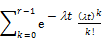
Erlang distribution |
F(t) = 1 - Parameters: r, l |
Process passes through r
sequential phases, each of which has an identical exponential distribution.
Exponential is a special case of Erlang, with r = 1 If a system can survive up to r-1
shocks and fails upon the arrival of the r-th shock, and the shocks arrive with a Poisson
distribution, then time to failure follows Erlang. |
|
Gamma distribution |
f(t) = G is the gamma function, defined
as G(a) = Parameters: l, a |
If r in the Erlang distribution can take non integer values, it gives
the Gamma distribution. For 0 < a < 1, Gamma
distribution is DFR; for a > 1, it is IFR; for a = 1, it is CFR. |
|
Hyperexponential distribution |
F(t) = where Parameters: li, ai, k
|
If a process faces k
parallel phases and it will go through only one of these, then the time
follows a Hyperexponential distribution. It is a DFR from |
|
Weibull distribution |
F(t) = 1 – e-lta h(t) = l a ta-1 Parameters: a (shape parameter), l (scale parameter) |
Most widely used parametric family of distributions. a = 1 Þ CFR a < 1 Þ DFR a > 1 Þ IFR |