
Research team works to reduce impacts of natural disasters
Research team works to reduce impacts of natural disasters
| Magazine Section: | Research |
|---|---|
| Article Type: | Feature |
| Alternate Magazine Section Name: | Discovery |
A team of six graduate student researchers are working with Makarand Hastak, Head and Professor of CEM, toward reducing the risks associated with natural disasters. The team is developing strategic decision support systems to aid in protecting infrastructure and enhancing its resilience and the resilience of the community. Systems they are developing will help minimize the severe and cascading impacts of future disasters.
The importance of this work could not be any clearer given the significant effects of global warming and climate change on our society and the built environment. The United Nations has been focusing on this issue with the UN Office for Disaster Risk Reduction since 1999.
According to Sayanti Mukhopadhyay, one of the team’s graduate research assistants, major climate change is increasing the earth’s average temperature (0.5°F to 8.6°F by the year 2100), causing more frequent tropical storms, hurricanes, and heatwaves; changing precipitation amounts and patterns, causing droughts and floods; reducing ice and snow coverage in the Arctic region (15 % by 2100); and raising sea level (1 to 4 feet by 2100), causing coastal flooding.
“Our society is faced with immense risk of such types of natural disasters,” she says. “However, we cannot completely avoid these types of events as they are at the hands of Mother Nature. But we as researchers can develop models and systems that would help to better prepare and minimize the impacts [of these events] on society and the economy through disaster risk reduction research.”
The team is working on reducing the risks of aftermath by increasing resilience and capacity building for seven interdependent layers of infrastructure: civil, civic, social, environmental, financial, educational, and cyber.
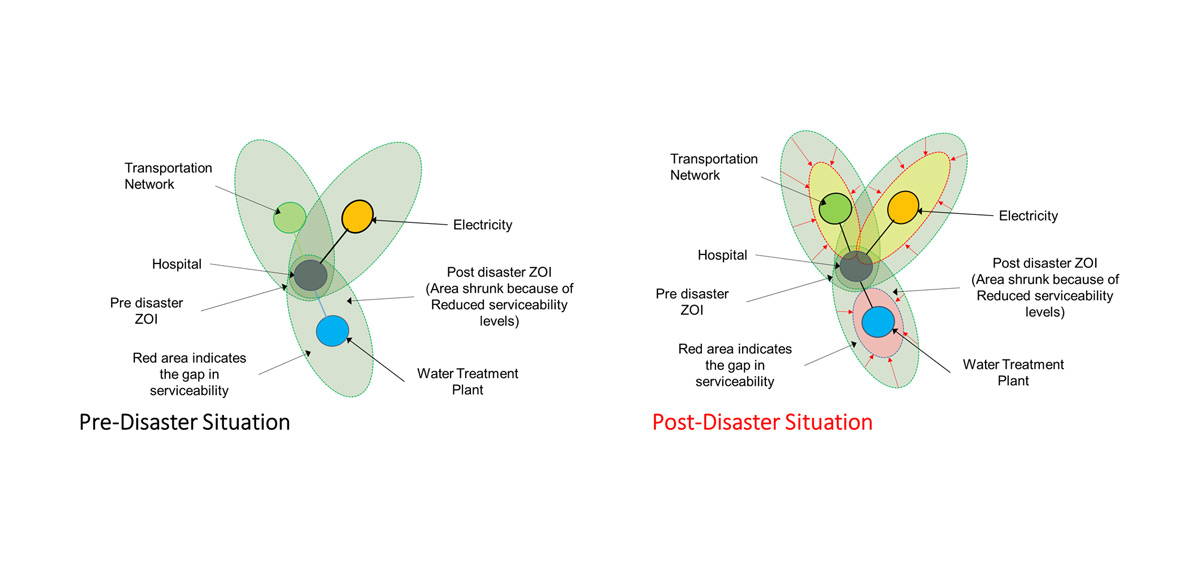
It is easy to see the benefits of the team’s research when looking at examples such as hospitals. Juyeong Choi, another graduate researcher on the team, says that hospital systems are one mechanism in need of disaster risk reduction. “During disaster situations, demand for medical assistance often increases,” he explains. “However, hospitals may not be able to provide services in a timely manner because of lack of capacity or the ability to fully function during these situations due to disaster impact on the hospital itself. This lack of capacity could be due to the lack of utilities to provide required water and electricity in a post-disaster situation.”
Generally, hospitals are able to use backup generators for up to 96 hours during a power outage caused by a disaster. However, Choi says this comes with limitations that could cause their productivity to drop from caring for ten patients per hour, for example, to only having the capacity to care for five patients per hour.
The infrastructure management research he is conducting could mitigate this functional stress by adding more primary capacity to the hospital system as well as the associated interdependent critical infrastructure. Choi is exploring the relationship between hospitals and the seven infrastructure layers and the need to increase capacities that would enhance the resilience of the hospital in a post-disaster situation.

He is working on improving connectivity between hospitals and their water and electricity sources so that hospitals can receive these services more easily during disasters. Another alternative Choi is investigating is an increase in capacity of backup generators and backup water supplies so that hospitals can run independently for longer periods after disaster strikes, without a decrease in functionality and productivity.
From an operational perspective, systems such as hospitals, community centers, police stations, cities, and even nations have much to gain from research focused on the mitigation of functional stress during disaster and recovery phases.
Hastak’s research team—including Mukhopadhyay, Choi, Abhijeet Deshmukh, Kyubyung Kang, Jooho Kim, and Saumyang Patel—will continue to identify solutions that can be implemented to help with issues of strain, debris removal, power grid resilience, business continuity, reinsurance support, capacity building, and resilience. With these types of risk reduction systems in place, the world will be much better prepared to bounce back from the growing number of disasters that occur every year.