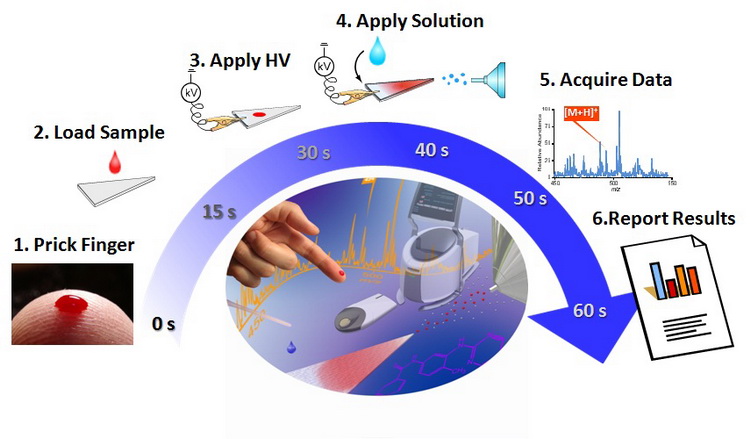
 A method is developed for the direct quantitative analysis of therapeutic drugs from dried blood spot samples by mass spectrometry. The method, paper spray mass spectrometry, generates gas phase ions directly from the blood card paper used to store dried blood samples without the need for complex sample preparation and separation; the entire time for preparation and analysis of blood samples is around 30 s. Limits of detection were investigated for a chemically diverse set of some 15 therapeutic drugs; hydrophobic and weakly basic drugs, such as sunitinib, citalopram, and verapamil, were found to be routinely detectable at approximately 1 ng/mL. Samples were prepared by addition of the drug to whole blood. Drug concentrations were measured quantitatively over several orders of magnitude, with accuracies within 10% of the expected value and relative standard deviation (RSD) of around 10% by prespotting an internal standard solution onto the paper prior to application of the blood sample. We have demonstrated that paper spray mass spectrometry can be used to quantitatively measure drug concentrations over the entire therapeutic range for a wide variety of drugs. The high quality analytical data obtained indicate that the technique may be a viable option for therapeutic drug monitoring. A method is developed for the direct quantitative analysis of therapeutic drugs from dried blood spot samples by mass spectrometry. The method, paper spray mass spectrometry, generates gas phase ions directly from the blood card paper used to store dried blood samples without the need for complex sample preparation and separation; the entire time for preparation and analysis of blood samples is around 30 s. Limits of detection were investigated for a chemically diverse set of some 15 therapeutic drugs; hydrophobic and weakly basic drugs, such as sunitinib, citalopram, and verapamil, were found to be routinely detectable at approximately 1 ng/mL. Samples were prepared by addition of the drug to whole blood. Drug concentrations were measured quantitatively over several orders of magnitude, with accuracies within 10% of the expected value and relative standard deviation (RSD) of around 10% by prespotting an internal standard solution onto the paper prior to application of the blood sample. We have demonstrated that paper spray mass spectrometry can be used to quantitatively measure drug concentrations over the entire therapeutic range for a wide variety of drugs. The high quality analytical data obtained indicate that the technique may be a viable option for therapeutic drug monitoring.
- N. E. Manicke, Q. A. Yang, H. Wang, S. Oradu, Z. Ouyang and R. G. Cooks, "Assessment of paper spray ionization for quantitation of pharmaceuticals in blood spots", International Journal of Mass Spectrometry, 2011, 300, 123-129, DOI: 10.1016/j.ijms.2010.06.037
- Nicholas E. Manicke, Paul Abu-Rabie, Neil Spooner, Zheng Ouyang and R. Graham Cooks, "Quantitative Analysis of Therapeutic Drugs in Dried Blood Spot Samples by Paper Spray Mass Spectrometry: An Avenue to Therapeutic Drug Monitoring" , Journal of the American Society of Mass Spectrometry , 2011 , in press, DOI: 10.1007/s13361-011-0177-x
- Yang, Q.; Wang, H.; Maas, J. D.; Chappell, W. J.; Manicke, N. E.; Cooks, R. G.; Ouyang, Z. International Journal of Mass Spectrometry, In Press, doi: 10.1016/j.ijms.2011.05.013
|
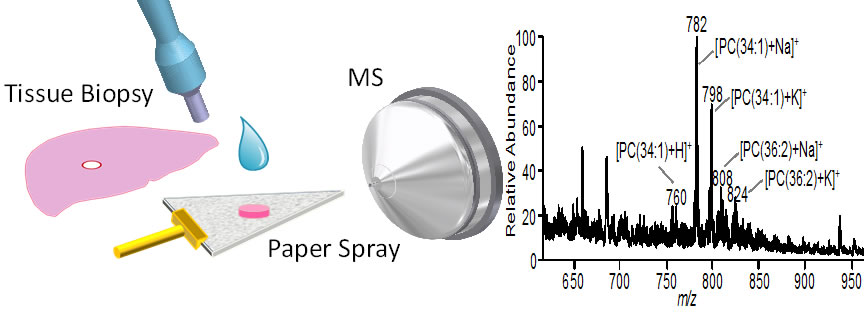 Paper spray mass spectrometry (PS-MS) is explored as a fast and convenient way for direct analysis of molecules in tissues with minimum sample pretreatment. This technique allows direct detection of different types of molecules such as hormones, lipids and therapeutic drugs in short total analysis times (less than one minute) using a small volume of tissue sample (typically 1 mm3 or less). The tissue sample could be obtained by needle aspiration biopsy, by punch biopsy, or by rubbing a thin tissue section across the paper. There exists potential for the application of paper spray mass spectrometry together with for clinical diagnostics. Paper spray mass spectrometry (PS-MS) is explored as a fast and convenient way for direct analysis of molecules in tissues with minimum sample pretreatment. This technique allows direct detection of different types of molecules such as hormones, lipids and therapeutic drugs in short total analysis times (less than one minute) using a small volume of tissue sample (typically 1 mm3 or less). The tissue sample could be obtained by needle aspiration biopsy, by punch biopsy, or by rubbing a thin tissue section across the paper. There exists potential for the application of paper spray mass spectrometry together with for clinical diagnostics.
- H. Wang, N. E. Manicke, Q. A. Yang, L. X. Zheng, R. Y. Shi, R. G. Cooks and Z. Ouyang, "Direct Analysis of Biological Tissue by Paper Spray Mass Spectrometry", Analytical Chemistry, 2011, 83, 1197-1201, DOI: 10.1021/ac103150a
|
|
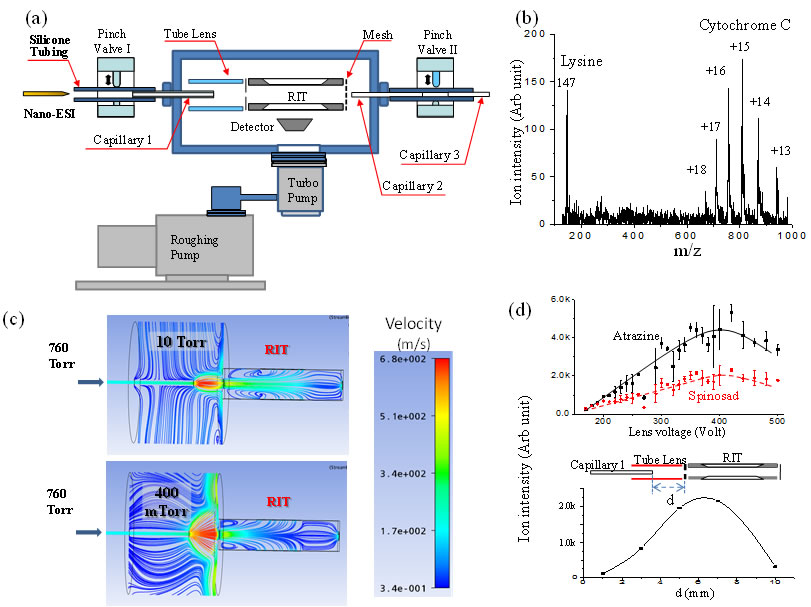 Discontinuous atmospheric pressure interface (DAPI) has allowed the transfer of ions from atmospheric pressure ionization sources to ion trap mass analyzer in handheld mass spectrometers with miniature pumping systems, at transfer efficiencies high enough for proper chemical analysis. The DAPI potentially would allow a significant enhancement to the mass analysis efficiency of lab-scale mass spectrometers, which have pumping systems of much larger capacities. A lab-scale mass spectrometer with a DAPI-RIT (rectilinear ion trap)-DAPI configuration has been developed to explore this possibility. The gas dynamic effects on ion trapping and mass analysis have been studied at various conditions. A pulsed nanoelectrospray ionization (nanoESI) source synchronized with the DAPI has been implemented to improve the sample usage efficiency as well as to adjust the number of ions to be trapped for MS analysis, so that space charge effects can be avoided. Single-scan spectra of peptides were recorded with ionization time as short as 1 µs, corresponding to an analyte consumption of several attomoles. The simplicity of application of the DAPI for performing ion-molecule and ion-ion reactions have also been demonstrated with proton transfer and electron transfer dissociation (ETD) reactions with peptides. Discontinuous atmospheric pressure interface (DAPI) has allowed the transfer of ions from atmospheric pressure ionization sources to ion trap mass analyzer in handheld mass spectrometers with miniature pumping systems, at transfer efficiencies high enough for proper chemical analysis. The DAPI potentially would allow a significant enhancement to the mass analysis efficiency of lab-scale mass spectrometers, which have pumping systems of much larger capacities. A lab-scale mass spectrometer with a DAPI-RIT (rectilinear ion trap)-DAPI configuration has been developed to explore this possibility. The gas dynamic effects on ion trapping and mass analysis have been studied at various conditions. A pulsed nanoelectrospray ionization (nanoESI) source synchronized with the DAPI has been implemented to improve the sample usage efficiency as well as to adjust the number of ions to be trapped for MS analysis, so that space charge effects can be avoided. Single-scan spectra of peptides were recorded with ionization time as short as 1 µs, corresponding to an analyte consumption of several attomoles. The simplicity of application of the DAPI for performing ion-molecule and ion-ion reactions have also been demonstrated with proton transfer and electron transfer dissociation (ETD) reactions with peptides.
Figure: Schematics of vacuum systems with (a) a continuous and (b) a discontinuous API. (c) Pressure variation inside the vacuum manifold during the operation of a DAPI. (d) Pressure variation for a DAPI-MS using ion trap as the mass analyzer.
- Wei Xu, Nicholas Charipar, Matthew A. Kirleis, Yu Xia, Zheng Ouyang, " Study of Discontinuous Atmospheric Pressure Interfaces for Mass Spectrometry Instrumentation Development", Analytical Chemistry, 2010, 82 (15), pp 6584–6592, doi:10.1021/ac101002t
|
|